Liquidation

Liquidation occurs when a trader’s collateral is no longer sufficient to cover their leveraged position’s losses, triggering an automated forced closure by the exchange's liquidation engine. It is a critical risk-management mechanism that ensures the solvency of lending protocols and derivative platforms. In 2026, the focus has moved toward MEV-resistant liquidation models that protect users from predatory "cascades." This tag provides essential information on maintenance margins, health factors, and how to avoid liquidation in high-volatility environments.

14404 Articles
Created: 2026/02/02 18:52
Updated: 2026/02/02 18:52

Bitcoin Sees Labor Day Lull, but Institutional Bulls Remain Unfazed

Bitcoin Sees Labor Day Lull, but Institutional Bulls Remain Unfazed

The digital asset’s price didn’t move much on Monday after shedding more than 3% over the past seven days, but the subdued price action hasn’t dampened institutional enthusiasm. BTC Treads Water on Labor Day Weekend and Metaplanet Buys the Dip “I’ve always said that I really believe in the next several years, bitcoin hits a […]

Author: Bitcoin.com News
from 24 to 50 billion in 12 months. Regulations and institutions ignite the market

from 24 to 50 billion in 12 months. Regulations and institutions ignite the market

The post from 24 to 50 billion in 12 months. Regulations and institutions ignite the market appeared on BitcoinEthereumNews.com. The market for tokenized real assets has entered a phase of institutional scale: over twelve months, it would have risen from about $24 billion to over $50 billion – as shown by data from 21.co and confirmed by analyses from RWA.xyz – and are consistent with international reports on the subject. Among these, the BIS report published on October 17, 2024, and the IMF note on January 29, 2025, Bank for International Settlements (BIS)International Monetary Fund (IMF) – due to the arrival of large managers and greater regulatory clarity between the USA and Europe. From regulated stablecoins to on-chain government bond funds, tokenization is gradually but consistently becoming an increasingly significant liquidity infrastructure for finance. In this context, the convergence between technology and regulations generates more robust trust mechanisms and more predictable operational processes. According to the data collected by our research team on on‑chain transactions (dataset updated to July 2025), the market‑making component on tokenized assets has shown an increase in average order sizes of ~35% YoY in professional markets. Industry analysts also observe a growth in integrations between institutional custody and smart contracts on authorized platforms, with effective settlement times reduced in many cases to under 24 hours for on‑chain monetary products (learn more on Cryptonomist). What is the tokenization of real assets Tokenization converts rights to physical or financial assets into tokens on blockchain. The result is a digital unit that represents shares of real estate, bonds, credits, or money market funds, with technical properties that facilitate circulation and control. It should be noted that representation on distributed ledgers also allows for lifecycle automations (coupons, maturities) that are difficult to achieve in legacy systems. Fractionalization: access to minimum amounts and greater inclusion. Transferability: near-instant settlement, 24/7. Traceability: on-chain auditability and automated reporting. Composability: use of tokens as…

Author: BitcoinEthereumNews
Solv and Chainlink integrate Proof of Reserve into SolvBTC

Solv and Chainlink integrate Proof of Reserve into SolvBTC

The post Solv and Chainlink integrate Proof of Reserve into SolvBTC appeared on BitcoinEthereumNews.com. Solv Protocol and Chainlink have launched a new feed that combines the market price with the on-chain verification of BTC reserves for SolvBTC, with a redemption rate anchored to the collateral and price limits designed to reduce manipulations. According to data collected by Chainlink Data, the SolvBTC feeds show public timestamps and updates accessible from the mainnet since the announcement. Industry analysts note that the PoR+price model can directly impact over 2 billion dollars in tokenized BTC, reducing the likelihood of depeg during market stress. By monitoring the official pages (Solv and Chainlink Data), it is possible to verify the operational status of the feeds on Ethereum and BOB in real-time. Solv Protocol shows data on its Bitcoin reserves collateralizing SolvBTC. Source: Solv Transparency SolvBTC: what has been launched and where it is active The new SolvBTC‑BTC feed combines the traditional exchange rate with the verification of reserves Bitcoin recorded on-chain. Unlike common price oracles, the value is anchored to the underlying collateral, enhancing transparency and consistency at the time of redemption. An interesting aspect is the immediate availability of data for public consultation. Ethereum mainnet: the Proof of Reserve (PoR) feed of SolvBTC is accessible with verifiable data and time-stamps. BOB network: the SolvBTC/BTC feed is operational for on‑chain pricing. Cross‑chain expansion: further integrations are in preparation, aiming to standardize the PoR + price model across multiple networks. Why it impacts the price of SolvBTC The feed directly integrates reserve coverage into the price calculation. This way, the redemption rate reflects not only the market spot price but also the actual availability of the BTC held, reducing possible misalignments between theoretical value and the value actually redeemable. It should be noted that the effect is particularly significant during times of volatility. How the Protection Mechanism Works The logic of…

Author: BitcoinEthereumNews
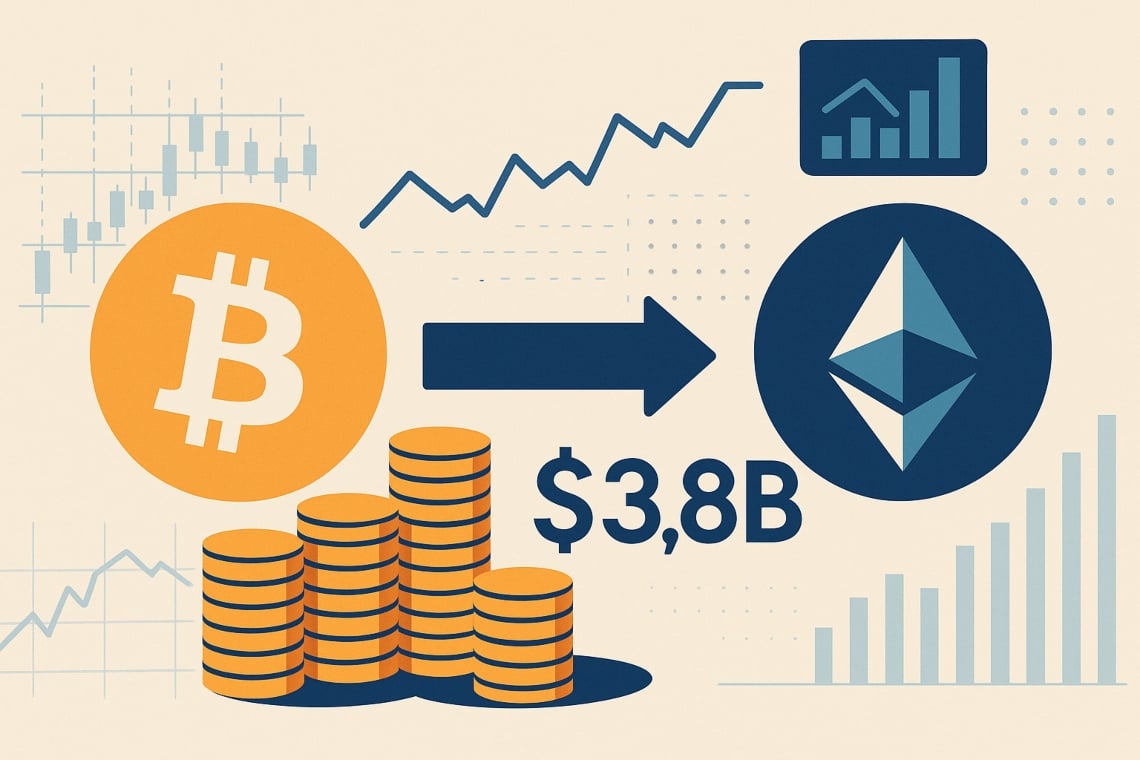
Whale shifts from Bitcoin to Ethereum: 4,000 BTC for 96,859 ETH, position at approximately $3.8 billion and spotlight on futures

Whale shifts from Bitcoin to Ethereum: 4,000 BTC for 96,859 ETH, position at approximately $3.8 billion and spotlight on futures

A large on-chain entity has converted a significant portion of BTC into ETH, bringing the exposure in Ether to approximately $3.8 billion.

Author: The Cryptonomist
$1M BTC Short With 20x Leverage Turns Sour

$1M BTC Short With 20x Leverage Turns Sour

The post $1M BTC Short With 20x Leverage Turns Sour appeared on BitcoinEthereumNews.com. A big-bet Bitcoin investor has attracted attention after putting down $1 million in USDC in the decentralized exchange HyperLiquid and acquiring a huge short position in Bitcoin. The trader had 20x leverage as he opened the short time with the view that Bitcoin price would go down. But the gamble has gone astray so far, and the position is in the red. The Bitcoin Position Breakdown This trader carried out a short of 111.75 BTC-USD contracts amounting to more than 12 million, according to blockchain-collected data by Hypurrscan. The opening price was fixed at 107 363.5, however, the market price of Bitcoin has since surged to approximately 108 976, drifting the position into a serious loss range. The loss as shown in the short has increased by a floating loss of 180,178.76, decreasing the balance of the account to approximately 814,874 instead of 1 million. The position is subject to loss though much of the loss is unrealised and it is scheduled to be liquidated at a price of 114,830. High Leverage, High Stakes The 20x leverage draw attention to the fact that such betting is very risky. Leverage is good as it allows traders to increase exposure on a reduced starting level, but increased losses are amplified as well. The trader is betting against the strength of the Bitcoin in the short term since the liquidation threshold is not too far from the current levels. There is also an added cost in the form of funding fees. Up to this moment, the account records the credit of a sum of 451.64 in funding, but this is nothing in view of the six figure paper loss. Onchain Lens a blockchain analytics platform flagged the trade as a “gambler” by trading an overly speculative position. According to crypto observers, such sizable,…

Author: BitcoinEthereumNews
Altcoins Set to Rip After Panic Selling, Analyst Claims

Altcoins Set to Rip After Panic Selling, Analyst Claims

Krüger argued that the level of fear now priced into crypto charts is setting the stage for a rebound. Capitulation […] The post Altcoins Set to Rip After Panic Selling, Analyst Claims appeared first on Coindoo.

Author: Coindoo
In the past 24 hours, the total network contract liquidation was US$302 million, mainly due to the short position

In the past 24 hours, the total network contract liquidation was US$302 million, mainly due to the short position

PANews reported on September 1st that Coinglass data showed that over the past 24 hours, the cryptocurrency market saw $302 million in liquidated contracts across the network, including $80.5396 million in long positions and $222 million in short positions. The total liquidation amount for BTC was $56.007 million, and the total liquidation amount for ETH was $78.1678 million.

Author: PANews
Crypto Markets at Crossroads as Traders Eye Fed Moves

Crypto Markets at Crossroads as Traders Eye Fed Moves

The post Crypto Markets at Crossroads as Traders Eye Fed Moves appeared on BitcoinEthereumNews.com. Bitcoin is up slightly to trade above $109,000, while altcoins are mostly in the red. Crypto markets started the month mostly flat, with total market capitalization holding steady over the past 24 hours, just below $3.9 trillion. Bitcoin (BTC) is up slightly today, Sept. 1, reaching back over $109,000, while Ethereum (ETH) declined by 1.5% to about $4,400 — losing 5% over the past week. On the monthly timeframe, BTC is down 4%, after hitting a new all-time high above $124,000 in mid-August. BTC 24-hour price chart. Source: CoinGecko ETH had a much stronger past 30 days, breaking over its former 2021 all-time high to reach above $4,900. The largest altcoin is up more than 25% over the past month. ETH 1-month price chart. Source: CoinGecko As for other large-cap crypto assets, Solana (SOL) fell 1% to trade around $200 today, while XRP is down 1.3% at $2.77. Meanwhile, BNB also lost around 1% over the past 24 hours and is trading at $853. At the same time, approximately $297 million in leveraged positions were liquidated over the past 24 hours, with ETH traders taking the biggest hit at $76.2 million. BTC accounted for nearly $55 million in liquidations, and other altcoins made up around $42 million, per CoinGlass. ETF Flows and Macro Update Spot Ethereum ETFs are still stealing the spotlight. In August, they pulled in $3.87 billion, pushing total inflows to $13.5 billion and total assets to $28.6 billion. August marks the second-largest monthly inflow ever for ETH ETFs, following July’s $5.43 billion in net inflows, according to data from SoSoValue. Meanwhile, spot Bitcoin ETFs moved in the opposite direction, seeing a total of $751 million in net outflows last month. Looking at macro economic signals, in the U.S., July’s Personal Consumption Expenditures (PCE) numbers came in at…

Author: BitcoinEthereumNews
Cardano Snubbed from U.S. Blockchain Data Program; Hoskinson Reveals Why

Cardano Snubbed from U.S. Blockchain Data Program; Hoskinson Reveals Why

The post Cardano Snubbed from U.S. Blockchain Data Program; Hoskinson Reveals Why appeared first on Coinpedia Fintech News Cardano’s absence from the U.S. government’s ambitious plan to publish official economic data on public blockchains has left many in the crypto community curious. Despite its strong market presence, Cardano was excluded. Its founder, Charles Hoskinson, recently addressed this in his latest AMA session. Why Was Cardano Left Out of the U.S. Data Project Hoskinson …

Author: CoinPedia
Tokenized real assets: from 24 to 50 billion in 12 months. Regulations and institutions ignite the market

Tokenized real assets: from 24 to 50 billion in 12 months. Regulations and institutions ignite the market

The market for tokenized real assets has entered an institutional scale phase: within twelve months it would have risen from approximately $24 billion to over $50 billion.

Author: The Cryptonomist