Liquidation

Liquidation occurs when a trader’s collateral is no longer sufficient to cover their leveraged position’s losses, triggering an automated forced closure by the exchange's liquidation engine. It is a critical risk-management mechanism that ensures the solvency of lending protocols and derivative platforms. In 2026, the focus has moved toward MEV-resistant liquidation models that protect users from predatory "cascades." This tag provides essential information on maintenance margins, health factors, and how to avoid liquidation in high-volatility environments.

15182 Articles
Created: 2026/02/02 18:52
Updated: 2026/02/02 18:52
It’s Solana’s Turn to Fill the Corporate Crypto War Chest

It’s Solana’s Turn to Fill the Corporate Crypto War Chest

The post It’s Solana’s Turn to Fill the Corporate Crypto War Chest appeared on BitcoinEthereumNews.com. Solana (SOL) treasury companies are following the trend set by Bitcoin (BTC) and Ether (ETH), whose adoption by public companies has boosted stock prices and graced media headlines. Digital asset treasuries (DATs) list on public markets, buy crypto, then work to grow tokens per share. The pitch is simple for traders who want to gain crypto exposure through a brokerage account, offering upside that can outpace spot prices. Exchange-traded funds (ETFs) also provide crypto exposure for investors nowadays, but DATs can hit the market faster. Additionally, premiums and discounts to net asset value (NAV) create embedded leverage without liquidation concerns, which allows these vehicles to trade away from the value of the tokens they hold. Solana treasuries have lower liquidity than Bitcoin and Ether. But with institutions already familiar with the name and willing to hold for longer, the bet is that Solana treasuries can dampen sell pressure, pull in more conservative capital and show that crypto’s next distribution war will be fought on public markets. Over the past 30 days, Solana treasury companies have accumulated close to 6.3 million SOL, representing more than 1.6% of the token’s circulating supply and over half of all SOL held in corporate treasuries. A growing number of public companies are adding Solana to their corporate treasuries. Source: CoinGecko Why Solana DATs look promising SOL is the world’s sixth-largest cryptocurrency by market capitalization, and its blockchain network is often seen as a challenger to Ethereum’s dominance in smart contracts and decentralized finance (DeFi), known for its high throughput and low transaction costs. But as a treasury asset, Solana’s digital asset treasuries remain less mature than those built around Bitcoin and Ether. Collectively, Solana treasury companies hold about 2.46% of SOL’s supply, worth nearly $3 billion, according to CoinGecko. Only four companies hold more than…

Author: BitcoinEthereumNews
Why the Crypto Market Is Crashing Today?

Why the Crypto Market Is Crashing Today?

The post Why the Crypto Market Is Crashing Today? appeared first on Coinpedia Fintech News The crypto market is crashing hard today, wiping out over $400 billion in value as the total market cap falls to $3.74 trillion. Bitcoin dropped to a low of $105,262 before a slight rebound, while Ethereum plunged over 16%, and many altcoins saw losses of up to 80–90% at their worst. In one of the …

Author: CoinPedia
Bitcoin Crash Sparks Largest Liquidation in Crypto History – $19B Gone and Counting

Bitcoin Crash Sparks Largest Liquidation in Crypto History – $19B Gone and Counting

More than 1.6 million traders have been wrecked daily.

Author: CryptoPotato
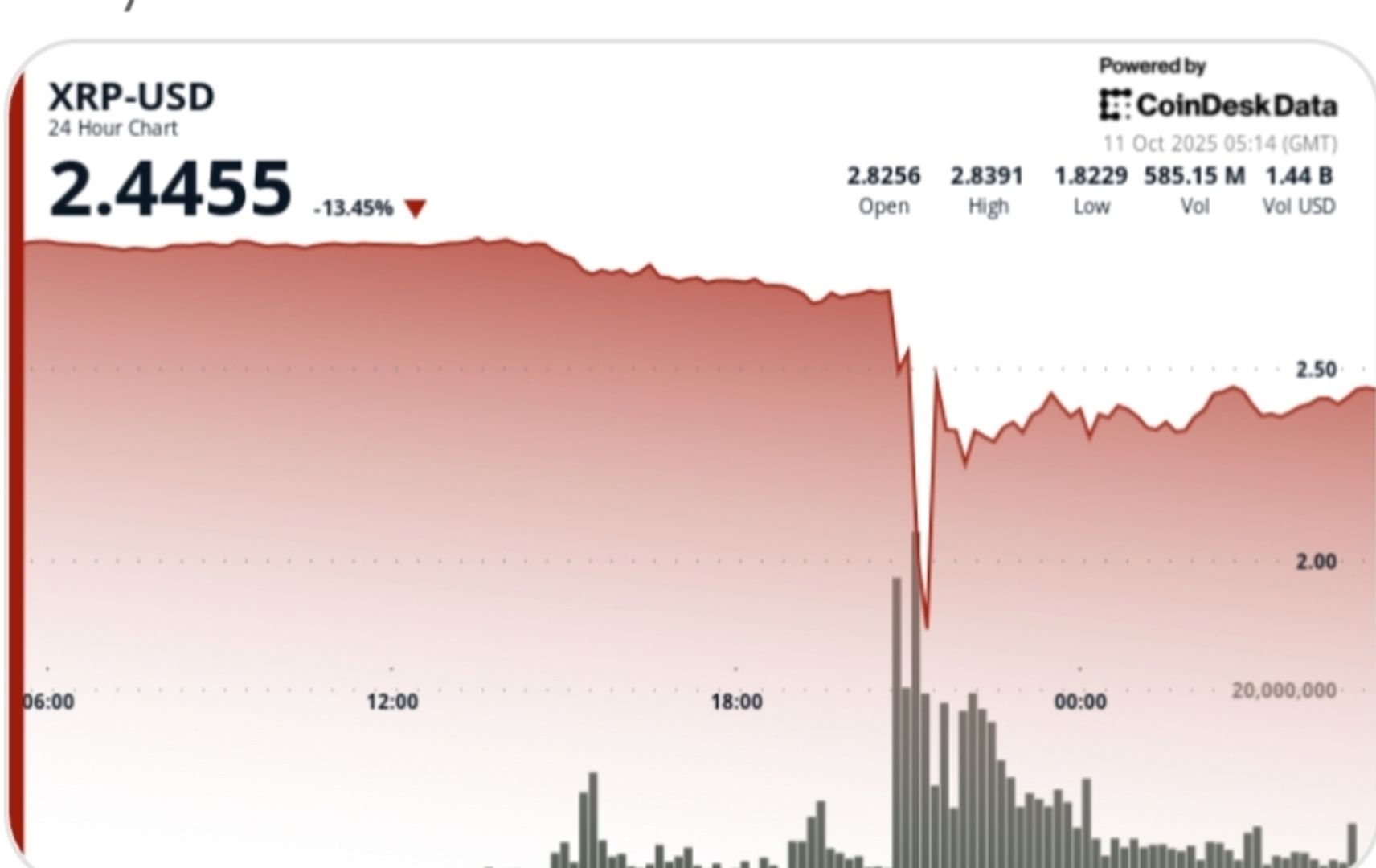
Expert Says ‘XRP Black Swan’ Made History as XRP Loses 1.27 Dollars

Expert Says ‘XRP Black Swan’ Made History as XRP Loses 1.27 Dollars

Popular XRP community figure Chad Steingraber emphasized that history has just been made, describing the latest XRP liquidation event as an XRP Black Swan. October 10 will go down as one of the most unforgettable days in crypto history — a day marked by one of the strongest liquidation waves the market has ever witnessed.Visit Website

Author: Coinstats
Crypto Market Loses $670 Billion on CEX Auto Liquidations, Altcoins Crash Intensifies

Crypto Market Loses $670 Billion on CEX Auto Liquidations, Altcoins Crash Intensifies

                         Read the full article at                             coingape.com.                         

Author: Coinstats
Bitcoin Sentiment Drops After Tariff News; Low Fear and Greed Reading Could Signal Contrarian Buying

Bitcoin Sentiment Drops After Tariff News; Low Fear and Greed Reading Could Signal Contrarian Buying

The post Bitcoin Sentiment Drops After Tariff News; Low Fear and Greed Reading Could Signal Contrarian Buying appeared on BitcoinEthereumNews.com. COINOTAG recommends • Exchange signup 💹 Trade with pro tools Fast execution, robust charts, clean risk controls. 👉 Open account → COINOTAG recommends • Exchange signup 🚀 Smooth orders, clear control Advanced order types and market depth in one view. 👉 Create account → COINOTAG recommends • Exchange signup 📈 Clarity in volatile markets Plan entries & exits, manage positions with discipline. 👉 Sign up → COINOTAG recommends • Exchange signup ⚡ Speed, depth, reliability Execute confidently when timing matters. 👉 Open account → COINOTAG recommends • Exchange signup 🧭 A focused workflow for traders Alerts, watchlists, and a repeatable process. 👉 Get started → COINOTAG recommends • Exchange signup ✅ Data‑driven decisions Focus on process—not noise. 👉 Sign up → The Crypto Fear & Greed Index fell to 27 after trade-tension headlines, signaling market “Fear” while Bitcoin briefly dipped to $102,000; institutional and retail liquidations exceeded $19 billion, creating a potential contrarian buying opportunity for long-term investors. Fear & Greed Index: 27 — market sentiment moved from Greed to Fear within 24 hours. Bitcoin briefly fell to $102,000; intraday liquidations were about $19.27 billion, per market trackers. Bitwise’s intraday Sentiment Index hit −2.8 standard deviations, a rare contrarian buying signal. Crypto Fear & Greed Index drops to 27 as Bitcoin dips to $102K; evaluate risk and consider contrarian signals — read analysis and next steps from COINOTAG. COINOTAG recommends • Exchange signup 📈 Clear interface, precise orders Sharp entries & exits with actionable alerts. 👉 Create free account → COINOTAG recommends • Exchange signup 🧠 Smarter tools. Better decisions. Depth analytics and risk features in one view. 👉 Sign up → COINOTAG recommends • Exchange signup 🎯 Take control of entries & exits Set alerts, define stops, execute consistently. 👉 Open account → COINOTAG recommends • Exchange signup 🛠️…

Author: BitcoinEthereumNews
XRP Crashes 40%, Before Recovering, in Biggest One-Day Drop

XRP Crashes 40%, Before Recovering, in Biggest One-Day Drop

XRP collapsed as much as 42% in Friday’s trade, its sharpest one-day drop in recent years, as whales liquidated across major venues and futures open interest fell $150 million. The selloff drove price as low as $1.64 before a partial recovery to $2.36, with volumes surging 164% above the 30-day average — a sign of forced deleveraging across corporate desks.What to Know• XRP fell from $2.82 to $2.36 between Oct 10, 01:00 and Oct 11, 00:00, posting a 16% daily loss.• Intraday volatility peaked at 43%, with prices briefly wicking to $1.64 during high-frequency liquidation sweeps.• Institutional futures open interest dropped from $9.0B to $8.85B as long liquidations hit $21M versus $2M shorts.• 320M XRP transferred to exchange wallets in the past week, confirming whale distribution pressure.• Late-session buying stabilized price near $2.35–$2.40, with accumulation volumes exceeding 12M in the final 15 minutes.News Background• Ripple’s ecosystem faces macro and structural stress: global trade tensions, diverging central-bank policy, and uncertainty over U.S. digital banking licenses.• Ripple’s National Trust charter deadline passed on Oct 7, heightening regulatory risk premiums around XRP-linked institutional products.• Despite the drawdown, on-chain data shows long-term holders adding below $2.40, suggesting value-based repositioning.Price Action Summary• XRP opened near $2.82 and sold off aggressively by mid-session, breaching key supports at $2.70 and $2.50.• The heaviest liquidation occurred between 15:00–21:00 UTC, when hourly volume hit 817.6M.• Low of $1.64 marked potential capitulation point; bounce to $2.36 capped at resistance around $2.84.• The final 60 minutes (23:41–00:40) saw a stabilization move from $2.31 → $2.38 (+2%), with algos breaking $2.35 on sustained bids.Technical Analysis• Support: Established around $2.30–$2.35; extended downside risk to $2.22 if volume dries up.• Resistance: Layered at $2.84–$2.90, with $3.05 as macro breakout trigger.• Volume: Up 164% vs. 30-day average — capitulation-grade turnover.• Trend: 75-day symmetrical triangle broken to downside; needs close above $2.90 to regain structure.• Momentum: RSI levels near multi-month lows; volatility bands expanding, signaling potential base formation.What Traders Are Watching• Whether $2.30 support zone attracts sustained whale accumulation.• Rebuild of open interest following $150M contraction in derivatives markets.• Regulatory clarity post-Ripple charter review, and its impact on corporate adoption.• Cross-asset spillover from BTC’s $125K rally — potential relief rotation back into XRP.• Technical confirmation above $2.90 to invalidate short-term bearish bias.

Author: Coinstats
Crypto Market Crash Today [ LIVE] Updates October 11th

Crypto Market Crash Today [ LIVE] Updates October 11th

The post Crypto Market Crash Today [ LIVE] Updates October 11th appeared on BitcoinEthereumNews.com. The post Crypto Market Crash Today [ LIVE] Updates October 11th appeared first on Coinpedia Fintech News October 11, 2025 05:24:21 UTC Ethereum Price Crash Faces More Than Bitcoin Gold advocate and Bitcoin critic Peter Schiff has sounded another alarm—this time on Ethereum’s sharp decline. While Bitcoin has dropped about 10% from its all-time high, Ether is down over 21%, now hovering near $3,900. Schiff cautioned that if ETH breaks its key support at $3,350, it could swiftly plunge toward $1,500. Known for his bearish stance on crypto, Schiff urged investors to “get out now,” predicting deeper pain if market sentiment worsens. As bad as Bitcoin looks, Ethereum looks even worse. While Bitcoin is only down about 10% from its record high priced in U.S. dollars, Ether is down 21%. It’s now trading near $3,900. If it breaks support around $3,350, a quick move down to $1,500 is a real risk. Get out now! — Peter Schiff (@PeterSchiff) October 10, 2025 October 11, 2025 05:12:37 UTC The Truth Behind the Crypto Crash Today The recent crypto crash became the perfect storm for the biggest liquidation event in history, wiping out over $19 billion as hidden leverage across the market unraveled. Traders and funds had shifted from spot to leveraged positions chasing perp DEX airdrops, masking true market risk. When Trump’s 100% tariff announcement hit an already overbought equities market, it triggered a chain reaction. Fragile altcoin liquidity, overexposed leverage, and mismatched valuations caused a violent unwinding, forcing funds to liquidate. A brutal reset yet a setup for the next cycle. October 11, 2025 05:12:37 UTC Crypto Liquidation Today Hit $19.16 billion The crypto market just witnessed its largest liquidation event in history, with over $19.16 billion wiped out in hours nearly 20x bigger than the March 2020 Covid crash and…

Author: BitcoinEthereumNews
an Crypto Market Survive the New Trade War?

an Crypto Market Survive the New Trade War?

The post an Crypto Market Survive the New Trade War? appeared on BitcoinEthereumNews.com. Unlike traditional equities, cryptocurrencies are not tied to a single economy, but they react sharply to macroeconomic shocks. Tariffs between the US and China hit two pressure points: inflation and liquidity. Higher import costs push inflation up, and central banks may respond with tighter monetary policy, reducing liquidity. For risk assets like Bitcoin and altcoins, reduced liquidity often translates into selling pressure. At the same time, crypto is increasingly viewed as a hedge against geopolitical risk. If trade tensions escalate into broader financial instability, investors may turn to Bitcoin as a digital safe haven, mirroring how gold reacts to crises. This dual role creates volatility: panic selling first, then speculative inflows if confidence in fiat weakens. Chart Analysis: Where Is the Crypto Market Headed? Total Market Cap: TradingView Looking at the Total Crypto Market Cap chart, the recent candles tell a story of sharp reversal. After testing the upper Bollinger Band near $4.2 trillion, the market plunged below $3.7 trillion, with a massive wick extending towards $3.2 trillion. That wick signals extreme panic liquidation, followed by partial recovery. The Bollinger Bands are widening, which usually signals higher volatility ahead. The mid-band around $3.93 trillion is acting as resistance, while immediate support sits near $3.59 trillion. If this level breaks decisively, the next stop could be $3.2 trillion. On the upside, reclaiming $3.9–4 trillion could set the stage for a rebound rally. Could Rare Earth Politics Spill Into Crypto Market? Image Source: Truthsocial China’s restrictions on rare earth exports aren’t just about minerals; they’re a geopolitical weapon. Rare earths are essential for high-tech industries, including chips, batteries, and EVs. Any disruption in this supply chain threatens US tech stocks, which are already reeling. When equities are unstable, crypto often becomes collateral damage as institutions de-risk across all volatile asset classes. But…

Author: BitcoinEthereumNews
US–China Tariff War: Can Crypto Market Survive the New Trade War?

US–China Tariff War: Can Crypto Market Survive the New Trade War?

The global markets were shaken after President Donald Trump announced a 100% tariff on Chinese goods starting November 1, reigniting a full-scale trade war between the two largest economies. With $1.6 trillion already wiped from the US stock market in a single day, the question on every investor’s mind is simple: what happens next for crypto?Why  US–China Tariff Matter for Crypto Market?Unlike traditional equities, cryptocurrencies are not tied to a single economy, but they react sharply to macroeconomic shocks. Tariffs between the US and China hit two pressure points: inflation and liquidity. Higher import costs push inflation up, and central banks may respond with tighter monetary policy, reducing liquidity. For risk assets like Bitcoin and altcoins, reduced liquidity often translates into selling pressure.At the same time, crypto is increasingly viewed as a hedge against geopolitical risk. If trade tensions escalate into broader financial instability, investors may turn to Bitcoin as a digital safe haven, mirroring how gold reacts to crises. This dual role creates volatility: panic selling first, then speculative inflows if confidence in fiat weakens.Chart Analysis: Where Is the Crypto Market Headed?Total Market Cap: TradingViewLooking at the Total Crypto Market Cap chart, the recent candles tell a story of sharp reversal. After testing the upper Bollinger Band near $4.2 trillion, the market plunged below $3.7 trillion, with a massive wick extending towards $3.2 trillion. That wick signals extreme panic liquidation, followed by partial recovery.The Bollinger Bands are widening, which usually signals higher volatility ahead. The mid-band around $3.93 trillion is acting as resistance, while immediate support sits near $3.59 trillion. If this level breaks decisively, the next stop could be $3.2 trillion. On the upside, reclaiming $3.9–4 trillion could set the stage for a rebound rally.Could Rare Earth Politics Spill Into Crypto Market?Image Source: TruthsocialChina’s restrictions on rare earth exports aren’t just about minerals; they’re a geopolitical weapon. Rare earths are essential for high-tech industries, including chips, batteries, and EVs. Any disruption in this supply chain threatens US tech stocks, which are already reeling. When equities are unstable, crypto often becomes collateral damage as institutions de-risk across all volatile asset classes.But here’s the twist: if US–China relations worsen further and global trust in traditional financial systems declines, crypto could see inflows as an alternative store of value. In essence, rare earth disputes may indirectly fuel Bitcoin’s “digital gold” narrative.Short-Term Outlook: More Crypto Market Crash Before Relief?Given the November 1 deadline for tariffs by Donald Trump, markets are bracing for weeks of uncertainty. Expect sharp swings as traders position for worst-case outcomes. The chart suggests crypto market cap could retest $3.5 trillion, with a possible extension to $3.2 trillion if panic deepens.However, if inflation fears push more investors to seek decentralized assets, Bitcoin and Ethereum may lead a relief rally. Historically, crypto thrives when traditional markets lose investor trust.Long-Term View: A Turning Point for Adoption?If the trade war escalates, crypto adoption could accelerate. Both the US and China are heavily invested in blockchain technologies. For China, pushing digital yuan adoption could reduce reliance on dollar-settled trade. For the US, crypto may gain traction as retail and institutional investors seek alternatives to inflation-weakened fiat.The rare earth standoff might also highlight blockchain’s role in securing supply chains, further intertwining crypto with geopolitics.Final TakeThe US–China tariff battle has thrown crypto into a storm of uncertainty. Short-term, volatility and downside risk dominate the charts. But long-term, these geopolitical tensions may be the very fuel that strengthens crypto’s case as a hedge against inflation, trade wars, and broken global trust.The question isn’t just whether crypto will fall or rise in the next few weeks. The deeper question is whether this trade war marks the beginning of crypto’s evolution from speculative asset to essential financial refuge.

Author: Coinstats