Lending

Lending protocols form the backbone of the decentralized money market, allowing users to lend or borrow digital assets without intermediaries. Using smart contracts, platforms like Aave and Morpho automate interest rates based on supply and demand while requiring over-collateralization for security. The 2026 lending landscape features advanced permissionless vaults and institutional-grade credit lines. This tag covers the evolution of capital efficiency, liquidations, and the integration of diverse collateral types, including LSTs and tokenized RWAs.

14735 Articles
Created: 2026/02/02 18:52
Updated: 2026/02/02 18:52
Top Cryptos to Buy Now That Could Turn $500 into Generational Wealth

Top Cryptos to Buy Now That Could Turn $500 into Generational Wealth

As investors search for the best ways to squeeze out as much as possible from this bull run, Shiba Inu (SHIB) and Mutuum Finance (MUTM) are among the best options with the potential to transform small bets into generational wealth. While SHIB relies on community-sourced hype, Mutuum Finance is distinguished by actual DeFi utility, featuring […]

Author: Cryptopolitan
PBOC sets USD/CNY reference rate at 7.1089 vs. 7.1152 previous

PBOC sets USD/CNY reference rate at 7.1089 vs. 7.1152 previous

The post PBOC sets USD/CNY reference rate at 7.1089 vs. 7.1152 previous appeared on BitcoinEthereumNews.com. The People’s Bank of China (PBOC) set the USD/CNY central rate for the trading session ahead on Monday at 7.1089 compared to the previous day’s fix of 7.1152. PBOC FAQs The primary monetary policy objectives of the People’s Bank of China (PBoC) are to safeguard price stability, including exchange rate stability, and promote economic growth. China’s central bank also aims to implement financial reforms, such as opening and developing the financial market. The PBoC is owned by the state of the People’s Republic of China (PRC), so it is not considered an autonomous institution. The Chinese Communist Party (CCP) Committee Secretary, nominated by the Chairman of the State Council, has a key influence on the PBoC’s management and direction, not the governor. However, Mr. Pan Gongsheng currently holds both of these posts. Unlike the Western economies, the PBoC uses a broader set of monetary policy instruments to achieve its objectives. The primary tools include a seven-day Reverse Repo Rate (RRR), Medium-term Lending Facility (MLF), foreign exchange interventions and Reserve Requirement Ratio (RRR). However, The Loan Prime Rate (LPR) is China’s benchmark interest rate. Changes to the LPR directly influence the rates that need to be paid in the market for loans and mortgages and the interest paid on savings. By changing the LPR, China’s central bank can also influence the exchange rates of the Chinese Renminbi. Yes, China has 19 private banks – a small fraction of the financial system. The largest private banks are digital lenders WeBank and MYbank, which are backed by tech giants Tencent and Ant Group, per The Straits Times. In 2014, China allowed domestic lenders fully capitalized by private funds to operate in the state-dominated financial sector. Source: https://www.fxstreet.com/news/pboc-sets-usd-cny-reference-rate-at-71089-vs-71152-previous-202509290119

Author: BitcoinEthereumNews
Pundit Claims That Ripple Is Building The Banking System Right On The Blockchain Using XRP

Pundit Claims That Ripple Is Building The Banking System Right On The Blockchain Using XRP

Both Ripple and XRP have been a topic of debate in the crypto community for years. However, recent discussions have reignited interest in its current and future role within the global finance sector. Market experts are now asking whether XRP is genuinely reforming the financial system or simply recreating existing banking structures on the blockchain. […]

Author: Bitcoinist
Dogecoin Price Prediction: DOGE Whales Looking for the Next 100x Crypto Seen Buying New Crypto at $0.035

Dogecoin Price Prediction: DOGE Whales Looking for the Next 100x Crypto Seen Buying New Crypto at $0.035

As Dogecoin (DOGE) keeps pace in the market, whale investors are seeking new investments that have greater potential for expansion. Among the areas they are looking is at the Mutuum Finance (MUTM) presale, a recently introduced decentralized finance (DeFi) project. The presale has seen the project take in more than $16.52 million with more than […]

Author: Cryptopolitan
Big Banks Push to Dismantle GENIUS Act as Crypto Group Fights Back

Big Banks Push to Dismantle GENIUS Act as Crypto Group Fights Back

TLDR: Blockchain Association warned banks want to roll back GENIUS Act protections, risking consumer access to stablecoin innovation. Letter to Congress stresses GENIUS guarantees one-to-one reserves, oversight, and clarity for U.S. crypto companies. Banking lobby argues stablecoins threaten deposits, though deposits total $18T versus $277B in stablecoins worldwide. Campaign launched to raise awareness and push [...] The post Big Banks Push to Dismantle GENIUS Act as Crypto Group Fights Back appeared first on Blockonomi.

Author: Blockonomi
What Is Bitcoin Hyper? Bitcoin’s Fastest Layer-2 Nears $19M in Viral Presale

What Is Bitcoin Hyper? Bitcoin’s Fastest Layer-2 Nears $19M in Viral Presale

The post What Is Bitcoin Hyper? Bitcoin’s Fastest Layer-2 Nears $19M in Viral Presale appeared on BitcoinEthereumNews.com. Yet for all its dominance, the network still struggles with a basic problem: speed. Bitcoin processes around seven transactions per second (TPS), making it slow, expensive, and unsuitable for today’s demands like dApps, DeFi, or even meme coins. During peak periods, fees can spike above $100, pricing out everyday users who simply want to move their $BTC. The concept has clearly struck a nerve. Its presale has already pulled in close to $19M. If you want to understand why investors are piling in, now’s the time to pay attention. The Problem Bitcoin Still Hasn’t Solved Bitcoin ($BTC) remains surprisingly clunky in 2025. The network averages around nine TPS in real-time, while Solana ($SOL) clears more than 770 TPS – around 85x faster. At peak, Bitcoin might touch 13 TPS, but Solana’s max throughput has hit 4.7K TPS in recent blocks, with a theoretical ceiling above 65K TPS. That gap shows just how far behind Bitcoin lags in terms of raw scalability. Source: Chainspect And block times don’t help. With 10 minutes between confirmations, using Bitcoin for everyday payments feels outdated in a world where people expect instant settlement. Fees are another sticking point. In April 2024, during the launch of the Runes protocol, average Bitcoin fees spiked above $120 as a result of high congestion, making small payments not only impractical but downright absurd. Imagine trying to buy a $4 coffee and having to pay $120 just to settle it. The surge in ordinals and BRC-20 meme coin activity in 2023–2024 filled blockspace, driving fees higher and leaving regular $BTC transactions stuck in the queue. At the same time, ETFs have made Bitcoin easier to hold, but not easier to use. Bitcoin remains unmatched as a store of value. But as an execution layer, it’s still missing critical components. And…

Author: BitcoinEthereumNews
Intro to DAOs: Deep dive into decentralized organizations

Intro to DAOs: Deep dive into decentralized organizations

Decentralized Autonomous Organizations (DAOs) represent one of blockchain technology’s most revolutionary applications, fundamentally reshaping how communities organize, govern, and collaborate in the digital age. Over the years, DAOs have evolved from experimental concepts to billion-dollar ecosystems managing everything from DeFi protocols to public goods funding, demonstrating their potential to redefine organizational structures across industries. What […]

Author: Cryptopolitan
Maple Finance and Elwood Technologies Create New Pathway for Institutional Crypto Credit

Maple Finance and Elwood Technologies Create New Pathway for Institutional Crypto Credit

TLDR Maple & Elwood unite to bridge DeFi credit with institutional-grade systems. Partnership powers secure, scalable access to institutional crypto credit. Maple taps Elwood’s risk tools to expand institutional DeFi credit markets. Elwood & Maple build seamless gateway to tokenized institutional credit. Institutional crypto credit gains robust rails with Maple–Elwood alliance. Maple Finance and Elwood [...] The post Maple Finance and Elwood Technologies Create New Pathway for Institutional Crypto Credit appeared first on CoinCentral.

Author: Coincentral
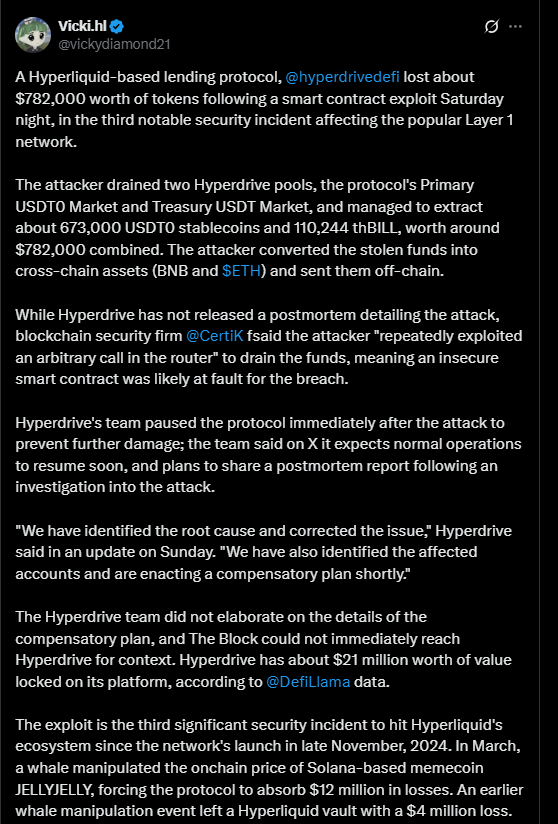
Hyperdrive Hack Drains $782K via Smart Contract Exploit

Hyperdrive Hack Drains $782K via Smart Contract Exploit

On Sept 27, Hyperdrive, a Hyperliquid protocol, lost 782K in tokens after a smart contract bug enabled a hacker to empty key pools. Hyperdrive, a lending protocol that is on top of the Hyperliquid network, lost $782,000 to a smart contract exploit on Saturday night. Two large liquidity pools were emptied: the Primary USDT0 Market […] The post Hyperdrive Hack Drains $782K via Smart Contract Exploit appeared first on Live Bitcoin News.

Author: LiveBitcoinNews
Quatrefoil Data Debuts to Build Benchmarks for Institutional Crypto Products

Quatrefoil Data Debuts to Build Benchmarks for Institutional Crypto Products

The post Quatrefoil Data Debuts to Build Benchmarks for Institutional Crypto Products appeared on BitcoinEthereumNews.com. Quatrefoil Data Services, a firm on a mission to provide institutional-grade benchmarks for digital assets, starting with a reference rate for Ethereum staking, has rolled out operations, the firm said on Monday Its flagship product, the Composite Ether Staking Rate (CESR), measures yields from Ethereum validators and is designed to function as crypto’s equivalent of a “risk-free rate.” CESR was created by investment firm CoinFund and is already distributed by CoinDesk Indices. Asset managers and protocols including Coinbase and FalconX rely on it to design products and manage risk. Benchmarks are a core feature of traditional markets, underpinning everything from futures to insurance. Without reliable standards, the crypto industry has struggled to create regulated financial products. Quatrefoil aims to fill that gap. The company has also secured a U.S. patent for its benchmark methodology and is developing new indices for Solana, Avalanche, liquid staking tokens, and stablecoin lending. To strengthen its policy expertise, Quatrefoil has brought on former CFTC Chair J. Christopher Giancarlo as an advisor. Giancarlo, known for his push to modernize U.S. derivatives regulation, said the firm is well-positioned to deliver “high impact” benchmarks to power the next generation of crypto-linked financial products. CEO Finbarr Hutcheson, a former Goldman Sachs executive and ex-CEO of ICE Clear Europe, said the benchmarks will help bring transparency and scalability to digital assets. CoinFund’s Christopher Perkins, who helped design CESR, added that such standards could eventually support trillions of dollars in products as institutional adoption deepens. Source: https://www.coindesk.com/business/2025/09/29/quatrefoil-data-launches-to-build-benchmarks-for-institutional-crypto-products

Author: BitcoinEthereumNews