Index

A crypto Index provides a way for investors to gain diversified exposure to a specific basket of digital assets through a single tokenized product. These indices often track specific sectors, such as DeFi, DePIN, or RWA, and are automatically rebalanced via smart contracts. In 2026, AI-managed thematic indices have become the gold standard for passive investing, allowing users to track the "blue chips" of the Web3 economy without manual portfolio management. This tag covers index methodology, rebalancing frequency, and the benefits of diversified crypto baskets.

25595 Articles
Created: 2026/02/02 18:52
Updated: 2026/02/02 18:52

Gavin Newsom trolls Trump with memecoin parody

Gavin Newsom trolls Trump with memecoin parody

Gavin Newsom Trump

Author: Crypto.news
Good News Regarding Bitcoin (BTC) and Altcoins from the United Arab Emirates (UAE)!

Good News Regarding Bitcoin (BTC) and Altcoins from the United Arab Emirates (UAE)!

The post Good News Regarding Bitcoin (BTC) and Altcoins from the United Arab Emirates (UAE)! appeared on BitcoinEthereumNews.com. The adoption and daily use of Bitcoin and cryptocurrencies continues to grow. At this point, the latest news came from the United Arab Emirates. RAK Properties, one of the largest publicly traded real estate companies in the United Arab Emirates (UAE), announced that it will begin accepting cryptocurrencies in international real estate transactions. Accordingly, RAK Properties announced that it will officially support crypto payments such as Bitcoin (BTC), Ethereum (ETH) and Tether (USDT). Cryptocurrencies used by customers for payments will be converted into UAE fiat currency before being deposited into RAK Properties. RAK Properties said in a statement that it plans to increase accessibility and improve transaction convenience for global investors through the introduction of cryptocurrency payments. “This move enables RAK Properties to attract a new generation of global buyers looking to invest in the rapidly growing property market. Customers can now purchase their properties using major digital assets such as USDT, BTC, ETH and more.” The UAE has recently become a major hub for the cryptocurrency industry, with clear regulatory frameworks and the absence of taxes on crypto profits fueling interest in digital assets. *This is not investment advice. Follow our Telegram and Twitter account now for exclusive news, analytics and on-chain data! Source: https://en.bitcoinsistemi.com/good-news-regarding-bitcoin-btc-and-altcoins-from-the-united-arab-emirates-uae/

Author: BitcoinEthereumNews
JPMorgan Drops a Bomb | Is Bitcoin Actually Undervalued?

JPMorgan Drops a Bomb | Is Bitcoin Actually Undervalued?

Did you ever think one of Wall Street’s biggest banks would admit Bitcoin is “too cheap”? Here’s where it gets crazy: In August 2025, JPMorgan stunned the financial world by declaring that, thanks to a massive plunge in Bitcoin’s volatility, the king of crypto is now undervalued compared to gold. What does this mean? The numbers don’t lie | let’s dive into the wildest story in finance right now. The Plot Twist: Bitcoin’s Volatility Disappears Remember the days when Bitcoin’s swings gave investors whiplash? Just six months ago, BTC volatility hovered around 60% | now it’s dropped to a record low of 30%. The chaos is cooling, and Bitcoin is suddenly only twice as volatile as gold | the smallest gap ever. So what’s changed? Corporate treasuries snatched up over 6% of all Bitcoin supply (that’s around a million coins!) More institutional investors are jumping in, often through ETFs and passive index funds. The rise of “sticky holders” means coins are locked up for the long haul, boosting stability. Reader question: Did you ever imagine Bitcoin could become the “safe play” for big investors? JPMorgan’s Jaw-Dropping Calculation: $126,000 per BTC? 🤯 Here’s the part that has crypto Twitter buzzing: JPMorgan’s analysts used gold as a benchmark, comparing Bitcoin’s risk profile to the $5 trillion gold private investment market. Their volatility-adjusted model says: Bitcoin needs to rise another 13% to match gold’s risk-adjusted value. That pegs a fair price at $126,000 per coin — which is about $16,000 more than today’s price ($111,000). Plot twist: JPMorgan isn’t claiming Bitcoin should be as valuable as all gold (including jewelry and central bank reserves). They’re strictly talking about the investment-grade gold market. Still, the implication is huge: Bitcoin may be trading at a discount right now. The Impact: Why Wall Street Is Actually Buying In Here’s where it gets even crazier. Bitcoin’s transformation has forced Wall Street to rethink everything: Institutional adoption is skyrocketing — not just in the U.S., but globally (Japan, Brazil, Bhutan, and El Salvador are stacking coins too). ETFs funneled a record-breaking $14.8 billion into Bitcoin so far this year. BlackRock’s Bitcoin fund alone controls $58 billion — making Bitcoin part of mainstream investment menus. As Bitcoin starts acting more like gold, investors and corporate treasuries see a hedge against inflation, risk, and geopolitical shocks. Is Bitcoin the digital gold everyone hyped up years ago? Reader question: Do you think Bitcoin can actually become more stable than gold in the next decade? The Speculation Game: Could Bitcoin Overtake Gold? Market commentators are running with JPMorgan’s headline. Analyst Joe Consorti says if Bitcoin ever matched gold’s entire market cap, the price would rocket to $1.17 million per coin — yes, you read that right! If both assets keep growing at current rates, “parity” could arrive in the early 2030s. But caution! Veteran traders still warn of downside risks. Peter Brandt says Bitcoin must reclaim the $117,570 level, or risk a market crash. So, while the model points “up,” the market remains a rollercoaster. Also Read This: All-Time Trending Best Cryptocurrencies for Day Trading The Backstory: How We Got Here It wasn’t long ago that JPMorgan dismissed Bitcoin as a “dangerous fad.” But with corporate treasuries locking away coins as strategic reserves and ETF inflows stabilizing prices, the asset class is evolving rapidly. The idea: less volatility means more predictable price action, attracting capital from risk-averse investors and pension funds. What Happens Next? As volatility sinks and institutional demand grows, the narrative around Bitcoin is changing. Wall Street’s endorsement isn’t just about price — it’s proof that mega-firms see Bitcoin as a serious part of future financial systems. JPMorgan’s model says Bitcoin is undervalued, but it goes deeper: a structural market shift is making Bitcoin a “must-have” for portfolios worldwide. Governments are quietly building reserves, supplies are locked away, and the asset is heading for “digital gold” status. If adoption accelerates and volatility keeps dropping, Bitcoin could cement its role as a low-risk investment… at least by Wall Street’s standards. What’s your take? Is Wall Street’s embrace of Bitcoin changing your mind about crypto investing?Subscribe for more crypto finance stories. Sources: https://coincentral.com/bitcoin-btc-price-prediction-jpmorgan-says-btc-undervalued-versus-gold-as-volatility-drops-to-record-low/ https://coinfomania.com/jpmorgan-calls-bitcoin-value-undervalued-could-hit-126000/ https://icobench.com/news/jpmorgan-eyes-126k-bitcoin-by-2025-says-price-is-too-low/ https://www.coindesk.com/markets/2025/08/28/bitcoin-undervalued-versus-gold-as-volatility-collapses-jpmorgan-says https://www.cointribune.com/en/bitcoin-too-underestimated-according-to-jpmorgan-heading-to-126000/ https://finance.yahoo.com/news/bitcoin-undervalued-compared-gold-fair-172230487.html JPMorgan Drops a Bomb | Is Bitcoin Actually Undervalued? 🚀🧐 was originally published in Coinmonks on Medium, where people are continuing the conversation by highlighting and responding to this story

Author: Medium
September Kickoff — Rate Cut or Dollar Comeback?

September Kickoff — Rate Cut or Dollar Comeback?

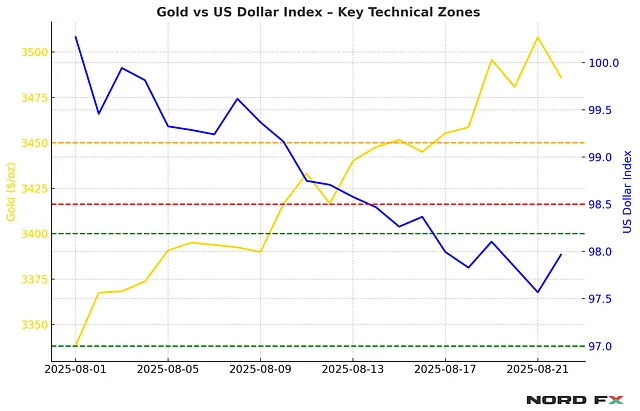
📊 September Kickoff — Rate Cut or Dollar Comeback? The first week of September sets the stage for one of the most crucial Fed decisions of the year. Markets are almost fully pricing in a 25 bps rate cut, with further easing expected in the coming months. Cooling labour data and stable inflation keep the door wide open for policy shifts. 💵 The US Dollar Index has been under pressure, hovering near recent lows as traders anticipate lower yields. Forecasts suggest more weakness could come in September, potentially driving gold and risk assets higher. ⚠️ Still, the story isn’t one-sided. Some analysts warn that if economic data surprises to the upside or inflation proves sticky, the dollar could stage a comeback. Stronger jobs reports this week and the Fed’s mid-September meeting will be decisive. 🥇 Gold has already surged to multi-month highs, with traders using it as a hedge against dollar weakness. Commodity currencies and equity markets could also benefit if the Fed confirms the start of an easing cycle. 🚀 The bottom line: September begins with a battle between dovish Fed expectations and the possibility of dollar resilience. Traders should stay alert, as volatility around jobs data and the Fed meeting could unlock new opportunities. 👉 Get ready for the moves. Open your account here: https://account.nordfx.com/account/register?id=1187185 📊 September Kickoff — Rate Cut or Dollar Comeback? was originally published in Coinmonks on Medium, where people are continuing the conversation by highlighting and responding to this story

Author: Medium
The Fiat Algorithm: How Broken Money Programs the Economy to Exploit

The Fiat Algorithm: How Broken Money Programs the Economy to Exploit

The world runs on fiat money — and it’s hardwired to sell our future at a discount TL;DR: The article uses a cash flow analysis to demonstrate how inflationary fiat money distorts economic incentives. It compares two companies: Company A, which focuses on long-term sustainable practices, and Company B, which maximises short-term profits through unsustainable methods. Using a 7% annual discount rate (reflecting money’s depreciation), the present value of Company B’s earnings is higher than Company A’s, despite both generating the same total earnings over 15 years. This shows how debasement rewards short-termism. In contrast, under a deflationary “hard money” system (where money appreciates at 5% annually), the analysis flips: Company A’s long-term earnings are valued higher, incentivising sustainability. The article shows that inflation-driven discounting punishes future-oriented investments, while deflation aligns profitability with sustainability by naturally rewarding long-term value creation. Today, we live under an inflationary economic framework. In simple terms, this means that whatever deflationary forces are created by productivity growth, they must be offset by inflationary forces (monetary expansion) to achieve net positive inflation (aka the inflation target).In an inflationary economy, natural deflation (caused by productivity growth) must be offset by an inflationary force to achieve the inflation target. This is a structural reality: if we fail to do this, the real value of debt will rise, ultimately causing the current economy to collapse under its own weight. This is because the entire system is highly leveraged — with approximately $3-4 of debt existing for every $1 of actual value globally.* To generate the required inflationary force, the type of money we use is continuously debased — diluted through the creation of more units — which results in a consistent loss of purchasing power. In practical terms, this means that every dollar today will buy you fewer goods and services next year, and even less the year after. The act of debasing money is referred to as “monetary expansion” or “monetary inflation”. This debasement can lead to price inflation (which ultimately is the goal in aggregate)— where prices rise, as measured by the Consumer Price Index — or it can simply suppress prices from falling. Advocates of this system argue that monetary expansion — frequently referred to as “stimulating the economy” — is a prerequisite for achieving any productivity growth in the first place. This gets the causal arrows exactly backwards. Productivity growth does not come from stimulating the economy with money; it comes from tinkering, trial and error, and real human ingenuity. The surplus created by innovation then gives us the optionality of what to do with it: consume it, save it, or reinvest it. To confuse money creation with productivity creation is like confusing the scoreboard with the game. You don’t win a football match by changing the numbers on the scoreboard (that’s called cheating); you win by playing the game better — which then changes the scoreboard as a consequence. The problem is that, once you accept this flawed causality, policymakers keep making sure there is always plenty of money floating around — far more claims on goods than actual goods to buy. When someone then tries to “tighten” that money supply, the economy feels pain in the short term. That pain is then used as proof that stimulating the economy is necessary — when in reality it only proves how backward everything is. In this piece, we will delve into the potential long-term benefits of an alternative system and examine how the continuous debasement of money fundamentally distorts the economy’s incentive structures, driving overconsumption, waste, and practices that not only threaten social cohesion but also the planet itself. We will explore why monetary debasement not only encourages unethical behaviors but is, in fact, indistinguishable from it. We will show how the “fiat algorithm” — the built-in rule that money must constantly lose value — programs the economy and all its participants to exploit. Fiat money — depreciating in purchasing power To illustrate, we’ll use the U.S. dollar, the world’s reserve currency, as a template for this exercise. The U.S. dollar is the most widely used currency globally and also one of the least inflationary. Like most international currencies, it is “fiat money”, meaning it is issued at the discretion of the government with nothing with no inherent constraints. Over the past 100 years, the dollar has expanded at an average annual rate of approximately 7%**, resulting in a halving of its purchasing power roughly every eight years. This rate of expansion has been deemed necessary to achieve a target of 2% net positive inflation, as visualised in the previous graph. Without these inflationary measures, the dollar’s purchasing power would have naturally appreciated over the same period. Later, we will explore what such appreciation could mean for the economy. For now, though, the analysis that follows will compare a type of money similar to the one we use today — one that is continuously devalued — and examine the incentive structures it creates. Cash Flow Analysis In finance, determining the value of a company involves estimating the present value of its future cash flows. Simply put, this means projecting the company’s future earnings and calculating what those earnings are worth today. This process relies on discounting, which adjusts future earnings to reflect their value in today’s terms. This adjustment accounts for the time value of money —the principle that a dollar today may hold a different value compared to a dollar in the future, due to factors such as monetary debasement. To make this adjustment, companies and investors use what’s known as a discount rate, which reflects the degree to which future earnings are valued today. As we will see, the higher the discount rate, the more heavily the future is discounted, meaning future cash flows are valued less in today’s terms. Conversely, a lower discount rate — or even a negative one — assigns more value to those future cash flows. While the anticipation of those future earning is an art and highly subjective — relying on assumptions about market trends, competition, and other factors — the ultimate objective remains consistent. To illustrate how the type of money we use — one that is continuously depreciating in value — strongly shapes those assessments and, consequently, the types of behaviors that are rewarded, we will compare two hypothetical companies, Company A and Company B. In this simplified example, both companies generate the same total earnings over a 15-year period, but the distribution of these earnings differ due to variations in their business practices. Let’s delve in. Company A— Maximises Long Term, Sustainable Practices This company template is designed to illustrate a business model — such as a farming enterprise — focused on long-term, sustainable growth.Linear earnings distribution, weighted to the right. Practices: Organic farming methods without synthetic chemicals. Crop rotation and natural pest control to maintain biodiversity and soil integrity. Soil enrichment through composting and conservation techniques to enhance fertility and long-term productivity. Earnings Profile: Linear earnings distribution, weighted to the right, reflecting gradual growth as sustainable investments yield increasing returns over time. Consequences: Gradual increases in yield as sustainable practices improve soil health. Long-term productivity is secured, preserving resources for future generations. Company B— Maximises Short-Term, Unsustainable Practices This company template is designed to illustrate a business model — such as an intensive farming operation — focused on short-term profit maximisation, prioritising immediate gains at the expense of long-term sustainability.Linear earnings distribution, weighted to the left. Business Model: Focuses on short-term profits through intensive and exploitative methods that deplete natural resources without regard for long-term viability. Earnings Profile: Linear earnings distribution, weighted to the left, reflecting high initial profits that steadily decline as the consequences of unsustainable practices gradually deplete the soil. Practices: Heavy reliance on pesticides and chemical fertilisers to artificially boost short-term yields. Continuous cropping with little allowance for soil recovery or replenishment. Consequences: Accelerated soil degradation and environmental damage, including significant harm to local ecosystems and loss of biodiversity. Over time, the land becomes increasingly infertile, rendering it unusable by the end of 15 years. This leads to the collapse of the business and nothing for future generations to build upon. Case Study: Cash Flow Analysis with Depreciating Money When we conduct a simple cash flow analysis on these two companies, using the previously mentioned discount rate of 7% annually — a rate that reflects the depreciation of the dollar — the results reveal the impact of a depreciating currency on their valuation:Company B’s present value of future earnings are higher than Company A’s. It’s important to note that the actual figures themselves are not what matters in this example. What matters is that both companies generate the same total earnings ($12,000) over 15 years — only distributed differently over time. Despite this identical total, the valuation method systematically favors Company B, which pursues unsustainable practices — even though it’s clear from the outset that these practices deplete the soil and undermine the long-term viability of the business. Despite achieving the same total earnings, the present value of Company A’s future earnings is only $6,155, compared to $8,417 for Company B. In other words, Company B, under the given circumstances, is likely to attract more capital than Company A. This structural bias reveals how artificial monetary expansion distorts investment incentives by heavily discounting (and effectively punishing) future earnings in favor of near-term profits. Before exploring an alternative scenario, let’s push this concept further with an even more extreme example: instead of linear earnings distribution, we’ll analyse exponential earnings distribution for both Company A and Company B.Left: Exponential earnings distribution, weighted to the right. Right: Exponential earnings distribution, weighted to the left. A simple cash flow analysis of these distribution curves yields the following results:Company B’s present value of future earnings are higher than Company A’s. In this extreme example, the bias becomes even more glaring, overwhelmingly favoring Company B. Here, Company B is ruthlessly stripping the land of every ounce of value it can extract as fast as possible, with total disregard for the long-term devastation it leaves behind. Their reckless, exploitative practices are rewarded exponentially, actively incentivising the most unsustainable and destructive behaviors imaginable. Meanwhile, a company taking the polar opposite approach — sacrificing short-term profits to prioritise long-term success through investments in research, development, or regenerative practices — is harshly penalised. Their dedication to investing in the future value is actively punished, sending a clear signal that responsible practices are economically irrational under this system. The same total earnings over the same period give Company B a present value that is nearly twice as high as Company A’s! What we can conclude is that not only are short-term profits ‘generally’ incentivised over long-term sustainable investments in an economy with a depreciating currency, but also that the more aggressive and extreme the pursuit of those short-term profits are, the greater the rewards! Now, consider how these results would look if the discount rate were even higher — as it is in most other countries around the world. The faster the currency debases, the more pronounced and magnified this effect becomes. Hard money — appreciating in purchasing power In contrast to the inflationary scenario we just explored, which reflects the economic framework we currently operate under, let us now consider an alternative economic order — one where the natural deflationary force of progress is NOT offset by artificial inflationary forces. In this alternative scenario, instead of enduring a debasement of money through an artificial inflationary force of approximately 7% annually, we imagine a hypothetical system where the purchasing power of money appreciates over time at an annual rate of 5%, driven by the naturally deflationary force of productivity growth. This appreciation means that one dollar next year would buy more goods and services than it does today — the inverse of the inflationary model. Case Study: Cash Flow Analysis with Appreciating Money Now, let’s examine how a monetary system with these deflationary properties would influence company valuations.Company A’s present value of future earnings are higher than Company B’s.Company A’s present value of future earnings are higher than Company B’s. What do you see? The incentive structures are completely reversed in this scenario. Long-term practices are not only encouraged, but the more ambitious and forward-looking the approach, the greater the compounding effect of the new discount rate. What’s even more remarkable is that this shift isn’t the result of artificially altering incentive structures through interventions. Instead, it comes from not engaging in monetary manipulation, thereby allowing the natural incentive structures of the economy to emerge. Of course, this is a simplification of the forces at play. The discount rate, for instance, is not solely constructed by the cost of capital (like the changing value of money over time); it also includes elements such as risk premiums. There is no doubt that long-term investments inherently carry more uncertainty because the further into the future we look, the harder it becomes to foresee outcomes. But it’s also true that in an economy free from excessive leverage (debt), many of the risks currently accounted for in various risk premiums would naturally diminish. For example, a less-leveraged system would be far less vulnerable to external shocks (and volatility). The origin of “growth of all cost” There are essentially two ways a company can position itself in an economy: It can be repulsive to investors — meaning it struggles to attract capital and slowly declines. It can be attractive to investors — meaning it secures funding, expands, and survives. Now, let’s take the starting point that the U.S. dollar is being debased at an annual rate of 7%. This means that any given company must grow its cash flows at a rate of at least 7% per year just to maintain its value in real terms. If a company grows at a slower rate, it is effectively shrinking in purchasing power. Over time, this leads to a slow but steady march toward bankruptcy. Why not just raise prices? At first glance, companies might attempt to offset this issue by increasing their prices by 7% each year. But in aggregate, this isn’t a sustainable solution. Why? Because prices in the economy cannot sustainably rise faster than wages, and wages cannot sustainably rise faster than actual productivity growth. But here’s the problem: Productivity growth in the economy is always lower than the rate of monetary debasement. If companies raise prices faster than wages increase, demand collapses, and they lose customers. Where does this leave us? For a company to remain competitive — that is, to avoid the slow track to bankruptcy and attract capital — it must at the very least grow at the rate of monetary debasement. Some companies can achieve this organically for a time — through innovation, market expansion, or efficiency improvements. But over the long term, no individual company — and certainly not the economy as a whole — can sustain a 7% growth rate indefinitely. Why? Because this growth rate compounds. A company growing at 7% annually must double its cash flows every 10 years just to stay even. In a single decade, the pressure to extract value and expand operations becomes exponentially harder. This relentless demand for growth forces businesses into short-term, unsustainable strategies — cost-cutting at the expense of long-term stability, financial engineering over real innovation, and resource exploitation instead of conservation. It’s not that businesses necessarily choose to operate this way. It’s that they must — because the monetary system demands it. If a company cannot grow sustainably (meaning organically) at the rate of monetary debasement, what options does it have? Go bankrupt, even if it’s otherwise a well-run business. Pursue unsustainable growth practices to keep up with the system’s demands. In a world where money constantly loses value, most businesses choose the latter. Here’s how they do it: Shrinkflation — Reducing product size while keeping the price the same, hoping consumers won’t notice. Quality degradation — Using cheaper, artificial ingredients, pesticides, or inferior materials to cut costs. Wage suppression — Keeping wages stagnant, cutting benefits, or increasing workload without compensation. Aggressive acquisitions — Larger companies buy up competitors to inflate cash flows rather than grow through real productivity. Excessive leverage — Taking on massive debt or overextending supply chains, making businesses dangerously fragile to external shocks. The race to the bottom Each of these strategies buys time but at the cost of long-term viability. There is only so much a company can shrink packaging, dilute product quality, suppress wages, or pile on debt before the cracks begin to show. And yet — this is exactly how the global economy operates today. We see ecosystems deteriorating as businesses prioritise short-term profits over sustainability. We feel the pressure of working harder for less, as wages fail to keep up with the cost of living. We experience declining product quality while corporations report record earnings. The irony is that many fail to recognise why this is happening. A system that consumes itself Monetary debasement is not just an economic issue — it’s an existential threat to all forms of capital. It programs the economy to consume and deplete: Financial capital — Purchasing power constantly goes down. Human capital — Workers squeezed to their limits, with wages lagging behind productivity. Natural capital — Resources extracted recklessly to meet short-term growth targets. Social capital — Trust and stability undermined as economic insecurity fuels division. The destruction we see around us — from environmental degradation to increasing inequality — is not an accident. It is the logical outcome of a system that forces perpetual expansion at the cost of everything else.Monetary debasement leads to the destruction of all forms of capital. The fallacy of using monetary policy to instill sustainability Faced with the very real consequences of the inflationary order — an economy that perpetually rewards short-term profits and actively depletes capital in all its forms —policymakers often make the mistake of advocating for centralised interventions that involve running a budget deficit to mitigate the harmful outputs of this system. In many cases, this takes the form of justifying money printing (further increasing the inflationary force) to fund various initiatives — such as temporary tax incentives or subsidies — to encourage companies to adopt long-term practices. This has the effect of, in a sense, ‘artificially lowering the discount rate’ by rewarding companies that engage in practices the central government deem sustainable. While such efforts may seem noble, they fail to address the systemic issues — and instead exacerbate them. Even when subsidised projects achieve success in isolation, they inadvertently redirect everyone outside the program to focus on short-term gains, intensifying the very behaviors these policies aim to correct. Instead of attempting to artificially manage sustainability through monetary manipulation, we should advocate for a neutral and incorruptible hard money system. Hard money, inherently compatible with deflation, constantly reflects economic reality, seamlessly extending the ethics of nature into our economy. It would align profitability with sustainability in ways that are currently beyond the imagination of most. Sustainability would no longer require enforcement to the same extent because the most profitable way of doing business would naturally be to pursue the most ambitious and sustainable visions. This shift would redirect the collective intelligence of 10 billion people toward the right cause: investing in tomorrow. Follow me on Twitter for more: https://x.com/PetterEnglund *https://www.iif.com/Products/Global-Debt-Monitor **https://fred.stlouisfed.org/series/M2SL The Fiat Algorithm: How Broken Money Programs the Economy to Exploit was originally published in Coinmonks on Medium, where people are continuing the conversation by highlighting and responding to this story

Author: Medium
Bitcoin at the Crossroads: Protocol Signals, Market Phases, and the Year-End Probability Map

Bitcoin at the Crossroads: Protocol Signals, Market Phases, and the Year-End Probability Map

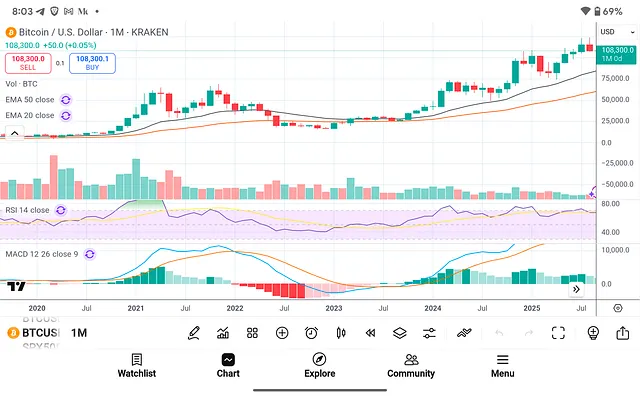
A technical dissection of volatility, on-chain profit metrics, and the shifting dynamics guiding Bitcoin’s path into 2026 Executive Summary CBBI ≈ 75 and Fear & Greed ≈ 46: conviction without mania. Price continues to adhere to the weekly 20-EMA, while the 50-EMA serves as a guardrail for the cycle. M2 is increasing, the DXY is staying below its weekly EMAs, and the on-chain indicators (MVRV Z-Score, Puell Multiple, and miner economics) are stable; the security budget is robust, and mempool pressure is orderly—conditions that have historically preceded measured-move continuation rather than blow-off risk.https://www.tradingview.com/u/Miked3482/ Market Structure —Trend Riding the 20-EMA Since the spring flag breakout, Bitcoin has steadily increased in value. Pullbacks to the 20-week EMA continue to be absorbed; the RSI remains in the 60s, and the MACD is positive but not overextended. The measured move from the previous bull flag still targets the 135–160k range, provided that weekly closes demonstrate consistent acceptance above 120–123k. The first defense is at 112–108k (20W + range retest), while the trend line in the sand is at 100–102k (50W). Macro Liquidity—M2 Uptrend Supports Risk The M2 money stock keeps rising and holds above its 20/50-week EMAs. Liquidity regimes don’t dictate daily price movements, but when base money expands and remains above trend, risk assets are bid up, and Bitcoin (BTC) tends to translate that environment into higher price levels and quicker recoveries after declines.https://www.tradingview.com/u/Miked3482/ Dollar Headwind Eases—DXY Beneath Weekly EMAs The U.S. Dollar Index remains trapped under its 20/50-week EMAs. The failed bounces of ACH in a similar posture during the periods of 2016–17 and 2020–21 accompanied the continuation of the BTC trend. A decisive DXY reclaim would dull momentum; until then, the macro breeze blows at our backs.https://www.tradingview.com/u/Miked3482/ On-Chain Valuation—Heat, Not Fever MVRV Z-Score: Mid-cycle prints—well shy of the 7–9 danger zone that preceded prior blow-offs. There is room to run before the froth. bitcoinmagazinepro.com/charts/mvrv-zscore Puell Multiple: Neutral-positive. Post-halving issuance (≈450 BTC/day) plus disciplined miner treasury behavior equals manageable sell pressure. bitcoinmagazinepro.com/charts/puell-multiple Realized Price: The orange cost-basis line keeps climbing; spot trades comfortably above it. This configuration historically marks accumulation → appreciation → acceleration transitions. charts.bitbo.io/realized-price Protocol-Level Technicals—Why This Base Is Durable Difficulty & Hash Rate: Difficulty keeps notching higher with only shallow downward adjustments; the network hash rate sits near cycle highs. That makes deep reorganizations economically absurd and forces any miner distress to appear as difficulty drops long before it threatens settlement finality. You don’t see that. Security Budget: Miner revenue (subsidy + fees) remains healthy at these price levels; fee share has normalized since post-halving spikes, but sustained base fees during UTXO churn maintain incentives. Security spend per block is orders of magnitude above the attack cost for any realistic adversary. Orphan/Stale Rates: Orphans remain low, indicating propagation efficiency and healthy relay paths across major pools. That limits non-deterministic variance in confirmation times. MakeSegWit/Taproot Utilization: Taproot spends and descriptor wallets continue to gain share; larger witness discounts and better batching makes on-chain throughput per sat more efficient—good for fee elasticity during risk-on phases. UTXO & Address Health: The UTXO set expands with price, indicating onboarding and coin-splitting rather than pure exchange churn. Dormancy remains moderate—long-term holders are not distributing aggressively. Lightning and L2 Posture: While public capacity has stabilized, private channels remain unclear; however, anecdotal evidence indicates that routing may achieve higher capital efficiency at comparable public capacity levels. For price, this means more transactional demand handled off-chain, reserving base-layer blockspace for high-value settlement without runaway fee spikes. bitcoin.clarkmoody.com/dashboard Cycle Context—Same Playbook, Larger Field 2013: After the halving, there was a consolidation phase that formed a flag pattern, leading to a measured move; the uptrend managed to absorb several 25% dips without dropping below the 20-week moving average. 2017: The market has been above the 20-week moving average for nine months; extreme conditions only occurred when on-chain thermals reached critical levels. 2020–21: Liquidity impulse + issuance shock; Realized Price slope guided every recovery. In 2025, we observe patterns rather than repetitions: thermals are in the mid-zone, M2 is rising, DXY is capped, and institutions are now providing bids on dips that were previously absent in earlier cycles. Flows & Risk Checklist Spot/ETF Creations: Consistent net creations serve as fuel for trends. Derivatives: Monitor funding and implied volatility (IV)—if they exceed spot inflows, anticipate a cleansing wick. Miners: No distress signals; any sharp drop in hash price or jump in pool outflows would be a yellow flag. Levels, Triggers, Invalidations Support: 112–108k (20W + prior range), then 100–102k (50W). Trigger: Weekly close >120–123k to activate the 135–160k measured-move path. Invalidation: A weekly close below the 50W EMA would shift the base case to a longer, choppy consolidation. Scenarios & Probability Cone (Into Year-End) Base Case—Trend With Breathers (60%) Stair-step continuation. Two or three 12–20% pullbacks reset leverage; price resolves into 135–160k by Q4 while on-chain thermals remain sub-extreme. Stretch—Momentum Overshoot (25%) DXY slumps, M2 stays hot, and net spot/ETF demand spikes. Overshoot prints 170–190k before a late-Q4 mean reversion. Repair—One More Shake-Out (15%) Macro wobble or leverage bulge forces a fast tag of 110–112k, reclaimed quickly; the year closes at 135–150k. Expanded Technical Conclusion—Acceleration, Engineered by the Protocol The concept of 'loose read' resembles the textbook example of the Acceleration Phase because the underlying mechanics align. Issuance Shock Absorbed: Halvings structurally reduce sell pressure; with Puell in neutral and fees steady, miners aren’t forced sellers. This creates more space for spot demand to determine the marginal price. Settlement Reliability: High levels of rising difficulty, low orphan rates, and broad pool distribution result in a finality that can be accurately priced. Institutions buy this, literally—hence the resilient bid on every 20W test. Cost-Basis Uptrend: Realized Price climbing under spot compresses bearish edge. In prior cycles, this slope persisted for months before on-chain overheating; we’re squarely in that window. Liquidity & FX Tailwinds: Growing M2 and a capped DXY create a permissive macro. We do not need zero rates or QE—just non-tightening paired with structural BTC scarcity. Demand Pipes Ready: SegWit/Taproot/Lightning ergonomics let transactional load move off-chain while high-value settlement stays on-chain. That keeps fees within range and prevents reflexive miner distress. Put bluntly: the protocol is paying for world-class security, issuance is throttled, cost basis is rising, and fiat liquidity isn’t fighting us. That’s the recipe that carried prior cycles from appreciation to acceleration. Expect volatility taxes—swift 12–20% purges—but unless the 50W breaks, the path of least resistance remains up, with 135–160k as the rational destination band and upper tails toward the high-$100Ks if macro stays cooperative. History doesn’t repeat; Bitcoin just keeps settling it—one block at a time. You can sign up to receive emails each time I publish. Get an email whenever Michael Di Fulvio publishes. Here is the link to the original Bitcoin White Paper: Become a Medium member… Stories from MP Di Fulvio: Membership: Dollar-Cost-Average Bitcoin ($10 Free Bitcoin): DCA-SWAN Access to our high-net-worth Bitcoin investor technical services is available now: cccCloud We solely intend this content for informational purposes. It is not a substitute for professional financial or legal counsel. We cannot guarantee the accuracy of the information, so we recommend consulting a qualified financial advisor before making any substantial financial commitments. Bitcoin at the Crossroads: Protocol Signals, Market Phases, and the Year-End Probability Map was originally published in Coinmonks on Medium, where people are continuing the conversation by highlighting and responding to this story

Author: Medium
David Bailey: Bitcoin price could only rise to $150,000 after two major whales complete their sell-offs

David Bailey: Bitcoin price could only rise to $150,000 after two major whales complete their sell-offs

According to PANews on September 2nd, David Bailey, CEO of Bitcoin holding company Nakamoto, stated that Bitcoin's price could only reach $150,000 after two major Bitcoin whales have completed their sell-offs. Bailey posted on the X platform on Tuesday: "The reason Bitcoin hasn't reached $150,000 yet is because of these two major whales. Once they've sold (one has already sold more than half, and the other is still in the process of selling)... the price will only continue to rise." Recently, numerous whale transactions have caused volatility in the Bitcoin market. On August 24th, a Bitcoin whale dumped 24,000 BTC (approximately $2.7 billion), triggering a flash crash. According to QCP analysis, the crash resulted in the liquidation of approximately $500 million in leveraged positions within minutes. A few days earlier, on August 21st, a whale who had held Bitcoin for over five years began transferring funds into Ethereum, selling $4 billion worth of Bitcoin through the decentralized exchange Hyperliquid. Cryptocurrency market sentiment has intensified, with the Crypto Fear & Greed Index falling into the "fear" zone on Saturday. Although it rebounded to the "neutral" level of 49 on Tuesday, it had previously fluctuated between "fear" and "neutral."

Author: PANews
What’s the Next Target for XRP, Cardano (ADA), and Dogecoin (DOGE) Prices? An Experienced Name Weighs In

What’s the Next Target for XRP, Cardano (ADA), and Dogecoin (DOGE) Prices? An Experienced Name Weighs In

The post What’s the Next Target for XRP, Cardano (ADA), and Dogecoin (DOGE) Prices? An Experienced Name Weighs In appeared on BitcoinEthereumNews.com. Cryptocurrency analyst Ali Martinez evaluated the latest developments in the market and drew attention to critical levels for prominent altcoins. Martinez noted that Dogecoin (DOGE) has defended the $0.208 support level five times in the recent period, saying that this level is critical for the price’s subsequent movement. On the XRP side, technical indicators are showing positive signals. Martinez, noting that the TD Sequential indicator is giving consecutive buy signals, explained XRP’s short-term roadmap as follows: maintaining $2.70 as support, breaking the $2.90 level, and then targeting $3.70. The $28 level is critical for Chainlink (LINK) investors. Martinez stated that LINK needs to reclaim this level as support, otherwise the price could drop to as low as $16. Stating that the Sei (SEI) is trading in a falling wedge formation, Martinez predicted that a possible breakout could push the price up 16% to the $0.34 level. Martinez stated that the $0.88 level must be surpassed for Cardano (ADA), after which the price can target $1.20. Finally, Martinez stated that $0.58 is a support level to watch for Mantle (MNT), and that the token was rejected again at the upper limit of the channel. *This is not investment advice. Follow our Telegram and Twitter account now for exclusive news, analytics and on-chain data! Source: https://en.bitcoinsistemi.com/whats-the-next-target-for-xrp-cardano-ada-and-dogecoin-doge-prices-an-experienced-name-weighs-in/

Author: BitcoinEthereumNews
Ethereum (ETH)-Based Altcoin Experiences Unexpected Outage! Team Issues Statement!

Ethereum (ETH)-Based Altcoin Experiences Unexpected Outage! Team Issues Statement!

The post Ethereum (ETH)-Based Altcoin Experiences Unexpected Outage! Team Issues Statement! appeared on BitcoinEthereumNews.com. Starknet (STRK), the Ethereum (ETH) layer 2 (L2) scaling solution, is currently experiencing a service outage. The network has been down and has not been producing blocks for over 20 minutes. The Starknet team released an official statement on the X account and confirmed the outage. Accordingly, Starknet announced that it experienced a service outage on its X share. The team stated that it is actively investigating the issue and is working to restore full functionality as quickly as possible. This unexpected outage has raised concerns among users and developers who rely on Starknet for decentralized applications and services. “Starknet is currently down. Our team is actively investigating the issue and working to restore full functionality as quickly as possible. We will provide updates as we learn more.” The Starknet (STRK) price did not appear to have experienced a significant drop after this outage. Starknet is a popular second-layer scaling solution for Ethereum that aims to increase transaction speeds and reduce costs. Starknet is currently experiencing downtime.Our team is actively investigating the issue and working to restore full functionality as quickly as possible.We’ll share updates as soon as we know more.Thank you for your patience. — Starknet (@Starknet) September 2, 2025 *This is not investment advice. Follow our Telegram and Twitter account now for exclusive news, analytics and on-chain data! Source: https://en.bitcoinsistemi.com/ethereum-eth-based-altcoin-experiences-unexpected-outage-team-issues-statement/

Author: BitcoinEthereumNews
South Korea’s SEC Chair Nominee’s Cryptocurrency Comments Spark Major Debate

South Korea’s SEC Chair Nominee’s Cryptocurrency Comments Spark Major Debate

The post South Korea’s SEC Chair Nominee’s Cryptocurrency Comments Spark Major Debate appeared on BitcoinEthereumNews.com. Lee Eok-won, the chairman candidate of South Korea’s Financial Services Commission (FSC), has sparked controversy by arguing that cryptocurrencies have no intrinsic value. Lee’s comments were contained in written responses submitted before he took office as head of the country’s top financial regulator. Lee stated that cryptocurrencies, due to their high price volatility, cannot fulfill the basic functions of a currency: store of value and medium of exchange. He also opposed pension and investment funds investing in crypto assets, arguing that the speculative nature of the market poses risks. However, these statements were met with criticism from local crypto industry representatives, who described Lee’s comments as “reactionary,” especially at a time when many governments and companies are incorporating crypto into their balance sheets. Some blockchain experts, however, argued that Bitcoin and other cryptocurrencies have “digital benefits,” such as security and ease of transfer. Lee stated that he takes a more balanced stance on stablecoins, saying he aims to balance innovation opportunities with security measures. South Korea is working on plans to regulate a local currency-pegged stablecoin market. This move parallels similar initiatives in regions like Japan, Hong Kong, and China, and is considered part of the countries’ strategy to maintain their monetary sovereignty in the Web3 era. *This is not investment advice. Follow our Telegram and Twitter account now for exclusive news, analytics and on-chain data! Source: https://en.bitcoinsistemi.com/south-koreas-sec-chair-nominees-cryptocurrency-comments-spark-major-debate/

Author: BitcoinEthereumNews