The post USD/CAD hovers around 1.3750 ahead of US PCE, Canada GDP Annualized data appeared on BitcoinEthereumNews.com. USD/CAD moves little as traders adopt caution ahead of economic data from both countries. Headline PCE is forecast to rise 2.6% YoY, while core PCE is expected to increase 2.9% in July. The commodity-linked CAD could strengthen on the back of rising crude Oil prices. USD/CAD halts its three-day losing streak, hovering around 1.3750 during the Asian trading hours on Friday. The pair maintains its position as the US Dollar (USD) advances as the United States (US) economy grew in the second quarter. The US Bureau of Economic Analysis (BEA) released Gross Domestic Product (GDP) Annualized data on Thursday, showing an increase of 3.3% in the second quarter, a faster pace than the initially estimated 3.1% increase and 3.0% prior. Traders are awaiting the July Personal Consumption Expenditures (PCE) Price Index due later in the North American session, the last key inflation release before the Federal Reserve’s September meeting. Headline PCE is forecast to rise 2.6% year-over-year in July, while core PCE is expected to increase 2.9% over the same period. The upbeat prints may fade the ongoing dovish sentiment surrounding the US Federal Reserve (Fed) policy outlook. Moreover, Canada’s GDP data will also be eyed on Friday. The market sentiment turns cautious over Fed independence concerns, driven by the recent remarks from US Vice President JD Vance. Vance confirmed, in an interview with USA Today on Thursday, the end of the Federal Reserve’s autonomy. He noted: “I don’t think we allow bureaucrats to make decisions about monetary policy and interest rates without any input from the people that were elected to serve the American people…POTUS is much better able to make these determinations.” The USD/CAD may lose its ground as the commodity-linked Canadian Dollar (CAD) may gain ground amid improved crude Oil prices. It is worth noting that Canada… The post USD/CAD hovers around 1.3750 ahead of US PCE, Canada GDP Annualized data appeared on BitcoinEthereumNews.com. USD/CAD moves little as traders adopt caution ahead of economic data from both countries. Headline PCE is forecast to rise 2.6% YoY, while core PCE is expected to increase 2.9% in July. The commodity-linked CAD could strengthen on the back of rising crude Oil prices. USD/CAD halts its three-day losing streak, hovering around 1.3750 during the Asian trading hours on Friday. The pair maintains its position as the US Dollar (USD) advances as the United States (US) economy grew in the second quarter. The US Bureau of Economic Analysis (BEA) released Gross Domestic Product (GDP) Annualized data on Thursday, showing an increase of 3.3% in the second quarter, a faster pace than the initially estimated 3.1% increase and 3.0% prior. Traders are awaiting the July Personal Consumption Expenditures (PCE) Price Index due later in the North American session, the last key inflation release before the Federal Reserve’s September meeting. Headline PCE is forecast to rise 2.6% year-over-year in July, while core PCE is expected to increase 2.9% over the same period. The upbeat prints may fade the ongoing dovish sentiment surrounding the US Federal Reserve (Fed) policy outlook. Moreover, Canada’s GDP data will also be eyed on Friday. The market sentiment turns cautious over Fed independence concerns, driven by the recent remarks from US Vice President JD Vance. Vance confirmed, in an interview with USA Today on Thursday, the end of the Federal Reserve’s autonomy. He noted: “I don’t think we allow bureaucrats to make decisions about monetary policy and interest rates without any input from the people that were elected to serve the American people…POTUS is much better able to make these determinations.” The USD/CAD may lose its ground as the commodity-linked Canadian Dollar (CAD) may gain ground amid improved crude Oil prices. It is worth noting that Canada…

USD/CAD hovers around 1.3750 ahead of US PCE, Canada GDP Annualized data

5 min read
  • USD/CAD moves little as traders adopt caution ahead of economic data from both countries.
  • Headline PCE is forecast to rise 2.6% YoY, while core PCE is expected to increase 2.9% in July.
  • The commodity-linked CAD could strengthen on the back of rising crude Oil prices.

USD/CAD halts its three-day losing streak, hovering around 1.3750 during the Asian trading hours on Friday. The pair maintains its position as the US Dollar (USD) advances as the United States (US) economy grew in the second quarter. The US Bureau of Economic Analysis (BEA) released Gross Domestic Product (GDP) Annualized data on Thursday, showing an increase of 3.3% in the second quarter, a faster pace than the initially estimated 3.1% increase and 3.0% prior.

Traders are awaiting the July Personal Consumption Expenditures (PCE) Price Index due later in the North American session, the last key inflation release before the Federal Reserve’s September meeting. Headline PCE is forecast to rise 2.6% year-over-year in July, while core PCE is expected to increase 2.9% over the same period. The upbeat prints may fade the ongoing dovish sentiment surrounding the US Federal Reserve (Fed) policy outlook. Moreover, Canada’s GDP data will also be eyed on Friday.

The market sentiment turns cautious over Fed independence concerns, driven by the recent remarks from US Vice President JD Vance. Vance confirmed, in an interview with USA Today on Thursday, the end of the Federal Reserve’s autonomy. He noted: “I don’t think we allow bureaucrats to make decisions about monetary policy and interest rates without any input from the people that were elected to serve the American people…POTUS is much better able to make these determinations.”

The USD/CAD may lose its ground as the commodity-linked Canadian Dollar (CAD) may gain ground amid improved crude Oil prices. It is worth noting that Canada is the largest Oil exporter to the United States (US). West Texas Intermediate (WTI) Oil price remains stronger for the third consecutive day, trading around $64.10 per barrel at the time of writing.

Crude Oil prices gain ground amid persistent geopolitical tensions and supply risks, as traders track Ukrainian drone strikes on Russian export terminals and await potential comments from US President Donald Trump on tighter sanctions.

Canadian Dollar FAQs

The key factors driving the Canadian Dollar (CAD) are the level of interest rates set by the Bank of Canada (BoC), the price of Oil, Canada’s largest export, the health of its economy, inflation and the Trade Balance, which is the difference between the value of Canada’s exports versus its imports. Other factors include market sentiment – whether investors are taking on more risky assets (risk-on) or seeking safe-havens (risk-off) – with risk-on being CAD-positive. As its largest trading partner, the health of the US economy is also a key factor influencing the Canadian Dollar.

The Bank of Canada (BoC) has a significant influence on the Canadian Dollar by setting the level of interest rates that banks can lend to one another. This influences the level of interest rates for everyone. The main goal of the BoC is to maintain inflation at 1-3% by adjusting interest rates up or down. Relatively higher interest rates tend to be positive for the CAD. The Bank of Canada can also use quantitative easing and tightening to influence credit conditions, with the former CAD-negative and the latter CAD-positive.

The price of Oil is a key factor impacting the value of the Canadian Dollar. Petroleum is Canada’s biggest export, so Oil price tends to have an immediate impact on the CAD value. Generally, if Oil price rises CAD also goes up, as aggregate demand for the currency increases. The opposite is the case if the price of Oil falls. Higher Oil prices also tend to result in a greater likelihood of a positive Trade Balance, which is also supportive of the CAD.

While inflation had always traditionally been thought of as a negative factor for a currency since it lowers the value of money, the opposite has actually been the case in modern times with the relaxation of cross-border capital controls. Higher inflation tends to lead central banks to put up interest rates which attracts more capital inflows from global investors seeking a lucrative place to keep their money. This increases demand for the local currency, which in Canada’s case is the Canadian Dollar.

Macroeconomic data releases gauge the health of the economy and can have an impact on the Canadian Dollar. Indicators such as GDP, Manufacturing and Services PMIs, employment, and consumer sentiment surveys can all influence the direction of the CAD. A strong economy is good for the Canadian Dollar. Not only does it attract more foreign investment but it may encourage the Bank of Canada to put up interest rates, leading to a stronger currency. If economic data is weak, however, the CAD is likely to fall.

Source: https://www.fxstreet.com/news/usd-cad-hovers-around-13750-ahead-of-us-pce-canada-gdp-annualized-data-202508290632


Market Opportunity
Threshold Logo
Threshold Price(T)
$0.006482
$0.006482$0.006482
-7.46%
USD
Threshold (T) Live Price Chart
Disclaimer: The articles reposted on this site are sourced from public platforms and are provided for informational purposes only. They do not necessarily reflect the views of MEXC. All rights remain with the original authors. If you believe any content infringes on third-party rights, please contact service@support.mexc.com for removal. MEXC makes no guarantees regarding the accuracy, completeness, or timeliness of the content and is not responsible for any actions taken based on the information provided. The content does not constitute financial, legal, or other professional advice, nor should it be considered a recommendation or endorsement by MEXC.

You May Also Like

Once Upon a Farm Announces Pricing of Initial Public Offering

Once Upon a Farm Announces Pricing of Initial Public Offering

BERKELEY, Calif.–(BUSINESS WIRE)–Once Upon a Farm today announced the pricing of its initial public offering of 10,997,209 shares of its common stock, 7,631,537
Share
AI Journal2026/02/06 08:15
Forward Industries Bets Big on Solana With $4B Capital Plan

Forward Industries Bets Big on Solana With $4B Capital Plan

The firm has filed with the U.S. Securities and Exchange Commission to launch a $4 billion at-the-market (ATM) equity program, […] The post Forward Industries Bets Big on Solana With $4B Capital Plan appeared first on Coindoo.
Share
Coindoo2025/09/18 04:15
332M accounts and $28B TVL,

332M accounts and $28B TVL,

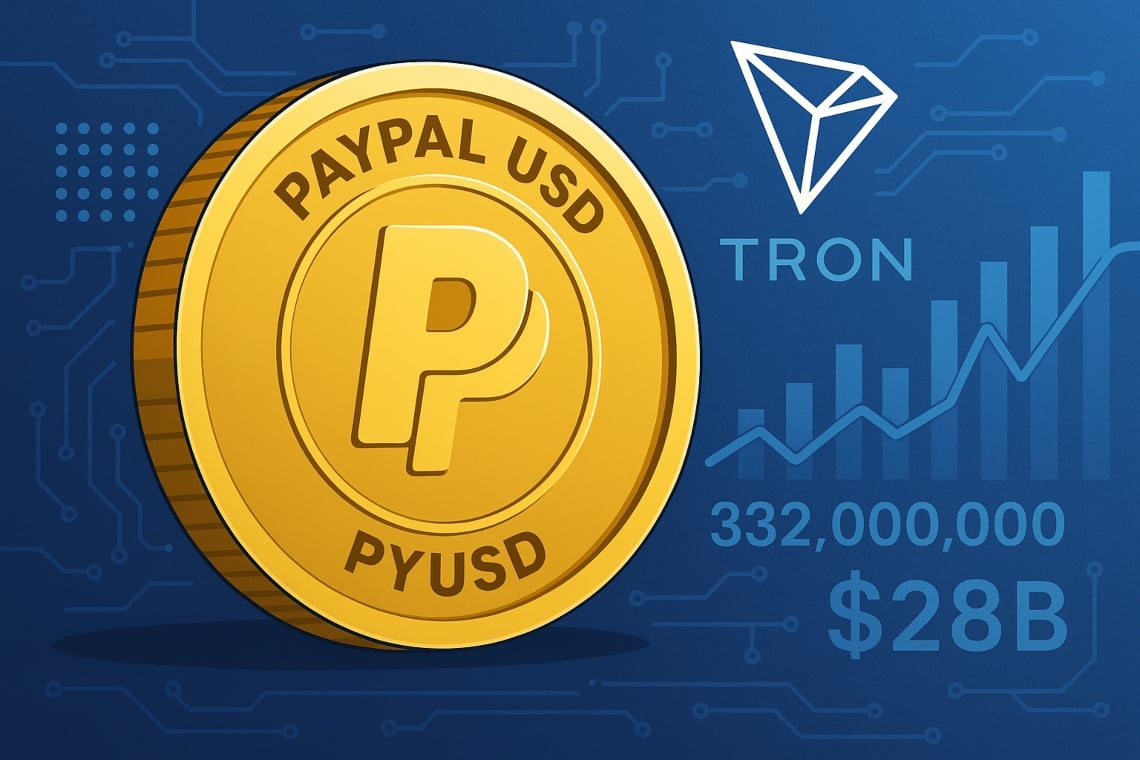
The post 332M accounts and $28B TVL, appeared on BitcoinEthereumNews.com. PayPal USD debuts on TRON as a permissionless token PYUSD0, enabled by LayerZero’s OFT standard and the Stargate Hydra extension. The announcement on September 18, 2025 (Geneva) introduces native interoperability between chains and transfers without manual steps for users; the news echoes elements already communicated by PayPal at the launch of PYUSD PayPal Newsroom. The move concerns an ecosystem that includes 332 million accounts and over $28 billion in TVL. In this context, the fungibility of a stablecoin regulated across multiple networks and the use of TRON as a settlement layer for payments and remittances is at stake. According to the data collected by TRONSCAN updated as of September 18, 2025, the network metrics confirm the cited volumes and highlighted traffic patterns. Our editorial team has verified the transaction logs and monitored the public chain metrics to corroborate the reported figures; the observations on daily flows and TVL are consistent with the network dashboards. Industry analysts observe that the entry of a regulated issuer like PayPal tends to increase institutional interest, provided there is transparency on reserves and compliance checks. What is PYUSD0 on TRON and why is it relevant PYUSD0 is the representation of PayPal USD on TRON. It is pegged one-to-one to PYUSD through the OFT standard: the two tokens remain a single stablecoin, fungible and reconciled across chains. The integration is made possible by Stargate Hydra, now operational through LayerZero. According to the founder of TRON, Justin Sun, the extension on TRON expands access and trust for users and institutions. For Bryan Pellegrino (CEO of LayerZero Labs), stablecoins represent a pillar of global payments and remittances, as the native compatibility between chains enables their operational scalability. It must be said that the alignment between issuer, cross-chain infrastructure, and settlement network is a key element. Key Numbers: TRON…
Share
BitcoinEthereumNews2025/09/19 08:18