The post Tokyo inflation cools on utility subsidies but stays above BOJ target appeared on BitcoinEthereumNews.com. Core consumer inflation in Tokyo eased in August but remained above the Bank of Japan’s 2% target, data showed Friday, sustaining market expectations for a potential resumption of interest rate hikes. Meanwhile, factory output slipped in July, and retail sales rose far less than anticipated, highlighting the fragility of Japan’s economic recovery as pressure from U.S. tariffs mounted. Analysts say lingering inflationary pressures, coupled with mounting growth risks, underscore the challenge facing the Bank of Japan (BOJ) in deciding when to move on its next rate hike. “Core consumer inflation is likely to slow as a trend as the yen’s rise and moderating increases in import costs weigh on prices,” said Masato Koike, senior economist at Sompo Institute Plus. He noted that while lowered under Japan’s trade deal with Washington, U.S. tariff rates remain high compared with last year’s levels and thus will keep hurting output for a while. Utility subsidies slow Tokyo inflation, but core prices stay elevated Tokyo’s core consumer price index (CPI) increased by 2.5% in August YoY. This figure excludes volatile fresh food but includes fuel costs, government data showed, matching a median market forecast. The CPI was sluggish after a 2.9% rise in July, mostly due to government fuel subsidies that reduced utility bills. An index excluding both volatile fresh food and energy costs—closely monitored by the BOJ as a key measure of underlying inflation—climbed 3.0% in August from a year earlier, following a 3.1% increase in July. Food inflation, excluding fresh produce such as vegetables, held at 7.4% in August, unchanged from the previous month, underscoring persistent pressure from higher prices of staples like rice, coffee beans, and other groceries. Overall, goods prices climbed 3.2% year-on-year, while service costs rose 2.0%, reflecting continued pass-through of rising labor expenses, government data showed. Factory output drops… The post Tokyo inflation cools on utility subsidies but stays above BOJ target appeared on BitcoinEthereumNews.com. Core consumer inflation in Tokyo eased in August but remained above the Bank of Japan’s 2% target, data showed Friday, sustaining market expectations for a potential resumption of interest rate hikes. Meanwhile, factory output slipped in July, and retail sales rose far less than anticipated, highlighting the fragility of Japan’s economic recovery as pressure from U.S. tariffs mounted. Analysts say lingering inflationary pressures, coupled with mounting growth risks, underscore the challenge facing the Bank of Japan (BOJ) in deciding when to move on its next rate hike. “Core consumer inflation is likely to slow as a trend as the yen’s rise and moderating increases in import costs weigh on prices,” said Masato Koike, senior economist at Sompo Institute Plus. He noted that while lowered under Japan’s trade deal with Washington, U.S. tariff rates remain high compared with last year’s levels and thus will keep hurting output for a while. Utility subsidies slow Tokyo inflation, but core prices stay elevated Tokyo’s core consumer price index (CPI) increased by 2.5% in August YoY. This figure excludes volatile fresh food but includes fuel costs, government data showed, matching a median market forecast. The CPI was sluggish after a 2.9% rise in July, mostly due to government fuel subsidies that reduced utility bills. An index excluding both volatile fresh food and energy costs—closely monitored by the BOJ as a key measure of underlying inflation—climbed 3.0% in August from a year earlier, following a 3.1% increase in July. Food inflation, excluding fresh produce such as vegetables, held at 7.4% in August, unchanged from the previous month, underscoring persistent pressure from higher prices of staples like rice, coffee beans, and other groceries. Overall, goods prices climbed 3.2% year-on-year, while service costs rose 2.0%, reflecting continued pass-through of rising labor expenses, government data showed. Factory output drops…

Tokyo inflation cools on utility subsidies but stays above BOJ target

3 min read

Core consumer inflation in Tokyo eased in August but remained above the Bank of Japan’s 2% target, data showed Friday, sustaining market expectations for a potential resumption of interest rate hikes.

Meanwhile, factory output slipped in July, and retail sales rose far less than anticipated, highlighting the fragility of Japan’s economic recovery as pressure from U.S. tariffs mounted.

Analysts say lingering inflationary pressures, coupled with mounting growth risks, underscore the challenge facing the Bank of Japan (BOJ) in deciding when to move on its next rate hike.

“Core consumer inflation is likely to slow as a trend as the yen’s rise and moderating increases in import costs weigh on prices,” said Masato Koike, senior economist at Sompo Institute Plus.

He noted that while lowered under Japan’s trade deal with Washington, U.S. tariff rates remain high compared with last year’s levels and thus will keep hurting output for a while.

Utility subsidies slow Tokyo inflation, but core prices stay elevated

Tokyo’s core consumer price index (CPI) increased by 2.5% in August YoY. This figure excludes volatile fresh food but includes fuel costs, government data showed, matching a median market forecast. The CPI was sluggish after a 2.9% rise in July, mostly due to government fuel subsidies that reduced utility bills.
An index excluding both volatile fresh food and energy costs—closely monitored by the BOJ as a key measure of underlying inflation—climbed 3.0% in August from a year earlier, following a 3.1% increase in July.

Food inflation, excluding fresh produce such as vegetables, held at 7.4% in August, unchanged from the previous month, underscoring persistent pressure from higher prices of staples like rice, coffee beans, and other groceries.

Overall, goods prices climbed 3.2% year-on-year, while service costs rose 2.0%, reflecting continued pass-through of rising labor expenses, government data showed.

Factory output drops as U.S. tariffs weigh on Japan’s recovery

The Bank of Japan (BOJ) ended its decade-long ultra-loose stimulus last year. It lifted short-term interest rates to 0.5% in January, signaling confidence that the economy was nearing a durable achievement of its 2% inflation target.

Still, while inflation has remained above 2% for more than three years, BOJ Governor Kazuo Ueda has emphasized a cautious approach to further tightening, warning of downside risks to growth from the impact of U.S. tariffs.

Highlighting these concerns, government data on Friday showed Japan’s factory output fell 1.6% in July from the previous month, a sharper decline than the market’s median forecast for a 1.0% drop, driven by weakness in the automobile and machinery sectors.

The manufacturers that the government surveyed expect production to increase by 2.8% in August and fall by 0.3% in September, the data showed. 

Other data brought more bad news, with retail sales barely gaining 0.3% in July, much lower than market forecasts for a 1.8% rise, indicating that the increasing cost of living was undermining consumption. 

With a tightening labor market, pressure on wages is increasing. Government data showed on Friday that the jobless rate eased to 2.3% from 2.5% in June, the lowest level since December 2019. Some 65% of economists questioned by Reuters in August forecast the BOJ will lift its key rate by another 25 basis points or more later this year compared with just over half a month ago.

Get seen where it counts. Advertise in Cryptopolitan Research and reach crypto’s sharpest investors and builders.

Source: https://www.cryptopolitan.com/tokyo-inflation-cools-on-utility-subsidies/

Market Opportunity
RICE AI Logo
RICE AI Price(RICE)
$0.003202
$0.003202$0.003202
-8.87%
USD
RICE AI (RICE) Live Price Chart
Disclaimer: The articles reposted on this site are sourced from public platforms and are provided for informational purposes only. They do not necessarily reflect the views of MEXC. All rights remain with the original authors. If you believe any content infringes on third-party rights, please contact service@support.mexc.com for removal. MEXC makes no guarantees regarding the accuracy, completeness, or timeliness of the content and is not responsible for any actions taken based on the information provided. The content does not constitute financial, legal, or other professional advice, nor should it be considered a recommendation or endorsement by MEXC.

You May Also Like

Once Upon a Farm Announces Pricing of Initial Public Offering

Once Upon a Farm Announces Pricing of Initial Public Offering

BERKELEY, Calif.–(BUSINESS WIRE)–Once Upon a Farm today announced the pricing of its initial public offering of 10,997,209 shares of its common stock, 7,631,537
Share
AI Journal2026/02/06 08:15
Forward Industries Bets Big on Solana With $4B Capital Plan

Forward Industries Bets Big on Solana With $4B Capital Plan

The firm has filed with the U.S. Securities and Exchange Commission to launch a $4 billion at-the-market (ATM) equity program, […] The post Forward Industries Bets Big on Solana With $4B Capital Plan appeared first on Coindoo.
Share
Coindoo2025/09/18 04:15
332M accounts and $28B TVL,

332M accounts and $28B TVL,

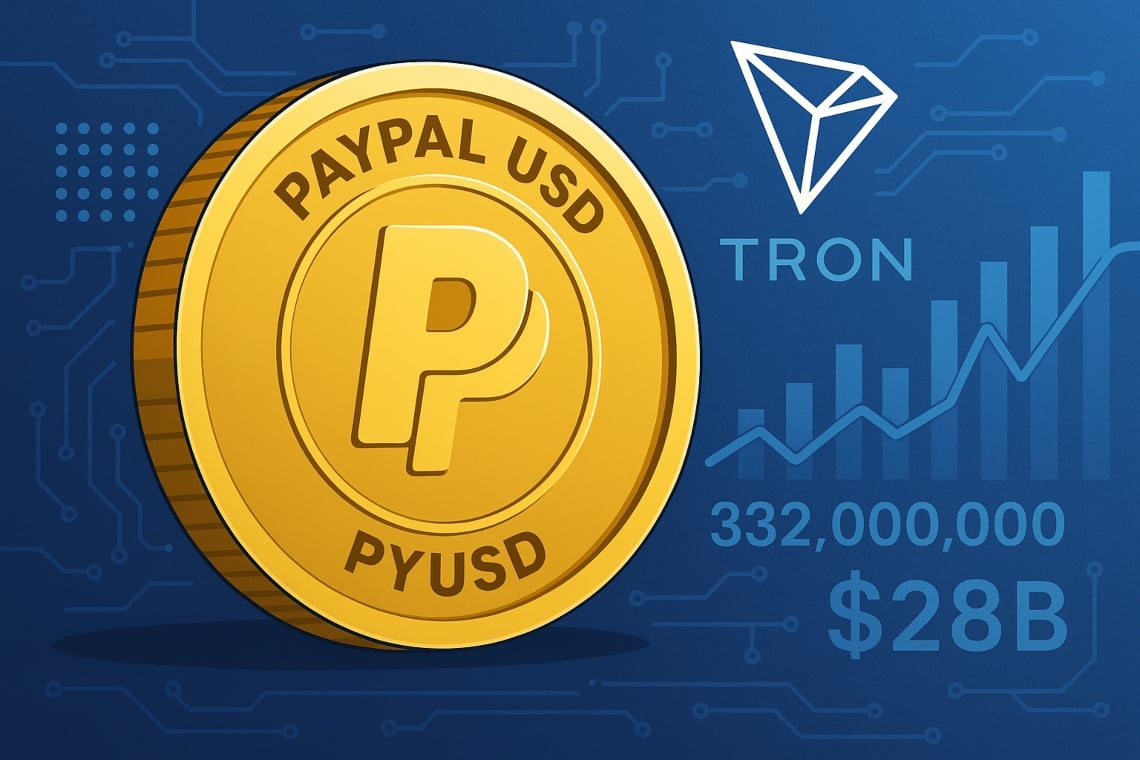
The post 332M accounts and $28B TVL, appeared on BitcoinEthereumNews.com. PayPal USD debuts on TRON as a permissionless token PYUSD0, enabled by LayerZero’s OFT standard and the Stargate Hydra extension. The announcement on September 18, 2025 (Geneva) introduces native interoperability between chains and transfers without manual steps for users; the news echoes elements already communicated by PayPal at the launch of PYUSD PayPal Newsroom. The move concerns an ecosystem that includes 332 million accounts and over $28 billion in TVL. In this context, the fungibility of a stablecoin regulated across multiple networks and the use of TRON as a settlement layer for payments and remittances is at stake. According to the data collected by TRONSCAN updated as of September 18, 2025, the network metrics confirm the cited volumes and highlighted traffic patterns. Our editorial team has verified the transaction logs and monitored the public chain metrics to corroborate the reported figures; the observations on daily flows and TVL are consistent with the network dashboards. Industry analysts observe that the entry of a regulated issuer like PayPal tends to increase institutional interest, provided there is transparency on reserves and compliance checks. What is PYUSD0 on TRON and why is it relevant PYUSD0 is the representation of PayPal USD on TRON. It is pegged one-to-one to PYUSD through the OFT standard: the two tokens remain a single stablecoin, fungible and reconciled across chains. The integration is made possible by Stargate Hydra, now operational through LayerZero. According to the founder of TRON, Justin Sun, the extension on TRON expands access and trust for users and institutions. For Bryan Pellegrino (CEO of LayerZero Labs), stablecoins represent a pillar of global payments and remittances, as the native compatibility between chains enables their operational scalability. It must be said that the alignment between issuer, cross-chain infrastructure, and settlement network is a key element. Key Numbers: TRON…
Share
BitcoinEthereumNews2025/09/19 08:18