TLDR: Aave Horizon allows stablecoin borrowing against tokenized Treasurys and collateralized loans. Chainlink powers Horizon with Onchain NAV, offering real-time net asset values for collateral. Horizon supports USDC, RLUSD, and GHO, providing predictable liquidity for institutions. Aave’s treasury hit $132.7M, reflecting 130% growth, showing protocol revenue strength. Aave Labs has rolled out Horizon, a new [...] The post Aave Launches Horizon, Letting Firms Borrow USDC, RLUSD, and GHO Against Tokenized Assets appeared first on Blockonomi.TLDR: Aave Horizon allows stablecoin borrowing against tokenized Treasurys and collateralized loans. Chainlink powers Horizon with Onchain NAV, offering real-time net asset values for collateral. Horizon supports USDC, RLUSD, and GHO, providing predictable liquidity for institutions. Aave’s treasury hit $132.7M, reflecting 130% growth, showing protocol revenue strength. Aave Labs has rolled out Horizon, a new [...] The post Aave Launches Horizon, Letting Firms Borrow USDC, RLUSD, and GHO Against Tokenized Assets appeared first on Blockonomi.

Aave Launches Horizon, Letting Firms Borrow USDC, RLUSD, and GHO Against Tokenized Assets

3 min read

TLDR:

  • Aave Horizon allows stablecoin borrowing against tokenized Treasurys and collateralized loans.
  • Chainlink powers Horizon with Onchain NAV, offering real-time net asset values for collateral.
  • Horizon supports USDC, RLUSD, and GHO, providing predictable liquidity for institutions.
  • Aave’s treasury hit $132.7M, reflecting 130% growth, showing protocol revenue strength.

Aave Labs has rolled out Horizon, a new platform aimed at institutional borrowing. The system allows stablecoins to be borrowed using tokenized real-world assets, including U.S. Treasurys and collateralized loan obligations. 

Horizon is built on a permissioned version of Aave V3, designed to meet compliance requirements. Institutions can now post tokenized securities as collateral to access USDC, RLUSD, and GHO with consistent liquidity. The platform combines permissioned collateral with permissionless stablecoin markets to preserve DeFi composability.

Stani Kulechov, Aave founder, described Horizon as a foundation for large-scale lending markets, offering the liquidity institutions need to operate onchain. The launch marks the next phase in Aave Labs’ institutional RWA strategy, first unveiled in March under its parent entity, Avara. 

With over $25 billion in tokenized real-world assets already onchain, Horizon seeks to unlock their utility.

Aave’s Horizon Platform: Institutional Borrowing With Stablecoins

Horizon targets qualified institutions, allowing them to borrow stablecoins while using tokenized assets as backing. Borrowers gain access to markets 24/7, supported by predictable liquidity. 

Collateral types at launch include tokenized Treasury and yield funds from Circle, Superstate, Centrifuge, and VanEck. By separating permissioned collateral from open stablecoin markets, Horizon maintains DeFi interoperability while meeting regulatory expectations.

The platform integrates partners such as Centrifuge, Superstate, Circle, RLUSD, Ant Digital Technologies, Ethena, KAIO, OpenEden, Securitize, VanEck, Hamilton Lane, WisdomTree, and Chainlink. 

Each partner contributes to creating a compliant, functional ecosystem that supports institutional requirements. The platform’s roadmap includes future features like Proof of Reserves and SmartAUM integrations to increase transparency and trust.

Chainlink provides Horizon’s core data layer through its Onchain NAV feed. This feed delivers real-time net asset values of tokenized funds, enabling automated, overcollateralized lending. 

The integration ensures institutions can monitor the value of collateral accurately at all times.

Meanwhile, Aave’s treasury excluding AAVE tokens reached an all-time high of $132.7 million, reflecting a 130% increase in reserves. 

BlockchainBaller tweeted that this demonstrates how DeFi blue chips are building revenue-driven ecosystems. Price data from CoinGecko shows Aave (AAVE) trading at $327.56, down 1.16% in 24 hours but up 13.82% over seven days.
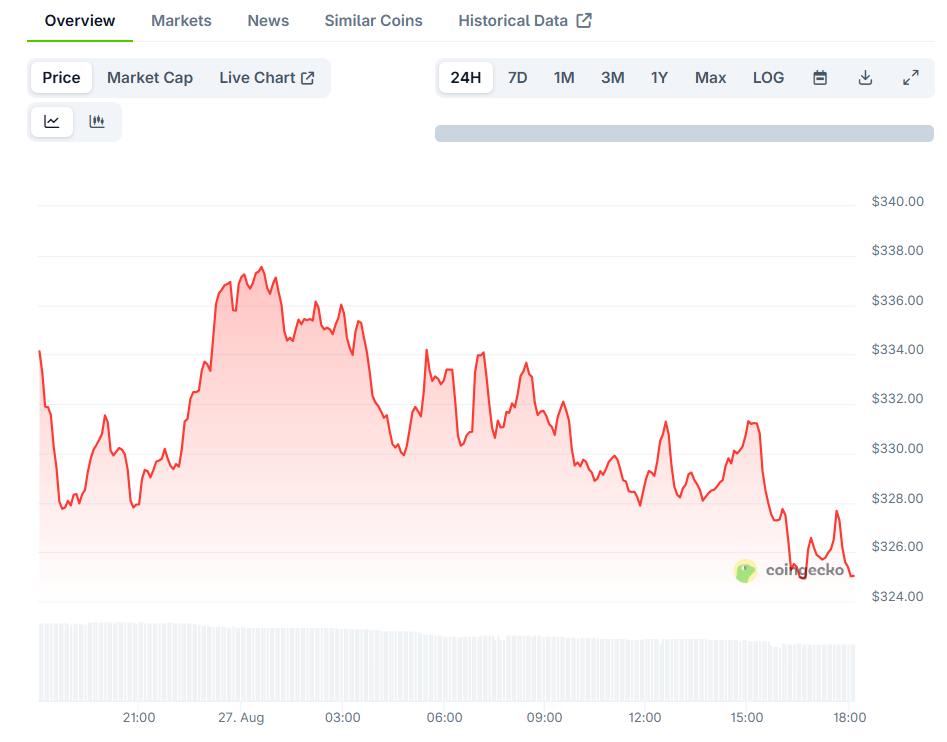
AAVE price on CoinGecko

Horizon represents a structured move by Aave Labs to bring compliance-ready, onchain lending solutions to institutions. By combining tokenized RWAs, stablecoin liquidity, and Chainlink’s real-time data, it establishes a clear path for borrowing at scale.

The post Aave Launches Horizon, Letting Firms Borrow USDC, RLUSD, and GHO Against Tokenized Assets appeared first on Blockonomi.

Market Opportunity
RealLink Logo
RealLink Price(REAL)
$0.04964
$0.04964$0.04964
-1.52%
USD
RealLink (REAL) Live Price Chart
Disclaimer: The articles reposted on this site are sourced from public platforms and are provided for informational purposes only. They do not necessarily reflect the views of MEXC. All rights remain with the original authors. If you believe any content infringes on third-party rights, please contact service@support.mexc.com for removal. MEXC makes no guarantees regarding the accuracy, completeness, or timeliness of the content and is not responsible for any actions taken based on the information provided. The content does not constitute financial, legal, or other professional advice, nor should it be considered a recommendation or endorsement by MEXC.

You May Also Like

eurosecurity.net Expands Cryptocurrency Asset Recovery Capabilities Amid Rising Investor Losses

eurosecurity.net Expands Cryptocurrency Asset Recovery Capabilities Amid Rising Investor Losses

New York, NY/ GlobePRWire / Feb 6, 2026 – eurosecurity.net announces the expansion of its cryptocurrency asset recovery services, reflecting increased demand from
Share
CryptoReporter2026/02/06 17:24
Ethereum to boost scalability and roll out Fusaka upgrade on Dec 3

Ethereum to boost scalability and roll out Fusaka upgrade on Dec 3

Ethereum's Fusaka update may happen on December 3, based on the date set in the latest developer call.
Share
Cryptopolitan2025/09/19 17:00
Google Cloud taps EigenLayer to bring trust to agentic payments

Google Cloud taps EigenLayer to bring trust to agentic payments

The post Google Cloud taps EigenLayer to bring trust to agentic payments appeared on BitcoinEthereumNews.com. Two days after unveiling AP2 — a universal payment layer for AI agents that supports everything from credit cards to stablecoins — Google and EigenLayer have released details of their partnership to bring verifiability and restaking security to the stack, using Ethereum. In addition to enabling verifiable compute and slashing-backed payment coordination, EigenCloud will support insured and sovereign AI agents, which introduce consequences for failure or deviation from specified behavior. Sovereign agents are positioned as autonomous actors that can own property, make decisions, and execute actions independently — think smart contracts with embedded intelligence. From demos to dollars AP2 extends Google’s agent-to-agent (A2A) protocol using the HTTP 402 status code — long reserved for “payment required” — to standardize payment requests between agents across different networks. It already supports stablecoins like USDC, and Coinbase has demoed an agent checkout using its Wallet-as-a-Service. Paired with a system like Lit Protocol’s Vincent — which enforces per-action policies and key custody at signing — Google’s AP2 with EigenCloud’s verifiability and cross-chain settlement could form an end-to-end trust loop. Payments between agents aren’t as simple as they are often made to sound by “Crypto x AI” LARPs. When an AI agent requests a payment in USDC on Base and the payer’s funds are locked in ETH on Arbitrum, the transaction stalls — unless something abstracts the bridging, swapping and delivery. That’s where EigenCloud comes in. Sreeram Kannan, founder of EigenLayer, said the integration will create agents that not only run on-chain verifiable compute, but are also economically incentivized to behave within programmable bounds. Through restaked operators, EigenCloud powers a verifiable payment service that handles asset routing and chain abstraction, with dishonest behavior subject to slashing. It also introduces cryptographic accountability to the agents themselves, enabling proofs that an agent actually executed the task it…
Share
BitcoinEthereumNews2025/09/19 03:52