U.S. stocks bounced back into positive territory as crude prices plunged more than 4% in the past 24 hours and have now slid 8.74% since June 12. Analysts at Deutsche Bank note that oil’s trajectory could oscillate unpredictably in the months ahead. $76 to $70: Crude Collapses as Nuclear Talks Stall While much attention remains […]U.S. stocks bounced back into positive territory as crude prices plunged more than 4% in the past 24 hours and have now slid 8.74% since June 12. Analysts at Deutsche Bank note that oil’s trajectory could oscillate unpredictably in the months ahead. $76 to $70: Crude Collapses as Nuclear Talks Stall While much attention remains […]

Oil Crashes 8.7% From Last Week’s Peak as Middle East Tensions Rattle Markets

U.S. stocks bounced back into positive territory as crude prices plunged more than 4% in the past 24 hours and have now slid 8.74% since June 12. Analysts at Deutsche Bank note that oil’s trajectory could oscillate unpredictably in the months ahead.

$76 to $70: Crude Collapses as Nuclear Talks Stall

While much attention remains fixed on equities, precious metals, and digital assets, traders and analysts are equally fixated on bond yields and the fluctuating price of crude. Last week, tensions escalated between Israel and Iran, with Israeli forces striking what they claimed were nuclear sites in Tehran. In response, Iran launched a barrage of missiles targeting Tel Aviv and Jerusalem.

Now, emerging reports suggest Iran may be looking to revive diplomatic dialogue concerning its nuclear ambitions. The recent tensions have caused earlier nuclear negotiations between Iran and the United States to be paused on June 15. When the military attacks first started, the price of crude oil swelled to $76.76 per barrel but today it is down 8.74% lower and trading at $70.05. The drop came even as Israel’s Haifa Oil Refinery was partly damaged.
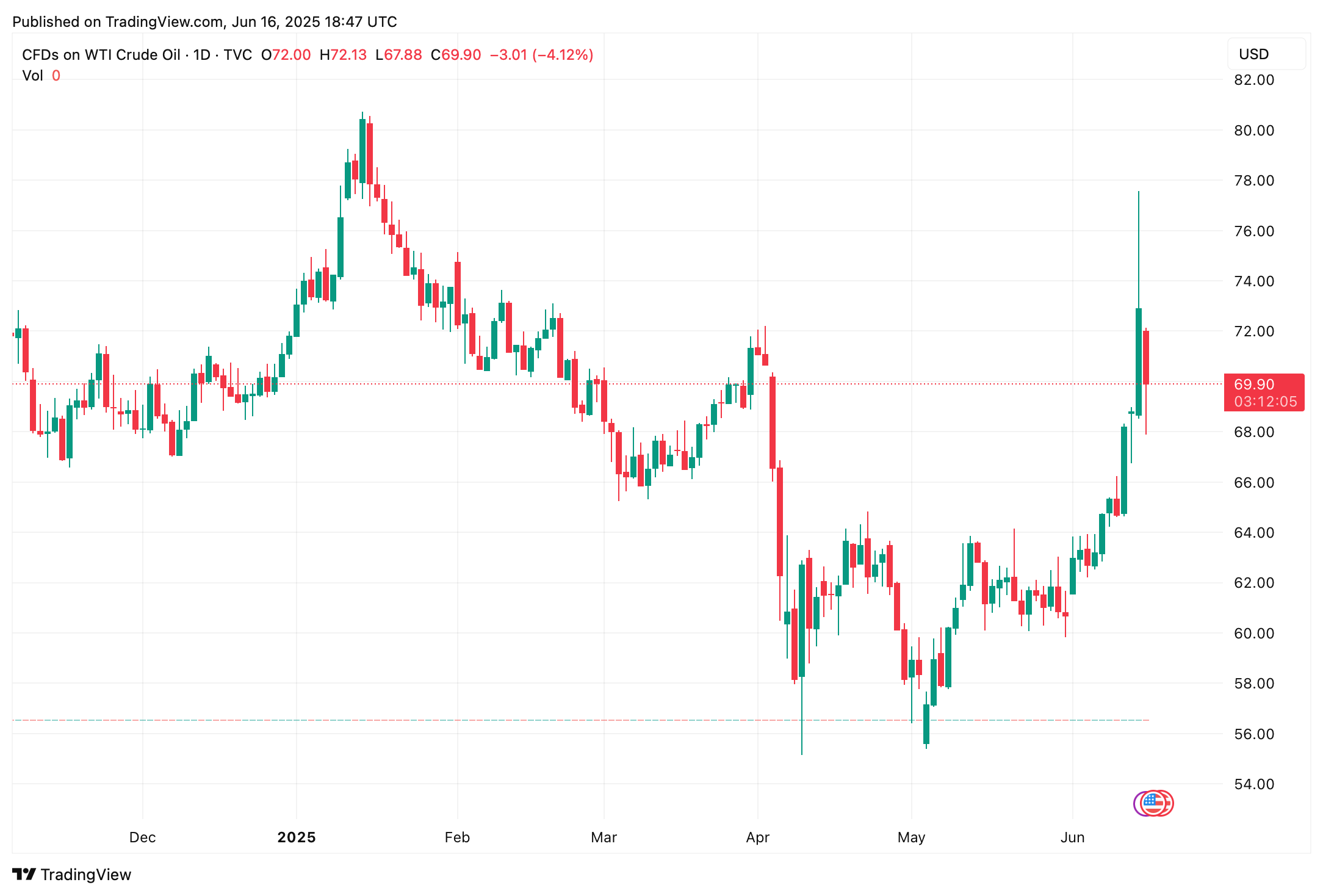
Oil Crashes 8.7% From Last Week’s Peak as Middle East Tensions Rattle Markets

An editorial from the New York Times (NYT) highlights insights from Deutsche Bank analysts, who suggest crude oil prices may fluctuate unpredictably from this point forward. The analysts outline a broad spectrum of potential scenarios, with extremes ranging from prices exceeding $120 per barrel to a slide toward $50 by next year. NYT journalist Stanley Reed, based in London, also spoke with an executive from the commodities research firm Argus Media.

The senior energy markets analyst at Argus Media, Bachar El-Halabi, told Reed:

According to prediction market Polymarket, the probability of Iran shutting the Strait of Hormuz in 2025 stands at 25%, down from the 40% range observed last week. Even a brief closure of the strait could jolt global oil prices upward almost instantly. As a strategic artery, it channels around 20% of the world’s seaborne oil—carrying exports from Saudi Arabia, the UAE, Kuwait, and Iraq. Any blockage would rattle energy markets, provoking a scramble as traders and governments brace for potential shortages and logistical snarls.

Brent crude and West Texas Intermediate (WTI) futures would likely leap as investors bake in geopolitical risk premiums. The magnitude of the price response would depend entirely on how long and how extensively the flow is interrupted. At present, equities continue their upward drift, while the crypto economy has advanced 2.62% over the past 24 hours. Meanwhile, gold slipped 1.26% on Monday, stabilizing around $3,389 per troy ounce.

Longer-term U.S. bond yields remain elevated relative to historical norms, a reflection of persistent economic and fiscal ambiguity in the air. During the session, the yield on the 10-year Treasury note fluctuated between roughly 4.42% and 4.55%. Recent benchmarks and comparable durations for the 30-year yield indicate it’s been hovering near 4.90% to 4.93%, with the latest 30-year issuance carrying a 4.75% coupon as of June 16.

The financial pulse now hinges not only on volatility in the oil trade but on a delicate geopolitical détente that could recalibrate risk sentiment overnight. Investors are navigating a matrix of uncertainty—sensitive to even whispers of escalation or diplomacy. Whether calm or conflict prevails, the balance of power in energy, equities, and fixed income will likely reflect every subtle shift on the global stage.

Market Opportunity
Moonveil Logo
Moonveil Price(MORE)
$0.0006374
$0.0006374$0.0006374
+8.92%
USD
Moonveil (MORE) Live Price Chart
Disclaimer: The articles reposted on this site are sourced from public platforms and are provided for informational purposes only. They do not necessarily reflect the views of MEXC. All rights remain with the original authors. If you believe any content infringes on third-party rights, please contact service@support.mexc.com for removal. MEXC makes no guarantees regarding the accuracy, completeness, or timeliness of the content and is not responsible for any actions taken based on the information provided. The content does not constitute financial, legal, or other professional advice, nor should it be considered a recommendation or endorsement by MEXC.

You May Also Like

Term deposit yields inch down on BSP cut bets

Term deposit yields inch down on BSP cut bets

YIELDS on the Bangko Sentral ng Pilipinas’ (BSP) seven-day term deposits edged down on Wednesday amid strong demand as still benign inflation and slow growth fueled
Share
Bworldonline2026/02/12 00:05
CEO Sandeep Nailwal Shared Highlights About RWA on Polygon

CEO Sandeep Nailwal Shared Highlights About RWA on Polygon

The post CEO Sandeep Nailwal Shared Highlights About RWA on Polygon appeared on BitcoinEthereumNews.com. Polygon CEO Sandeep Nailwal highlighted Polygon’s lead in global bonds, Spiko US T-Bill, and Spiko Euro T-Bill. Polygon published an X post to share that its roadmap to GigaGas was still scaling. Sentiments around POL price were last seen to be bearish. Polygon CEO Sandeep Nailwal shared key pointers from the Dune and RWA.xyz report. These pertain to highlights about RWA on Polygon. Simultaneously, Polygon underlined its roadmap towards GigaGas. Sentiments around POL price were last seen fumbling under bearish emotions. Polygon CEO Sandeep Nailwal on Polygon RWA CEO Sandeep Nailwal highlighted three key points from the Dune and RWA.xyz report. The Chief Executive of Polygon maintained that Polygon PoS was hosting RWA TVL worth $1.13 billion across 269 assets plus 2,900 holders. Nailwal confirmed from the report that RWA was happening on Polygon. The Dune and https://t.co/W6WSFlHoQF report on RWA is out and it shows that RWA is happening on Polygon. Here are a few highlights: – Leading in Global Bonds: Polygon holds 62% share of tokenized global bonds (driven by Spiko’s euro MMF and Cashlink euro issues) – Spiko U.S.… — Sandeep | CEO, Polygon Foundation (※,※) (@sandeepnailwal) September 17, 2025 The X post published by Polygon CEO Sandeep Nailwal underlined that the ecosystem was leading in global bonds by holding a 62% share of tokenized global bonds. He further highlighted that Polygon was leading with Spiko US T-Bill at approximately 29% share of TVL along with Ethereum, adding that the ecosystem had more than 50% share in the number of holders. Finally, Sandeep highlighted from the report that there was a strong adoption for Spiko Euro T-Bill with 38% share of TVL. He added that 68% of returns were on Polygon across all the chains. Polygon Roadmap to GigaGas In a different update from Polygon, the community…
Share
BitcoinEthereumNews2025/09/18 01:10
‘This Is Not Good for Crypto’: Lawmakers Slam SEC Chair for Easing Industry Policing

‘This Is Not Good for Crypto’: Lawmakers Slam SEC Chair for Easing Industry Policing

The post ‘This Is Not Good for Crypto’: Lawmakers Slam SEC Chair for Easing Industry Policing appeared on BitcoinEthereumNews.com. In brief House Democrats accused
Share
BitcoinEthereumNews2026/02/12 02:04