This paper details ArSyTa, a new, massive dataset for citation AI. It has 8.27M rich contexts from arXiv papers to improve recommendation models.This paper details ArSyTa, a new, massive dataset for citation AI. It has 8.27M rich contexts from arXiv papers to improve recommendation models.

The Creation of ArSyTa, a Novel 8.27-Million-Context Dataset for Local Citation Recommendation

8 min read

Abstract and 1. Introduction

  1. Related Work

  2. Proposed Dataset

  3. SymTax Model

    4.1 Prefetcher

    4.2 Enricher

    4.3 Reranker

  4. Experiments and Results

  5. Analysis

    6.1 Ablation Study

    6.2 Quantitative Analysis and 6.3 Qualitative Analysis

  6. Conclusion

  7. Limitations

  8. Ethics Statement and References

Appendix

2 Related Work

Local citation recommendation has drawn comparatively less interest than its global counterpart until recently. He et al. (2010) introduced the task of local citation recommendation by using tf-idf based vector similarity between context and cited articles. Livne et al. (2014) extracted hand-crafted features from the citation excerpt and the remaining document text, and developed a system to recommend citations while the document is being drafted. The neural probabilistic model of (Huang et al., 2015) determines the citation probability for a given context by jointly embedding context and all articles in a shared embedding space. Ebesu and Fang (2017) proposed neural citation network based on encoder-decoder architecture. The encoder obtains a robust representation of citation context and further augments it via author networks and attention mechanism, which the decoder uses to generate the title of the cited paper. Dai et al. (2019) utilised stacked denoising autoencoders for representing cited articles, bidirectional LSTMs for citation context representation and attention principle over citation context to enhance the learning ability of their framework.

\ Jeong et al. (2020) proposed a BERT-GCN model which uses BERT (Kenton and Toutanova, 2019) to obtain embeddings for context sentences, and Graph Convolutional Network (Kipf and Welling, 2017) to derive embeddings from citation graph nodes. The two embeddings are then concatenated and passed through a feedforward neural network to obtain relevance between them. However, due to the high cost of computing GCN, as mentioned in Gu et al. (2022), BERT-GCN model was evaluated on tiny datasets containing merely a few thousand citation contexts. It highlights the limitation of scaling such GNN models for recommending citations on large datasets.

\ Medic and Šnajder (2020) suggested the use of global information of articles along with citation context to recommend citations. It computes semantic matching score between citation context and cited article text, and bibliographic score from the article’s popularity in the community to generate a final recommendation score. Ostendorff et al. (2022) perform neighbourhood contrastive learning over the full citation graph to yield citation embeddings and then uses k-nearest neighbourhood based indexing to retrieve the top recommendations. The most recent work in local citation recommendation by Gu et al. (2022) proposed a two-stage recommendation architecture comprising a fast prefetching module and a slow reranking module. We build upon work of Gu et al. (2022) by borrowing their prefetching module and designing a novel reranking module and another novel module named Enricher that fits between Prefetcher and Reranker. We name our model as SymTax (Symbiotic Relationship and Taxonomy Fusion).

\

3 Proposed Dataset

Motivation. Citation recommendation algorithms depend on the availability of the labelled data for training. However, curating such a dataset is challenging as full pdf papers must be parsed to extract citation excerpts and map the respective
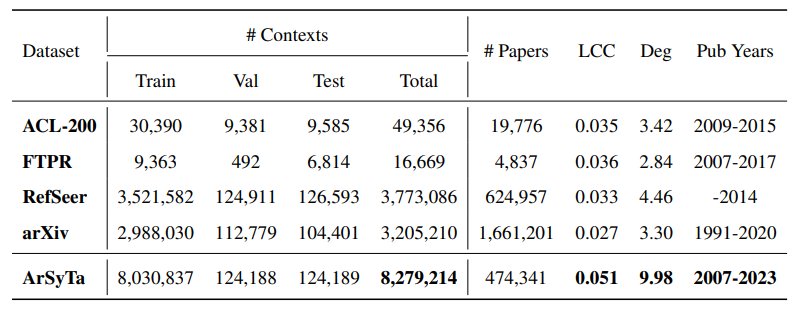
Table 1: Statistics across various datasets indicate the largest, densest and most recent nature of our dataset, ArSyTa. FTPR is FullTextPeerRead, arXiv is arXiv(HAtten), and LCC and Deg are the average local clustering coefficient and average degree of the citation context network, respectively.

\ cited articles. Further, the constraint that cited articles should be present in the corpus eliminates a large proportion of it, thus reducing the dataset size considerably. e.g. FullTextPeerRead (Jeong et al., 2020) and ACL-200 (Medic and Šnajder, 2020) datasets contain only a few thousand papers and contexts. RefSeer (Medic and Šnajder, 2020) contains 0.6 million papers published till 2014 and hence is not up-to-date. Gu et al. (2022) released a large and recent arXiv-based dataset (we refer to it as arXiv(HAtten)) by following the same strategy adopted by ACL-200 and FullTextPeerRead for extracting contexts. They consider 200 characters around the citation marker as the citation context. The above mentioned datasets have limited features, which may restrict the design of new algorithms for local citation recommendation. Thus, we propose a novel dataset ArSyTa[3] which is latest, largest and contains rich citation contexts with additional features.

\ Dataset Creation. We selected 475, 170 papers belonging to Computer Science (CS) categories from over 1.7 million scholarly papers spanning STEM disciplines available on arXiv. The papers are selected from April 2007-January 2023 publication dates to ensure current relevance. arXiv contains an extensive collection of scientific papers that offer innate diversity in different formatting styles, templates and written characterisation, posing a significant challenge in parsing pdfs. We comprehensively evaluate established frameworks, namely, arXiv Vanity[4], CERMINE[5], and GROBID[6], for data extraction. arXiv Vanity converts pdfs to HTML format for data extraction but produces inconsistent results, thus turning extraction infeasible in this scenario. CERMINE uses JAVA binaries to generate BibTeX format from pdf but fails to extract many references, thereby not providing the required level of information. GROBID is a state-of-the-art tool that accurately and efficiently produces easy-to-parse results in XML format with a standard syntax. We conduct extensive manual testing to assess parsing efficacy and finally choose GROBID as it adeptly parses more than 99.99% (i.e., 474, 341) of the documents. We organise the constructed dataset into a directed graph. Nodes within the graph encapsulate a rich array of attributes, encompassing abstracts, titles, authors, submitters, publication dates, topics, categories within CS, and comments associated with each paper. Edges within graph symbolise citations, carrying citation contexts and section headings in which they appear. This provides a format that offers better visualisation and utilisation of data.

\ Unlike previously available datasets, which use a 200-character length window to extract citation context, we consider one sentence before and after the citation sentence as a complete citation context. We create a robust mapping function for efficient data retrieval. Since every citation does not contain a Digital Object Identifier, mapping citations to corresponding papers is challenging. The use of several citation formats and the grammatical errors adds a further challenge to the task. To expedite title-based searches that associate titles with unique paper IDs, we devise an approximate mapping function based on LCS (Longest Common Substring), but the sheer size of the number of papers makes it infeasible to run directly, as each query requires around 10 seconds. Finally, to identify potential matches, we employ an approximate hash function called MinHash LSH (Locality Sensitivity Hashing), which provides the top 100 candidates with a high probability for a citation existing in our raw database to be present in the candidate list. We then utilise LCS matching with a 0.9 similarity score threshold to give a final candidate, thus reducing the time to a few microseconds. Finally, our dataset consists of 8.27 million citation contexts whereas the largest existing dataset, RefSeer, consists of only 3.7 million contexts. The dataset is essentially comprised of contexts and the corresponding metadata only and not the research papers, as is the case with other datasets. Even after considering a relatively lesser number of papers as a raw source, we curated significantly more citation contexts (i.e.,final data), thus showing the effectiveness of our data extraction technique. This is further supported empirically by the fact that our dataset has significantly higher values of average local clustering coefficient and average degree with respect to the other datasets (as shown in Table 1). Each citing paper and cited paper that corresponds to a citation context respectively belongs to a CS concept in the flat-level arXiv taxonomy that contains 40 classes. The distribution of category classes in arXiv taxonomy for ArSyTa is shown in Figure 3 (Appendix).

\ Technical Merits. ArSyTa offers the following merits over the existing datasets: (i) As shown in Table 1, ArSyTa is 2.2x and 2.6x larger than RefSeer and arXiv(HAtten), respectively. Also, our citation context network is more dense than all other datasets, clearly showing that our dataset creation strategy is better. (ii) It is the most recent dataset that contains papers till January 2023. (iii) It contains longer citation contexts and additional signals such as section heading and document category. (iv) ArSyTa is suitable for additional scientific document processing tasks that can leverage section heading as a feature or a label. (v) ArSyTa is more challenging than others as it contains papers from different publication venues with varied formats and styles submitted to arXiv.

\

:::info Authors:

(1) Karan Goyal, IIIT Delhi, India (karang@iiitd.ac.in);

(2) Mayank Goel, NSUT Delhi, India (mayank.co19@nsut.ac.in);

(3) Vikram Goyal, IIIT Delhi, India (vikram@iiitd.ac.in);

(4) Mukesh Mohania, IIIT Delhi, India (mukesh@iiitd.ac.in).

:::


:::info This paper is available on arxiv under CC by-SA 4.0 Deed (Attribution-Sharealike 4.0 International) license.

:::

[3] ArSyTa: Arxiv Symbiotic Relationship Taxonomy Fusion

\ [4] https://github.com/arxiv-vanity/arxiv-vanity

\ [5] https://github.com/CeON/CERMINE

\ [6] https://github.com/kermitt2/grobidclientpython

Market Opportunity
null Logo
null Price(null)
--
----
USD
null (null) Live Price Chart
Disclaimer: The articles reposted on this site are sourced from public platforms and are provided for informational purposes only. They do not necessarily reflect the views of MEXC. All rights remain with the original authors. If you believe any content infringes on third-party rights, please contact service@support.mexc.com for removal. MEXC makes no guarantees regarding the accuracy, completeness, or timeliness of the content and is not responsible for any actions taken based on the information provided. The content does not constitute financial, legal, or other professional advice, nor should it be considered a recommendation or endorsement by MEXC.

You May Also Like

SEC greenlights new generic standards to expedite crypto ETP listings

SEC greenlights new generic standards to expedite crypto ETP listings

The post SEC greenlights new generic standards to expedite crypto ETP listings appeared on BitcoinEthereumNews.com. The U.S. Securities and Exchange Commission (SEC) has approved a new set of generic listing standards for commodity-based trust shares on Nasdaq, Cboe, and the New York Stock Exchange. The move is expected to streamline the approval process for exchange-traded products (ETPs) tied to digital assets, according to Fox Business reporter Eleanor Terret. However, she added that the Generic Listing Standards don’t open up every type of crypto ETP because threshold requirements remain in place, meaning not all products will immediately qualify. To add context, she quoted Tushar Jain of Multicoin Capital, who noted that the standards don’t apply to every type of crypto ETP and that threshold requirements remain. He expects the SEC will iterate further on these standards. The order, issued on Sept. 17, grants accelerated approval of proposed rule changes filed by the exchanges. By adopting the standards, the SEC aims to shorten the time it takes to bring new commodity-based ETPs to market, potentially clearing a path for broader crypto investment products. The regulator has been delaying the decision on several altcoin ETFs, most of which are set to reach their final deadlines in October. The move was rumored to be the SEC’s way of expediting approvals for crypto ETFs. The approval follows years of back-and-forth between the SEC and exchanges over how to handle crypto-based products, with past applications facing lengthy reviews. The new process is expected to reduce delays and provide more clarity for issuers, though the SEC signaled it may revisit and refine the standards as the market evolves. While the decision marks progress, experts emphasized that the so-called “floodgates” for crypto ETPs are not yet fully open. Future SEC actions will determine how broadly these standards can be applied across different digital asset products. Source: https://cryptoslate.com/sec-greenlights-new-generic-standards-to-expedite-crypto-etp-listings/
Share
BitcoinEthereumNews2025/09/18 08:43
Optimizely Named a Leader in the 2026 Gartner® Magic Quadrant™ for Personalization Engines

Optimizely Named a Leader in the 2026 Gartner® Magic Quadrant™ for Personalization Engines

Company recognized as a Leader for the second consecutive year NEW YORK, Feb. 5, 2026 /PRNewswire/ — Optimizely, the leading digital experience platform (DXP) provider
Share
AI Journal2026/02/06 00:47
Lovable AI’s Astonishing Rise: Anton Osika Reveals Startup Secrets at Bitcoin World Disrupt 2025

Lovable AI’s Astonishing Rise: Anton Osika Reveals Startup Secrets at Bitcoin World Disrupt 2025

BitcoinWorld Lovable AI’s Astonishing Rise: Anton Osika Reveals Startup Secrets at Bitcoin World Disrupt 2025 Are you ready to witness a phenomenon? The world of technology is abuzz with the incredible rise of Lovable AI, a startup that’s not just breaking records but rewriting the rulebook for rapid growth. Imagine creating powerful apps and websites just by speaking to an AI – that’s the magic Lovable brings to the masses. This groundbreaking approach has propelled the company into the spotlight, making it one of the fastest-growing software firms in history. And now, the visionary behind this sensation, co-founder and CEO Anton Osika, is set to share his invaluable insights on the Disrupt Stage at the highly anticipated Bitcoin World Disrupt 2025. If you’re a founder, investor, or tech enthusiast eager to understand the future of innovation, this is an event you cannot afford to miss. Lovable AI’s Meteoric Ascent: Redefining Software Creation In an era where digital transformation is paramount, Lovable AI has emerged as a true game-changer. Its core premise is deceptively simple yet profoundly impactful: democratize software creation. By enabling anyone to build applications and websites through intuitive AI conversations, Lovable is empowering the vast majority of individuals who lack coding skills to transform their ideas into tangible digital products. This mission has resonated globally, leading to unprecedented momentum. The numbers speak for themselves: Achieved an astonishing $100 million Annual Recurring Revenue (ARR) in less than a year. Successfully raised a $200 million Series A funding round, valuing the company at $1.8 billion, led by industry giant Accel. Is currently fielding unsolicited investor offers, pushing its valuation towards an incredible $4 billion. As industry reports suggest, investors are unequivocally “loving Lovable,” and it’s clear why. This isn’t just about impressive financial metrics; it’s about a company that has tapped into a fundamental need, offering a solution that is both innovative and accessible. The rapid scaling of Lovable AI provides a compelling case study for any entrepreneur aiming for similar exponential growth. The Visionary Behind the Hype: Anton Osika’s Journey to Innovation Every groundbreaking company has a driving force, and for Lovable, that force is co-founder and CEO Anton Osika. His journey is as fascinating as his company’s success. A physicist by training, Osika previously contributed to the cutting-edge research at CERN, the European Organization for Nuclear Research. This deep technical background, combined with his entrepreneurial spirit, has been instrumental in Lovable’s rapid ascent. Before Lovable, he honed his skills as a co-founder of Depict.ai and a Founding Engineer at Sana. Based in Stockholm, Osika has masterfully steered Lovable from a nascent idea to a global phenomenon in record time. His leadership embodies a unique blend of profound technical understanding and a keen, consumer-first vision. At Bitcoin World Disrupt 2025, attendees will have the rare opportunity to hear directly from Osika about what it truly takes to build a brand that not only scales at an incredible pace in a fiercely competitive market but also adeptly manages the intense cultural conversations that inevitably accompany such swift and significant success. His insights will be crucial for anyone looking to understand the dynamics of high-growth tech leadership. Unpacking Consumer Tech Innovation at Bitcoin World Disrupt 2025 The 20th anniversary of Bitcoin World is set to be marked by a truly special event: Bitcoin World Disrupt 2025. From October 27–29, Moscone West in San Francisco will transform into the epicenter of innovation, gathering over 10,000 founders, investors, and tech leaders. It’s the ideal platform to explore the future of consumer tech innovation, and Anton Osika’s presence on the Disrupt Stage is a highlight. His session will delve into how Lovable is not just participating in but actively shaping the next wave of consumer-facing technologies. Why is this session particularly relevant for those interested in the future of consumer experiences? Osika’s discussion will go beyond the superficial, offering a deep dive into the strategies that have allowed Lovable to carve out a unique category in a market long thought to be saturated. Attendees will gain a front-row seat to understanding how to identify unmet consumer needs, leverage advanced AI to meet those needs, and build a product that captivates users globally. The event itself promises a rich tapestry of ideas and networking opportunities: For Founders: Sharpen your pitch and connect with potential investors. For Investors: Discover the next breakout startup poised for massive growth. For Innovators: Claim your spot at the forefront of technological advancements. The insights shared regarding consumer tech innovation at this event will be invaluable for anyone looking to navigate the complexities and capitalize on the opportunities within this dynamic sector. Mastering Startup Growth Strategies: A Blueprint for the Future Lovable’s journey isn’t just another startup success story; it’s a meticulously crafted blueprint for effective startup growth strategies in the modern era. Anton Osika’s experience offers a rare glimpse into the practicalities of scaling a business at breakneck speed while maintaining product integrity and managing external pressures. For entrepreneurs and aspiring tech leaders, his talk will serve as a masterclass in several critical areas: Strategy Focus Key Takeaways from Lovable’s Journey Rapid Scaling How to build infrastructure and teams that support exponential user and revenue growth without compromising quality. Product-Market Fit Identifying a significant, underserved market (the 99% who can’t code) and developing a truly innovative solution (AI-powered app creation). Investor Relations Balancing intense investor interest and pressure with a steadfast focus on product development and long-term vision. Category Creation Carving out an entirely new niche by democratizing complex technologies, rather than competing in existing crowded markets. Understanding these startup growth strategies is essential for anyone aiming to build a resilient and impactful consumer experience. Osika’s session will provide actionable insights into how to replicate elements of Lovable’s success, offering guidance on navigating challenges from product development to market penetration and investor management. Conclusion: Seize the Future of Tech The story of Lovable, under the astute leadership of Anton Osika, is a testament to the power of innovative ideas meeting flawless execution. Their remarkable journey from concept to a multi-billion-dollar valuation in record time is a compelling narrative for anyone interested in the future of technology. By democratizing software creation through Lovable AI, they are not just building a company; they are fostering a new generation of creators. His appearance at Bitcoin World Disrupt 2025 is an unmissable opportunity to gain direct insights from a leader who is truly shaping the landscape of consumer tech innovation. Don’t miss this chance to learn about cutting-edge startup growth strategies and secure your front-row seat to the future. Register now and save up to $668 before Regular Bird rates end on September 26. To learn more about the latest AI market trends, explore our article on key developments shaping AI features. This post Lovable AI’s Astonishing Rise: Anton Osika Reveals Startup Secrets at Bitcoin World Disrupt 2025 first appeared on BitcoinWorld.
Share
Coinstats2025/09/17 23:40