The post Bitcoin Price in Extreme Fear Zone, But Is This Time Different? appeared first on Coinpedia Fintech News The Bitcoin price is once again sitting in “ExtremeThe post Bitcoin Price in Extreme Fear Zone, But Is This Time Different? appeared first on Coinpedia Fintech News The Bitcoin price is once again sitting in “Extreme

Bitcoin Price in Extreme Fear Zone, But Is This Time Different?
2026/02/14 21:35
3 min read
Bitcoin Dips Below $89,000 as Bull Correction Deepens— What’s Next for BTC Price

The post Bitcoin Price in Extreme Fear Zone, But Is This Time Different? appeared first on Coinpedia Fintech News

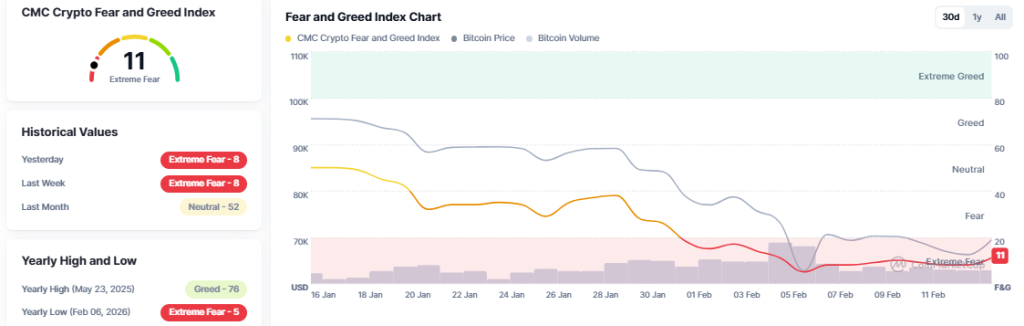
The Bitcoin price is once again sitting in “Extreme Fear.” Historically, that label has marked some of the best accumulation zones the market has ever seen. But 2026 isn’t seeing one particular event based crash. And the structure behind current selloff looks very different.

Let’s rewind. Back in 2012, price collapsed to $7.10. During the Mt. Gox crisis, it dropped to $421.55. The 2017–2018 crash bottomed at $3,129.39. The COVID panic low came in at $3,852.65. Then the FTX-driven washout pushed price to $15,642.12. Each of those moments coincided with extreme fear readings. Each time, institutional interest was minimal, and government support was nonexistent, and retail capitulation defined the mood. And eventually, rallies followed.

Extreme Fear Then and Now

Fast forward to the 2026 crash. A low of $60,001.01 on Coinbase has printed in February while sentiment sits in the same “Extreme Fear” zone.
Bitcoin Price in Extreme Fear Zone, But Is This Time Different?

On paper, that sounds familiar. Historically, fear extremes have aligned with major bottoms on the Bitcoin price chart. But here’s the complication: the market today is saturated with institutional flows, ETF structures, and macro-driven liquidity cycles.

This isn’t just retail panic anymore. The fear and greed index may reflect retail sentiment, but in a market increasingly influenced by ETF sponsors and large capital allocators, that dial might not be accurate this time.

ETFs and Macro Pressure

Well, here’s the reason why a dip has more odds. If institutions tend to scale in at discounted levels, the indicator could simply be lagging liquidation events rather than signaling recovery. In other words, extreme fear might just be a snapshot of damage already done and its not confirmation that selling pressure has ended.

Macro-driven selloffs also muddy the picture. BTC/USD doesn’t move in isolation when broader markets tighten. Risk-off environments can override sentiment-based signals, especially if forced liquidations are still unfolding.

Historically, the most powerful accumulation phases began when even dip-buyers went quiet. We’re approaching that disbelief phase, but whether it’s fully played out is another question.

Whale Activity Adds Pressure

And then there’s whale activity. A prominent known whale wallet recently deposited another 5,000 $BTC  thats worth $348.82 million into Binance. Large inflows to exchanges often precede potential distribution. That doesn’t guarantee selling, but it adds supply-side uncertainty at a fragile moment.

So what does this mean for Bitcoin price prediction narrative?

Extreme fear alone isn’t a timing tool. Until forced liquidations ease and spot demand absorbs supply without heavy reliance on sentiment gauges, the Bitcoin price remains vulnerable to another leg lower beneath $60K even if history suggests these zones eventually become accumulation opportunities.

Market Opportunity
LooksRare Logo
LooksRare Price(LOOKS)
$0,0006629
$0,0006629$0,0006629
-0,45%
USD
LooksRare (LOOKS) Live Price Chart
Disclaimer: The articles reposted on this site are sourced from public platforms and are provided for informational purposes only. They do not necessarily reflect the views of MEXC. All rights remain with the original authors. If you believe any content infringes on third-party rights, please contact service@support.mexc.com for removal. MEXC makes no guarantees regarding the accuracy, completeness, or timeliness of the content and is not responsible for any actions taken based on the information provided. The content does not constitute financial, legal, or other professional advice, nor should it be considered a recommendation or endorsement by MEXC.

You May Also Like

Shocking OpenVPP Partnership Claim Draws Urgent Scrutiny

Shocking OpenVPP Partnership Claim Draws Urgent Scrutiny

The post Shocking OpenVPP Partnership Claim Draws Urgent Scrutiny appeared on BitcoinEthereumNews.com. The cryptocurrency world is buzzing with a recent controversy surrounding a bold OpenVPP partnership claim. This week, OpenVPP (OVPP) announced what it presented as a significant collaboration with the U.S. government in the innovative field of energy tokenization. However, this claim quickly drew the sharp eye of on-chain analyst ZachXBT, who highlighted a swift and official rebuttal that has sent ripples through the digital asset community. What Sparked the OpenVPP Partnership Claim Controversy? The core of the issue revolves around OpenVPP’s assertion of a U.S. government partnership. This kind of collaboration would typically be a monumental endorsement for any private cryptocurrency project, especially given the current regulatory climate. Such a partnership could signify a new era of mainstream adoption and legitimacy for energy tokenization initiatives. OpenVPP initially claimed cooperation with the U.S. government. This alleged partnership was said to be in the domain of energy tokenization. The announcement generated considerable interest and discussion online. ZachXBT, known for his diligent on-chain investigations, was quick to flag the development. He brought attention to the fact that U.S. Securities and Exchange Commission (SEC) Commissioner Hester Peirce had directly addressed the OpenVPP partnership claim. Her response, delivered within hours, was unequivocal and starkly contradicted OpenVPP’s narrative. How Did Regulatory Authorities Respond to the OpenVPP Partnership Claim? Commissioner Hester Peirce’s statement was a crucial turning point in this unfolding story. She clearly stated that the SEC, as an agency, does not engage in partnerships with private cryptocurrency projects. This response effectively dismantled the credibility of OpenVPP’s initial announcement regarding their supposed government collaboration. Peirce’s swift clarification underscores a fundamental principle of regulatory bodies: maintaining impartiality and avoiding endorsements of private entities. Her statement serves as a vital reminder to the crypto community about the official stance of government agencies concerning private ventures. Moreover, ZachXBT’s analysis…
Share
BitcoinEthereumNews2025/09/18 02:13
MAXI DOGE Holders Diversify into $GGs for Fast-Growth 2025 Crypto Presale Opportunities

MAXI DOGE Holders Diversify into $GGs for Fast-Growth 2025 Crypto Presale Opportunities

Presale crypto tokens have become some of the most active areas in Web3, offering early access to projects that blend culture, finance, and technology. Investors are constantly searching for the best crypto presale to buy right now, comparing new token presales across different niches. MAXI DOGE has gained attention for its meme-driven energy, but early [...] The post MAXI DOGE Holders Diversify into $GGs for Fast-Growth 2025 Crypto Presale Opportunities appeared first on Blockonomi.
Share
Blockonomi2025/09/18 00:00
DeAgentAI releases new white paper, detailing $AIA token economics and staking model

DeAgentAI releases new white paper, detailing $AIA token economics and staking model

PANews reported on September 18 that the Sui ecological AI project DeAgentAI announced that it has updated its official white paper to version V2. The new white paper primarily adds "token economics" and "staking mechanisms." The token economics section details $AIA's core functions, value capture model, token distribution ratio, and detailed release rules. The staking mechanism section explains $AIA's value and how to stake it. In addition, the white paper also published security audit reports issued by multiple institutions on core components such as token contracts and cross-chain bridges.
Share
PANews2025/09/18 12:05
