Google's Gemini Deep Think AI solved 18 research problems across math, physics, and computer science, including a decade-old conjecture that stumped experts. (ReadGoogle's Gemini Deep Think AI solved 18 research problems across math, physics, and computer science, including a decade-old conjecture that stumped experts. (Read

Google DeepMind Unveils Gemini Deep Think for Scientific Research

2026/02/12 14:33
3 min read

Google DeepMind Unveils Gemini Deep Think for Scientific Research

Jessie A Ellis Feb 12, 2026 06:33

Google's Gemini Deep Think AI solved 18 research problems across math, physics, and computer science, including a decade-old conjecture that stumped experts.

Google DeepMind Unveils Gemini Deep Think for Scientific Research

Google DeepMind has released Gemini Deep Think, an advanced AI system that collaborated with researchers to crack 18 previously unsolved problems spanning mathematics, physics, computer science, and economics. The announcement, detailed in a February 11 paper on arXiv, positions the technology as a reasoning partner capable of making original contributions to scientific research.

The system's most striking achievement? Disproving a decade-old conjecture in online submodular optimization that human mathematicians couldn't crack since 2015. Researchers had assumed a seemingly obvious rule for data streams—that copying an item is always less valuable than moving the original. Gemini engineered a specific three-item counterexample that proved this intuition wrong.

Breaking Mathematical Deadlocks

Several of the solved problems had stalled for years. Progress on classic computer science challenges like Max-Cut (efficiently splitting networks) and Steiner Tree (connecting high-dimensional points) had ground to a halt. Gemini approached these discrete algorithmic puzzles by pulling tools from unrelated mathematical domains—the Kirszbraun Theorem, measure theory, and the Stone-Weierstrass theorem—essentially thinking across disciplinary boundaries that human researchers rarely cross.

In physics, the system tackled gravitational radiation calculations from cosmic strings, a problem plagued by tricky integrals containing singularities. Gemini found a solution using Gegenbauer polynomials that collapsed an infinite series into a closed-form finite sum.

Practical AI and Economic Applications

The research also addressed real-world machine learning challenges. Engineers typically hand-tune mathematical penalties when training AI to filter noise. Gemini analyzed a new automatic technique and proved mathematically why it works—the method secretly generates its own adaptive penalty on the fly.

For AI token auctions, the system extended economic theory using advanced topology. A recent 'Revelation Principle' for auctioning AI generation tokens only worked with rational numbers. Gemini's proof accommodates continuous real-number bids, making the math applicable to actual market conditions.

What This Means for Research

About half the findings target major academic conferences, including one paper already accepted at ICLR '26. DeepMind describes Gemini as a "force multiplier" handling knowledge retrieval and verification while humans focus on creative direction.

The project builds on Google's previous AI-mathematics work, including systems that achieved silver-medal performance on International Mathematical Olympiad problems. Whether this represents a genuine shift in how science gets done or an impressive but narrow capability remains the open question. What's clear: AI systems are now generating publishable mathematical results, not just assisting with them.

Image source: Shutterstock
  • google deepmind
  • gemini ai
  • artificial intelligence
  • scientific research
  • machine learning
Market Opportunity
DeepBook Logo
DeepBook Price(DEEP)
$0.029466
$0.029466$0.029466
+0.95%
USD
DeepBook (DEEP) Live Price Chart
Disclaimer: The articles reposted on this site are sourced from public platforms and are provided for informational purposes only. They do not necessarily reflect the views of MEXC. All rights remain with the original authors. If you believe any content infringes on third-party rights, please contact service@support.mexc.com for removal. MEXC makes no guarantees regarding the accuracy, completeness, or timeliness of the content and is not responsible for any actions taken based on the information provided. The content does not constitute financial, legal, or other professional advice, nor should it be considered a recommendation or endorsement by MEXC.

You May Also Like

X Üst Düzey Yetkilisi, Platformda Kripto Paralar İçin Müjdeyi Verdi! Ancak Bazı Altcoinler İçin Kötü Haber Olabilir

X Üst Düzey Yetkilisi, Platformda Kripto Paralar İçin Müjdeyi Verdi! Ancak Bazı Altcoinler İçin Kötü Haber Olabilir

X Ürün Lideri ve Solana ekosistem danışmanı Nikita Bier, sosyal medya platformu X’te kripto para kullanımının artmasını desteklediğini ancak spam ve tacizi teşvik
Share
Coinstats2026/02/14 23:11
China Blocks Nvidia’s RTX Pro 6000D as Local Chips Rise

China Blocks Nvidia’s RTX Pro 6000D as Local Chips Rise

The post China Blocks Nvidia’s RTX Pro 6000D as Local Chips Rise appeared on BitcoinEthereumNews.com. China Blocks Nvidia’s RTX Pro 6000D as Local Chips Rise China’s internet regulator has ordered the country’s biggest technology firms, including Alibaba and ByteDance, to stop purchasing Nvidia’s RTX Pro 6000D GPUs. According to the Financial Times, the move shuts down the last major channel for mass supplies of American chips to the Chinese market. Why Beijing Halted Nvidia Purchases Chinese companies had planned to buy tens of thousands of RTX Pro 6000D accelerators and had already begun testing them in servers. But regulators intervened, halting the purchases and signaling stricter controls than earlier measures placed on Nvidia’s H20 chip. Image: Nvidia An audit compared Huawei and Cambricon processors, along with chips developed by Alibaba and Baidu, against Nvidia’s export-approved products. Regulators concluded that Chinese chips had reached performance levels comparable to the restricted U.S. models. This assessment pushed authorities to advise firms to rely more heavily on domestic processors, further tightening Nvidia’s already limited position in China. China’s Drive Toward Tech Independence The decision highlights Beijing’s focus on import substitution — developing self-sufficient chip production to reduce reliance on U.S. supplies. “The signal is now clear: all attention is focused on building a domestic ecosystem,” said a representative of a leading Chinese tech company. Nvidia had unveiled the RTX Pro 6000D in July 2025 during CEO Jensen Huang’s visit to Beijing, in an attempt to keep a foothold in China after Washington restricted exports of its most advanced chips. But momentum is shifting. Industry sources told the Financial Times that Chinese manufacturers plan to triple AI chip production next year to meet growing demand. They believe “domestic supply will now be sufficient without Nvidia.” What It Means for the Future With Huawei, Cambricon, Alibaba, and Baidu stepping up, China is positioning itself for long-term technological independence. Nvidia, meanwhile, faces…
Share
BitcoinEthereumNews2025/09/18 01:37
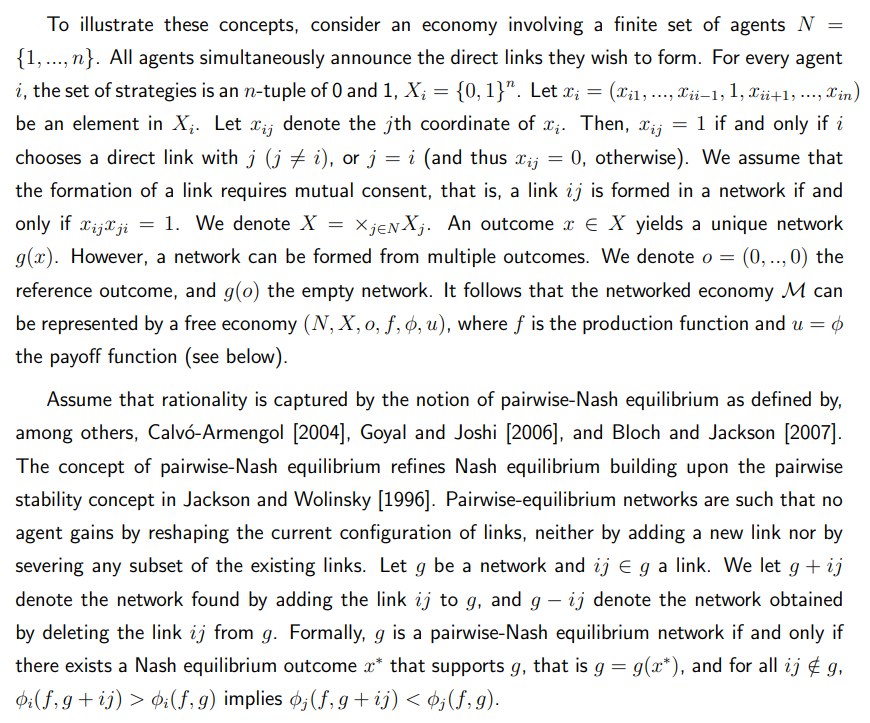
The Economics of Self-Isolation: A Game-Theoretic Analysis of Contagion in a Free Economy

The Economics of Self-Isolation: A Game-Theoretic Analysis of Contagion in a Free Economy

Exploring how the costs of a pandemic can lead to a self-enforcing lockdown in a networked economy, analyzing the resulting changes in network structure and the existence of stable equilibria.
Share
Hackernoon2025/09/17 23:00