BitcoinWorld THB Currency: Remarkable Political Stability Bolsters Thai Baht According to MUFG Analysis BANGKOK, Thailand – Political stability continues to provideBitcoinWorld THB Currency: Remarkable Political Stability Bolsters Thai Baht According to MUFG Analysis BANGKOK, Thailand – Political stability continues to provide

THB Currency: Remarkable Political Stability Bolsters Thai Baht According to MUFG Analysis

2026/02/11 08:55
5 min read
THB currency stability supported by Thailand's political environment and economic factors

BitcoinWorld

THB Currency: Remarkable Political Stability Bolsters Thai Baht According to MUFG Analysis

BANGKOK, Thailand – Political stability continues to provide crucial support for the Thai baht (THB) currency, according to comprehensive analysis from Mitsubishi UFJ Financial Group (MUFG). The financial institution’s latest assessment reveals how Thailand’s evolving political landscape directly influences currency valuation and investor confidence in Southeast Asia’s second-largest economy.

THB Currency Performance and Political Stability Correlation

MUFG’s currency analysts demonstrate a clear correlation between Thailand’s political developments and THB performance. The Thai baht has maintained relative strength against regional peers despite global economic uncertainties. This resilience stems primarily from improved political predictability following recent elections and government formation. Furthermore, institutional continuity has provided foreign investors with increased confidence in Thailand’s economic management.

Historical data reveals that periods of political transition typically correlate with THB volatility. However, the current administration has established policy consistency that supports currency stability. The Bank of Thailand’s monetary policy decisions now operate within a more predictable political framework. Consequently, interest rate adjustments and foreign exchange interventions gain enhanced effectiveness when political uncertainty diminishes.

Economic Mechanisms Behind Political Support for THB

Political stability influences the Thai baht through multiple economic channels. First, predictable governance reduces risk premiums that foreign investors demand for Thai assets. Second, consistent policymaking enables more effective implementation of economic stimulus measures. Third, reduced political friction facilitates crucial infrastructure projects that boost long-term economic growth.

MUFG’s analysis identifies three primary transmission mechanisms:

  • Foreign Direct Investment (FDI): Stable politics increases Thailand’s attractiveness for manufacturing and technology investments
  • Tourism Recovery: Predictable policies support tourism sector revival, generating substantial foreign exchange
  • Export Competitiveness: Currency stability helps Thai exporters manage pricing and contract negotiations
THB Performance Against Major Currencies (Recent Quarter)
Currency PairTHB ChangePrimary Driver
THB/USD+2.3%Political stability, tourism recovery
THB/EUR+1.8%Export growth, EU trade relations
THB/JPY+3.1%Tourist arrivals, manufacturing investment
THB/CNY+0.9%Regional supply chain integration

Expert Analysis from MUFG’s Currency Strategy Team

MUFG’s currency strategists emphasize that Thailand’s political normalization follows a decade of periodic disruptions. The current government has maintained fiscal discipline while implementing targeted economic support measures. This balanced approach prevents excessive inflation that could undermine THB purchasing power. Additionally, Thailand’s current account surplus provides fundamental support for the baht regardless of political developments.

The analysis references Thailand’s foreign exchange reserves, which remain substantial at approximately $220 billion. These reserves provide the Bank of Thailand with significant capacity to manage THB volatility during global financial stress. Moreover, Thailand’s relatively low external debt reduces vulnerability to currency crises that sometimes affect emerging markets during political transitions.

Comparative Regional Analysis and THB Positioning

Within Southeast Asia, Thailand’s political stability contrasts with some neighboring countries experiencing greater uncertainty. This relative advantage has positioned THB as a regional safe haven during periods of market stress. Compared to Indonesia’s rupiah and the Philippine peso, the Thai baht has demonstrated lower volatility throughout recent global financial turbulence.

Thailand’s manufacturing sector benefits particularly from currency stability. Automotive and electronics exporters can negotiate longer-term contracts with international buyers when THB fluctuations remain predictable. Furthermore, Thailand’s vital tourism industry recovers more rapidly when political headlines don’t discourage international visitors.

Regional currency performance data reveals:

  • THB volatility measures 15% lower than regional average
  • Thai bond market inflows increased 22% year-over-year
  • Currency swap utilization declined 18% indicating reduced hedging needs

Historical Context and Future Projections

Thailand’s political landscape has evolved significantly since the 2014 military intervention. The transition to elected government, while maintaining some institutional continuity, has created conditions favorable for currency stability. MUFG’s analysis examines five distinct political periods since 2010, correlating each with THB performance metrics.

Looking forward, several factors could influence the relationship between politics and THB valuation. Upcoming local elections, potential constitutional reforms, and international trade negotiations all represent variables that currency markets will monitor closely. However, Thailand’s established bureaucratic institutions provide continuity that often mitigates political transition effects on economic management.

Conclusion

Political stability serves as a fundamental pillar supporting THB currency strength according to MUFG analysis. The Thai baht benefits from predictable policymaking, consistent economic management, and reduced investor uncertainty. While global factors inevitably influence currency valuations, Thailand’s domestic political environment provides crucial stability that distinguishes THB from many regional peers. Continued political normalization should maintain this supportive backdrop for Thailand’s currency and broader economic prospects.

FAQs

Q1: How does political stability specifically support the THB currency?
Political stability reduces investor risk premiums, enables consistent economic policymaking, and supports tourism and foreign investment—all generating foreign exchange demand that strengthens THB.

Q2: What metrics does MUFG use to measure political stability’s impact on THB?
MUFG analyzes currency volatility indices, foreign investment flows, bond market performance, tourism recovery rates, and export contract patterns relative to political developments.

Q3: How does THB performance compare to other Southeast Asian currencies?
The Thai baht has demonstrated lower volatility and relative strength against regional peers, partially attributable to Thailand’s comparatively stable political environment.

Q4: Could political changes still negatively impact THB in the future?
While current conditions support THB, significant political upheaval or policy discontinuity could increase currency volatility, though Thailand’s strong reserves provide substantial缓冲.

Q5: What other factors besides politics influence THB valuation?
Tourism recovery, export performance, interest rate differentials, global risk sentiment, and regional economic integration all significantly impact THB alongside political factors.

This post THB Currency: Remarkable Political Stability Bolsters Thai Baht According to MUFG Analysis first appeared on BitcoinWorld.

Disclaimer: The articles reposted on this site are sourced from public platforms and are provided for informational purposes only. They do not necessarily reflect the views of MEXC. All rights remain with the original authors. If you believe any content infringes on third-party rights, please contact service@support.mexc.com for removal. MEXC makes no guarantees regarding the accuracy, completeness, or timeliness of the content and is not responsible for any actions taken based on the information provided. The content does not constitute financial, legal, or other professional advice, nor should it be considered a recommendation or endorsement by MEXC.
Tags:

You May Also Like

Bitcoin Hyper Not Far from $20M, Whales Keep Buying: See What This $BTC Layer-2 Plans
Bitcoin Hyper Not Far from $20M, Whales Keep Buying: See What This $BTC Layer-2 Plans

To the uninitiated, Bitcoin and crypto are synonymous – and it’s only fair, given that the granddaddy of all crypto has been the face of the industry ever since it burst onto the scene a few years back. Since 2020, Bitcoin has generated over 1,500% in returns. Basically, crypto is so much about Bitcoin. All […]
Share
Bitcoinist2025/09/22 16:37
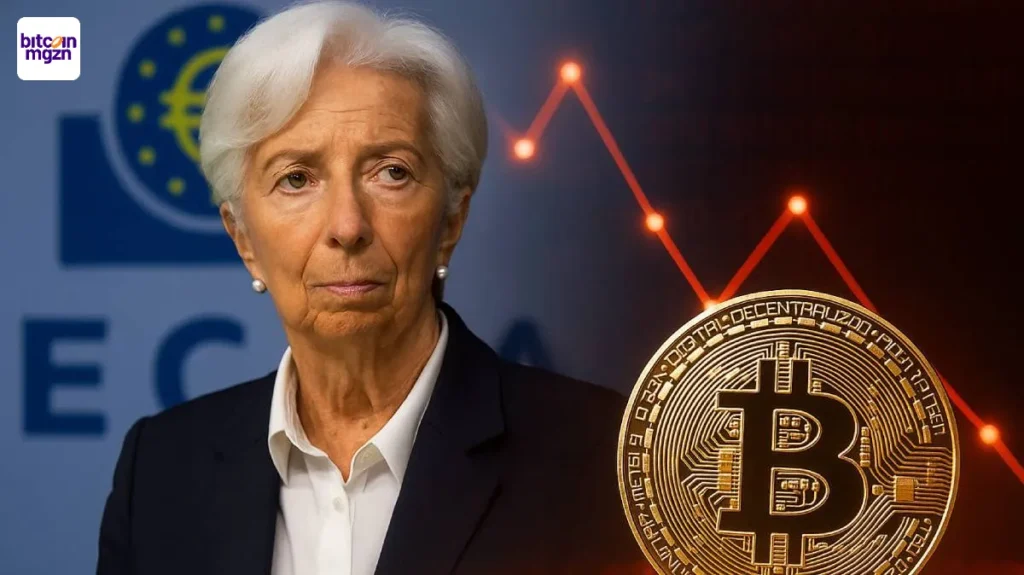
ECB-president hernieuwt aanval op Bitcoin terwijl euro daalt

ECB-president hernieuwt aanval op Bitcoin terwijl euro daalt

Snelle crypto updates? Connect op Instagram! Check onze Instagram   ECB-president Christine Lagarde noemt Bitcoin waardeloos en waarschuwt voor zijn speculatieve aard. Haar uitspraken komen op een moment dat DeFi groeit en de euro onder druk staat, wat de discussie over geld en controle opnieuw tot leven brengt. ECB houdt vast aan kritiek op Bitcoin en DeFi De Europese Centrale Bank (ECB) blijft vasthouden aan haar scherpe toon over Bitcoin. Volgens president Christine Lagarde ontbreekt de munt het fundament dat echt geld kenmerkt. Ze noemt het een speculatief middel zonder onderliggende waarde, en benadrukt dat de ECB het publieke vertrouwen in geld moet beschermen. Terwijl de digitale economie zich steeds meer richting decentralisatie beweegt, probeert de bank haar rol als stabiele pijler te behouden. ECB (European Central Bank) De European Central Bank (ECB) is de centrale bank van de eurozone en bepaalt samen met de nationale banken het monetaire beleid voor de euro. Ze houdt de inflatie in de gaten, bepaalt de rente en zorgt voor stabiliteit van het financiële systeem. In de cryptowereld speelt de ECB vooral een rol met het onderzoek en de voorbereidingen voor een digitale euro, een eigen centrale bank digitale munt (CBDC). Daarmee wil de bank inspelen op de groei van digitaal geld en alternatieven zoals stablecoins. Voor de crypto-industrie is dit belangrijk omdat een digitale euro de concurrentie en het speelveld voor private stablecoins kan veranderen. De waarschuwing van Lagarde past in een bredere strategie van de ECB. De opkomst van decentrale financiële systemen (DeFi) wordt gezien als een uitdaging voor de invloed van centrale banken. In die waarschuwing lijkt ook iets van zelfbescherming door te klinken: het behoud van macht over monetair beleid. Voorstanders van Bitcoin wijzen juist op de kracht van schaarste, transparantie en onafhankelijkheid; eigenschappen die fiatgeld in hun ogen steeds meer verliest. “How many bitcoin do you own?” That’s how it starts, a stupid question from the host. From there, it goes downhill fast. Christine Lagarde repeats every tired anti-bitcoin cliché the ECB has ever pushed. Let’s go… 1️⃣ “Bitcoin has no intrinsic value.” Neither does fiat.… pic.twitter.com/uMqtEHvkD0 — Eli Nagar (@EliNagarBrr) October 7, 2025 De euro verzwakt terwijl crypto aan invloed wint Ondertussen verliest de euro langzaam maar zeker aan koopkracht. Sinds de invoering in 2002 is de munt ruim veertig procent van haar reële waarde kwijtgeraakt. Dat voedt de twijfel over de houdbaarheid van het huidige fiatstelsel en vergroot de interesse in alternatieven zoals Bitcoin en andere cryptovaluta. Binnen de Europese cryptogemeenschap worden de woorden van de ECB dan ook met de nodige scepsis onthaald. Been 22 years, physical $Euro coins and banknotes entered circulation on January 1st 2002. Since then, this fiasco lost 40% of its buying power according to “official” stats. Won’t even mention real stats, or you’d be dumping ALL your Eurobolivars for #Bitcoin right now. pic.twitter.com/Rp3KinVfPm — Vandelay ₿TC Industries ⚡ (@VandelayBTC) January 3, 2024 DeFi-platforms en stablecoins winnen terrein in Europa, juist omdat ze nieuwe mogelijkheden bieden voor rendement en autonomie. Waar Lagarde waarschuwt voor volatiliteit, zien veel gebruikers vooral vrijheid in een systeem dat zich niets aantrekt van centrale banken. De groei van DeFi laat zien dat vertrouwen niet alleen via instituties ontstaat, maar ook via technologie. Monetaire controle en vertrouwen in het digitale tijdperk De standpunten van de ECB leggen een oud spanningsveld bloot: de strijd tussen stabiliteit en vrijheid. Aan de ene kant verdedigt de bank haar rol als bewaker van orde, aan de andere kant tonen cryptomarkten dat vertrouwen ook buiten traditionele kanalen kan bestaan. Terwijl de ECB pleit voor zekerheid en voorspelbaarheid, zoeken investeerders steeds vaker transparantie en zelfbeschikking. Lagarde’s uitspraken passen in een wereldwijde trend waarin centrale banken proberen hun gezag te behouden in een economie die snel verandert. Toch klinkt steeds luider de vraag of die vorm van controle nog houdbaar is. Nieuwe technologieën maken directe waardeoverdracht mogelijk,zonder tussenkomst van banken. Dat idee wringt natuurlijk met de kern van het bestaande financiële systeem. Exactly. It was narrative management. They feel threatened. That’s why real questions about monetary policy, inflation, and accountability never make it to the script. — Eli Nagar (@EliNagarBrr) October 8, 2025 De toekomst van waarde: centraal of gedecentraliseerd? De discussie tussen de ECB en de cryptowereld draait om meer dan geld. Het gaat om vertrouwen, transparantie en macht over waarde. Zolang de euro verder verzwakt en decentrale technologieën blijven groeien, lijkt de kloof tussen centrale banken en de cryptosector alleen maar groter te worden. Hoeveel invloed de ECB kan behouden, hangt af van haar vermogen zich aan te passen aan dit nieuwe tijdperk. De strijd om waarde is niet enkel economisch, maar ook ideologisch. In dat licht voelt de opkomst van Bitcoin minder als een bedreiging, en meer als een logisch gevolg van de zoektocht naar onafhankelijkheid in geld. Koop je Bitcoin via Best Wallet Best wallet is een topklasse crypto wallet waarmee je anoniem crypto kan kopen. Met meer dan 60 chains gesupport kan je al je main crypto coins aanschaffen via Best Wallet. Best wallet - betrouwbare en anonieme wallet Best wallet - betrouwbare en anonieme wallet Meer dan 60 chains beschikbaar voor alle crypto Vroege toegang tot nieuwe projecten Hoge staking belongingen Lage transactiekosten Best wallet review Koop nu via Best Wallet Let op: cryptocurrency is een zeer volatiele en ongereguleerde investering. Doe je eigen onderzoek. Het bericht ECB-president hernieuwt aanval op Bitcoin terwijl euro daalt is geschreven door Sebastiaan Krijnen en verscheen als eerst op Bitcoinmagazine.nl.
Share
Coinstats2025/10/11 03:16
What SBI Really Owns in Ripple May Surprise XRP Investors

What SBI Really Owns in Ripple May Surprise XRP Investors

The post What SBI Really Owns in Ripple May Surprise XRP Investors appeared on BitcoinEthereumNews.com. SBI Holdings Chairman Yoshitaka Kitao has confirmed that
Share
BitcoinEthereumNews2026/02/16 16:14