The post S&P 500 at 7000 is a valuation test, not a liquidity problem appeared on BitcoinEthereumNews.com. Valuation test The rebound from last week’s drawdown The post S&P 500 at 7000 is a valuation test, not a liquidity problem appeared on BitcoinEthereumNews.com. Valuation test The rebound from last week’s drawdown

S&P 500 at 7000 is a valuation test, not a liquidity problem

Valuation test

The rebound from last week’s drawdown never quite shook the sense that it was being supported by borrowed conviction. The S&P 500 once again tested near the 7000 level (6986 as the high watermark) and failed, despite a macro backdrop that would normally be interpreted as supportive of risk. Weak retail sales and softer small-business sentiment reinforced expectations for Federal Reserve easing, pushing rate-cut pricing toward roughly 60 basis points for the year and pulling Treasury yields lower in a clean bull flattening. That impulse worked well for bonds. It did not translate cleanly into equities.

This is an important distinction. The market is no longer responding uniformly to the idea that weaker data automatically lifts stocks. Lower yields are helping duration assets at the margin, but equity investors appear more selective and more fragile in their conviction. Early gains faded, Nasdaq struggled to hold technical support, and leadership narrowed as defensives and value-oriented segments quietly outperformed growth-heavy indices.

Beneath the surface, anxiety around AI-related headline risk is clearly elevated. Recent selling pressure has not been driven by material changes in near-term fundamentals, but by sensitivity to perceived long-term disruption risk. We observed this first in SaaS, then in insurance, and now in parts of financial services, particularly wealth and brokerage firms. Moves in several of these stocks appear disproportionate to the actual news flow, suggesting positioning and narrative risk are doing more work than detailed fundamental reassessment.

Software stabilization later in the session was constructive, but the broader message remains that investors are quick to de-risk first and evaluate second. Retail flows continue to show dip-buying behaviour, which has helped cushion downside risks, but that support has not yet been sufficient to push the index through key resistance. The Dow closing at record highs while the Nasdaq lagged is a clear signal of a more defensive tilt rather than renewed enthusiasm for growth beta.

Technically, the S&P 500 remains capped near 7000, an area that has become a meaningful gamma and positioning threshold. Until the market can establish acceptance above that level, rallies are likely to be treated as tactical rather than structural. Volatility measures have stabilized, but they are not signalling an all-clear. This market is still debating which narrative deserves the premium.

The larger and more consequential issue sits beyond the daily data and headlines. Capex guidance from the hyperscalers has reset expectations in a way that directly challenges the equity support framework of recent years. Aggregate 2026 capex projections across the major platforms now approach $650 billion to $740 billion, implying growth far in excess of prior consensus and absorbing all free cash flow essentially. The implication is straightforward. Buybacks, a critical and underappreciated source of index-level support, are likely to diminish materially.

AI-related uncertainty has heightened investor sensitivity, leading to faster de-risking and reduced tolerance for headline risk.

The key question that first surfaced in 2024 has never really gone away. Is generative AI ultimately a productivity engine, or does it risk becoming a capital sinkhole whose returns struggle to justify the scale of investment required? That debate was never resolved. Instead, the numbers simply kept getting larger.

It is now back at the center of market pricing. Capital expenditure guidance across the hyperscaler complex has reset expectations in a way that forces a more uncomfortable conversation around return on invested capital. Despite broad-based earnings growth, equity markets have been notably unresponsive. Alphabet delivered its strongest Search performance in three years and its best Cloud results in four. Amazon posted its fastest year-over-year AWS growth in roughly three years. Microsoft reported Azure growth of nearly 37 percent. Meta delivered roughly 24 percent topline growth. None were rewarded.

That response is telling. The issue is not demand. It is capital intensity.

If aggregate AI-related capex approaches $700 billion, as current guidance implies, it would effectively absorb all hyperscaler free cash flow. That level of investment would place the AI buildout close to the peak investment impulse observed in the late 1990s, when capital expenditure reached roughly 1.4 percent of GDP. While still below the scale of the Industrial Revolution, it is large enough to warrant a reassessment of capital returns, balance-sheet flexibility, and shareholder support mechanisms.

The market’s anxiety is therefore understandable. Buybacks have quietly been among the most important stabilizers of index-level performance over the past cycle. A sustained shift from capital return to capital absorption materially changes that dynamic.

The debate over the internal rate of return will likely persist for several more years, particularly as contractual commitments begin to mature and the economics of the AI ecosystem are tested under real cash-flow constraints. But even before those outcomes are clear, the scale of announced spending has reopened a critical fault line. Investors are no longer debating whether AI is transformative. They are debating whether the cost of building it is becoming more important than the promise of what it might deliver.

Credit markets are beginning to reflect this uncertainty. The sector has begun trading with a higher risk premium relative to the bond market, a notable shift given how tightly tech credit had traded for much of the past decade. As issuance accelerates and balance sheets absorb continued investment, investors are demanding greater compensation for uncertainty regarding future cash flows.

Elsewhere, cross-asset signals were broadly consistent with a cautious macro read. The dollar softened modestly; gold remained well supported near $ 5,000; silver held steady; crude prices drifted lower despite geopolitical headlines; and bitcoin failed to fully recover from earlier weakness, although leverage conditions have normalized somewhat.

Near-term attention will turn, as usual, to payrolls, though recent changes to the birth/death assumptions raise the risk of increased noise and reduced signal quality in the headline data. But the market’s bigger question is not about one data point. It concerns whether easier financial conditions alone are sufficient to justify higher multiples at a time when the index’s largest constituents are shifting from capital return to capital absorption. Until that tension is resolved, 7000 remains less a launchpad and more a ceiling.

Source: https://www.fxstreet.com/news/sp-500-at-7000-is-a-valuation-test-not-a-liquidity-problem-202602102352

Market Opportunity
Notcoin Logo
Notcoin Price(NOT)
$0.0004083
$0.0004083$0.0004083
+0.51%
USD
Notcoin (NOT) Live Price Chart
Disclaimer: The articles reposted on this site are sourced from public platforms and are provided for informational purposes only. They do not necessarily reflect the views of MEXC. All rights remain with the original authors. If you believe any content infringes on third-party rights, please contact service@support.mexc.com for removal. MEXC makes no guarantees regarding the accuracy, completeness, or timeliness of the content and is not responsible for any actions taken based on the information provided. The content does not constitute financial, legal, or other professional advice, nor should it be considered a recommendation or endorsement by MEXC.

You May Also Like

Bitcoin Hyper Not Far from $20M, Whales Keep Buying: See What This $BTC Layer-2 Plans

Bitcoin Hyper Not Far from $20M, Whales Keep Buying: See What This $BTC Layer-2 Plans

To the uninitiated, Bitcoin and crypto are synonymous – and it’s only fair, given that the granddaddy of all crypto has been the face of the industry ever since it burst onto the scene a few years back. Since 2020, Bitcoin has generated over 1,500% in returns. Basically, crypto is so much about Bitcoin. All […]
Share
Bitcoinist2025/09/22 16:37
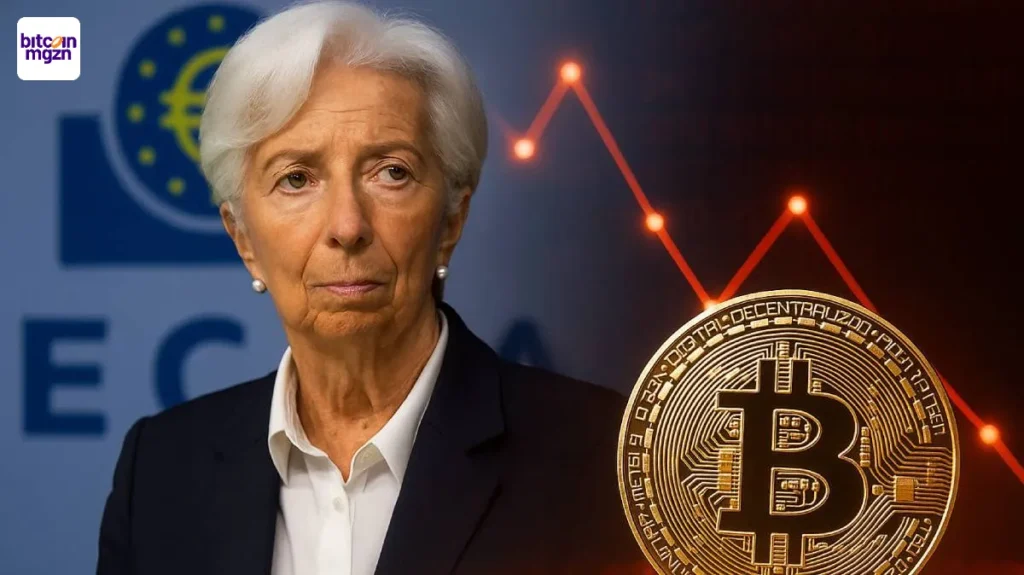
ECB-president hernieuwt aanval op Bitcoin terwijl euro daalt

ECB-president hernieuwt aanval op Bitcoin terwijl euro daalt

Snelle crypto updates? Connect op Instagram! Check onze Instagram   ECB-president Christine Lagarde noemt Bitcoin waardeloos en waarschuwt voor zijn speculatieve aard. Haar uitspraken komen op een moment dat DeFi groeit en de euro onder druk staat, wat de discussie over geld en controle opnieuw tot leven brengt. ECB houdt vast aan kritiek op Bitcoin en DeFi De Europese Centrale Bank (ECB) blijft vasthouden aan haar scherpe toon over Bitcoin. Volgens president Christine Lagarde ontbreekt de munt het fundament dat echt geld kenmerkt. Ze noemt het een speculatief middel zonder onderliggende waarde, en benadrukt dat de ECB het publieke vertrouwen in geld moet beschermen. Terwijl de digitale economie zich steeds meer richting decentralisatie beweegt, probeert de bank haar rol als stabiele pijler te behouden. ECB (European Central Bank) De European Central Bank (ECB) is de centrale bank van de eurozone en bepaalt samen met de nationale banken het monetaire beleid voor de euro. Ze houdt de inflatie in de gaten, bepaalt de rente en zorgt voor stabiliteit van het financiële systeem. In de cryptowereld speelt de ECB vooral een rol met het onderzoek en de voorbereidingen voor een digitale euro, een eigen centrale bank digitale munt (CBDC). Daarmee wil de bank inspelen op de groei van digitaal geld en alternatieven zoals stablecoins. Voor de crypto-industrie is dit belangrijk omdat een digitale euro de concurrentie en het speelveld voor private stablecoins kan veranderen. De waarschuwing van Lagarde past in een bredere strategie van de ECB. De opkomst van decentrale financiële systemen (DeFi) wordt gezien als een uitdaging voor de invloed van centrale banken. In die waarschuwing lijkt ook iets van zelfbescherming door te klinken: het behoud van macht over monetair beleid. Voorstanders van Bitcoin wijzen juist op de kracht van schaarste, transparantie en onafhankelijkheid; eigenschappen die fiatgeld in hun ogen steeds meer verliest. “How many bitcoin do you own?” That’s how it starts, a stupid question from the host. From there, it goes downhill fast. Christine Lagarde repeats every tired anti-bitcoin cliché the ECB has ever pushed. Let’s go… 1️⃣ “Bitcoin has no intrinsic value.” Neither does fiat.… pic.twitter.com/uMqtEHvkD0 — Eli Nagar (@EliNagarBrr) October 7, 2025 De euro verzwakt terwijl crypto aan invloed wint Ondertussen verliest de euro langzaam maar zeker aan koopkracht. Sinds de invoering in 2002 is de munt ruim veertig procent van haar reële waarde kwijtgeraakt. Dat voedt de twijfel over de houdbaarheid van het huidige fiatstelsel en vergroot de interesse in alternatieven zoals Bitcoin en andere cryptovaluta. Binnen de Europese cryptogemeenschap worden de woorden van de ECB dan ook met de nodige scepsis onthaald. Been 22 years, physical $Euro coins and banknotes entered circulation on January 1st 2002. Since then, this fiasco lost 40% of its buying power according to “official” stats. Won’t even mention real stats, or you’d be dumping ALL your Eurobolivars for #Bitcoin right now. pic.twitter.com/Rp3KinVfPm — Vandelay ₿TC Industries ⚡ (@VandelayBTC) January 3, 2024 DeFi-platforms en stablecoins winnen terrein in Europa, juist omdat ze nieuwe mogelijkheden bieden voor rendement en autonomie. Waar Lagarde waarschuwt voor volatiliteit, zien veel gebruikers vooral vrijheid in een systeem dat zich niets aantrekt van centrale banken. De groei van DeFi laat zien dat vertrouwen niet alleen via instituties ontstaat, maar ook via technologie. Monetaire controle en vertrouwen in het digitale tijdperk De standpunten van de ECB leggen een oud spanningsveld bloot: de strijd tussen stabiliteit en vrijheid. Aan de ene kant verdedigt de bank haar rol als bewaker van orde, aan de andere kant tonen cryptomarkten dat vertrouwen ook buiten traditionele kanalen kan bestaan. Terwijl de ECB pleit voor zekerheid en voorspelbaarheid, zoeken investeerders steeds vaker transparantie en zelfbeschikking. Lagarde’s uitspraken passen in een wereldwijde trend waarin centrale banken proberen hun gezag te behouden in een economie die snel verandert. Toch klinkt steeds luider de vraag of die vorm van controle nog houdbaar is. Nieuwe technologieën maken directe waardeoverdracht mogelijk,zonder tussenkomst van banken. Dat idee wringt natuurlijk met de kern van het bestaande financiële systeem. Exactly. It was narrative management. They feel threatened. That’s why real questions about monetary policy, inflation, and accountability never make it to the script. — Eli Nagar (@EliNagarBrr) October 8, 2025 De toekomst van waarde: centraal of gedecentraliseerd? De discussie tussen de ECB en de cryptowereld draait om meer dan geld. Het gaat om vertrouwen, transparantie en macht over waarde. Zolang de euro verder verzwakt en decentrale technologieën blijven groeien, lijkt de kloof tussen centrale banken en de cryptosector alleen maar groter te worden. Hoeveel invloed de ECB kan behouden, hangt af van haar vermogen zich aan te passen aan dit nieuwe tijdperk. De strijd om waarde is niet enkel economisch, maar ook ideologisch. In dat licht voelt de opkomst van Bitcoin minder als een bedreiging, en meer als een logisch gevolg van de zoektocht naar onafhankelijkheid in geld. Koop je Bitcoin via Best Wallet Best wallet is een topklasse crypto wallet waarmee je anoniem crypto kan kopen. Met meer dan 60 chains gesupport kan je al je main crypto coins aanschaffen via Best Wallet. Best wallet - betrouwbare en anonieme wallet Best wallet - betrouwbare en anonieme wallet Meer dan 60 chains beschikbaar voor alle crypto Vroege toegang tot nieuwe projecten Hoge staking belongingen Lage transactiekosten Best wallet review Koop nu via Best Wallet Let op: cryptocurrency is een zeer volatiele en ongereguleerde investering. Doe je eigen onderzoek. Het bericht ECB-president hernieuwt aanval op Bitcoin terwijl euro daalt is geschreven door Sebastiaan Krijnen en verscheen als eerst op Bitcoinmagazine.nl.
Share
Coinstats2025/10/11 03:16
What SBI Really Owns in Ripple May Surprise XRP Investors

What SBI Really Owns in Ripple May Surprise XRP Investors

The post What SBI Really Owns in Ripple May Surprise XRP Investors appeared on BitcoinEthereumNews.com. SBI Holdings Chairman Yoshitaka Kitao has confirmed that
Share
BitcoinEthereumNews2026/02/16 16:14