Bitcoin plunged below $115,000 on Friday as renewed political pressure from former President Donald Trump unsettled markets. The top cryptocurrency dropped to $113,164, its lowest in weeks, triggering over $200 million in liquidations from leveraged long positions and raising fresh concerns over investor confidence. The drop comes amid escalating geopolitical tension. Trump Orders Submarine Move Amid Russia Tensions, Bitcoin Reacts to Risk Fears Trump announced the repositioning of two U.S. nuclear submarines in response to comments by former Russian President Dmitry Medvedev, now deputy chairman of Russia’s Security Council. Medvedev had criticized Trump’s ultimatum that Russia end its conflict with Ukraine within ten days, calling it “a step towards war.” “Based on the highly provocative statements of the former president of Russia, Dmitry Medvedev, […] I have ordered two nuclear submarines to be positioned in the appropriate regions,” Trump wrote on Truth Social. He added that “Words are very important and can often lead to unintended consequences. I hope this will not be one of those instances.” Bitcoin’s price decline followed these remarks from Trump, reflecting broader investor anxiety as tensions between nuclear powers rise. Friday’s market reaction also follows Trump’s public attacks on U.S. economic institutions. The former president accused Erika McEntarfer, Commissioner of Labor Statistics, of manipulating jobs data ahead of the 2024 election to help Kamala Harris. He called for her immediate removal and claimed the Bureau had “faked the jobs numbers” by overstating employment growth. “We need accurate Jobs Numbers,” Trump wrote. “She will be replaced with someone much more competent and qualified.” He also turned his attention to the Federal Reserve, sharply criticizing its chair, Jerome Powell. Trump claimed the Fed’s pre-election rate cuts were politically motivated and called Powell “a stubborn MORON.” “Jerome ‘Too Late’ Powell must substantially lower interest rates NOW,” he wrote. “IF HE CONTINUES TO REFUSE, THE BOARD SHOULD ASSUME CONTROL AND DO WHAT EVERYONE KNOWS HAS TO BE DONE!” While presidents traditionally avoid interfering with central bank decisions, Trump urged Fed officials to overrule Powell and slash rates to support what he described as a booming economy under his leadership. The Fed has held rates steady for five consecutive meetings, citing inflation concerns. But Trump, in a flurry of posts, accused Powell of damaging the economy and failing to act on the consequences of new tariffs. Fed Governor Adriana Kugler Resigns, Opening Key Seat for Trump Amid the political pressure, Federal Reserve Governor Adriana Kugler announced her resignation on Friday, creating a key vacancy at the central bank. Kugler, a Biden appointee, joined the Fed’s Board of Governors in 2023 and was a permanent voting member on the Federal Open Market Committee. JUST IN: 🇺🇸 Federal Reserve Governor Adriana Kulger steps down from the Fed 👀 pic.twitter.com/QP8SoiX0fJ — Bitcoin Magazine (@BitcoinMagazine) August 1, 2025 She did not give a reason for her early departure but stated she would return to Georgetown University in the fall. “It has been an honor of a lifetime to serve,” Kugler wrote in a letter addressed to Trump. Her exit, nearly 18 months before her term was set to expire, clears a path for Trump to nominate a replacement. Kugler had recently voiced support for keeping rates steady, pending a clearer picture of how tariffs are affecting inflation. She was absent during this week’s policy vote, where two Trump-appointed members dissented, favoring a rate cut. Fed Chair Jerome Powell thanked Kugler for her service, noting her contributions brought “impressive experience and academic insights” to the Board. Bitcoin Slides as Political Tensions and Market Jitters Weigh on Sentiment Bitcoin slipped further on Friday as rising geopolitical tensions and cautious investor sentiment added pressure to already fragile markets. The cryptocurrency is now trading just 7% below its all-time high of $123,182 set in mid-July , though momentum in derivatives markets is showing signs of cooling. Notably, the monthly futures premium for Bitcoin has narrowed to 6%, down from earlier highs this month. Analysts say the drop reflects reduced appetite for leveraged long positions, suggesting traders are becoming more risk-averse despite ongoing institutional interest. Source: Laevitas.ch Bitcoin’s recent price behavior has also contributed to uncertainty. Rather than acting as a hedge, the asset has moved in step with tech stocks, exposing it to broader macro and political shocks. With tensions between the U.S. and Russia flaring again this week, risk appetite appears to be shifting. The political back-and-forth added to a market already grappling with trade friction and weak economic data. While gold has remained stable around $3,350, it has offered little relief for those hoping Bitcoin would act as a safe-haven alternative. Traders appear to be rotating into cash and short-term government bonds as volatility increases. Despite the decline, Bitcoin remains well above its January levels. However, with global uncertainty rising, traders may remain cautious in the short term. Amid the broader pullback, some investors are reassessing Bitcoin’s long-term role. Bridgewater Associates founder Ray Dalio, previously skeptical, has updated his outlook . Speaking on a recent podcast, Dalio recommended allocating up to 15% of a portfolio to gold or Bitcoin as a hedge against U.S. debt and inflation. “The U.S. is entering a debt doom loop,” he said, referencing Treasury forecasts of $12 trillion in new debt within the next year. Dalio noted that while Bitcoin remains volatile and faces regulatory questions, its role as a store of value is becoming harder to ignore.Bitcoin plunged below $115,000 on Friday as renewed political pressure from former President Donald Trump unsettled markets. The top cryptocurrency dropped to $113,164, its lowest in weeks, triggering over $200 million in liquidations from leveraged long positions and raising fresh concerns over investor confidence. The drop comes amid escalating geopolitical tension. Trump Orders Submarine Move Amid Russia Tensions, Bitcoin Reacts to Risk Fears Trump announced the repositioning of two U.S. nuclear submarines in response to comments by former Russian President Dmitry Medvedev, now deputy chairman of Russia’s Security Council. Medvedev had criticized Trump’s ultimatum that Russia end its conflict with Ukraine within ten days, calling it “a step towards war.” “Based on the highly provocative statements of the former president of Russia, Dmitry Medvedev, […] I have ordered two nuclear submarines to be positioned in the appropriate regions,” Trump wrote on Truth Social. He added that “Words are very important and can often lead to unintended consequences. I hope this will not be one of those instances.” Bitcoin’s price decline followed these remarks from Trump, reflecting broader investor anxiety as tensions between nuclear powers rise. Friday’s market reaction also follows Trump’s public attacks on U.S. economic institutions. The former president accused Erika McEntarfer, Commissioner of Labor Statistics, of manipulating jobs data ahead of the 2024 election to help Kamala Harris. He called for her immediate removal and claimed the Bureau had “faked the jobs numbers” by overstating employment growth. “We need accurate Jobs Numbers,” Trump wrote. “She will be replaced with someone much more competent and qualified.” He also turned his attention to the Federal Reserve, sharply criticizing its chair, Jerome Powell. Trump claimed the Fed’s pre-election rate cuts were politically motivated and called Powell “a stubborn MORON.” “Jerome ‘Too Late’ Powell must substantially lower interest rates NOW,” he wrote. “IF HE CONTINUES TO REFUSE, THE BOARD SHOULD ASSUME CONTROL AND DO WHAT EVERYONE KNOWS HAS TO BE DONE!” While presidents traditionally avoid interfering with central bank decisions, Trump urged Fed officials to overrule Powell and slash rates to support what he described as a booming economy under his leadership. The Fed has held rates steady for five consecutive meetings, citing inflation concerns. But Trump, in a flurry of posts, accused Powell of damaging the economy and failing to act on the consequences of new tariffs. Fed Governor Adriana Kugler Resigns, Opening Key Seat for Trump Amid the political pressure, Federal Reserve Governor Adriana Kugler announced her resignation on Friday, creating a key vacancy at the central bank. Kugler, a Biden appointee, joined the Fed’s Board of Governors in 2023 and was a permanent voting member on the Federal Open Market Committee. JUST IN: 🇺🇸 Federal Reserve Governor Adriana Kulger steps down from the Fed 👀 pic.twitter.com/QP8SoiX0fJ — Bitcoin Magazine (@BitcoinMagazine) August 1, 2025 She did not give a reason for her early departure but stated she would return to Georgetown University in the fall. “It has been an honor of a lifetime to serve,” Kugler wrote in a letter addressed to Trump. Her exit, nearly 18 months before her term was set to expire, clears a path for Trump to nominate a replacement. Kugler had recently voiced support for keeping rates steady, pending a clearer picture of how tariffs are affecting inflation. She was absent during this week’s policy vote, where two Trump-appointed members dissented, favoring a rate cut. Fed Chair Jerome Powell thanked Kugler for her service, noting her contributions brought “impressive experience and academic insights” to the Board. Bitcoin Slides as Political Tensions and Market Jitters Weigh on Sentiment Bitcoin slipped further on Friday as rising geopolitical tensions and cautious investor sentiment added pressure to already fragile markets. The cryptocurrency is now trading just 7% below its all-time high of $123,182 set in mid-July , though momentum in derivatives markets is showing signs of cooling. Notably, the monthly futures premium for Bitcoin has narrowed to 6%, down from earlier highs this month. Analysts say the drop reflects reduced appetite for leveraged long positions, suggesting traders are becoming more risk-averse despite ongoing institutional interest. Source: Laevitas.ch Bitcoin’s recent price behavior has also contributed to uncertainty. Rather than acting as a hedge, the asset has moved in step with tech stocks, exposing it to broader macro and political shocks. With tensions between the U.S. and Russia flaring again this week, risk appetite appears to be shifting. The political back-and-forth added to a market already grappling with trade friction and weak economic data. While gold has remained stable around $3,350, it has offered little relief for those hoping Bitcoin would act as a safe-haven alternative. Traders appear to be rotating into cash and short-term government bonds as volatility increases. Despite the decline, Bitcoin remains well above its January levels. However, with global uncertainty rising, traders may remain cautious in the short term. Amid the broader pullback, some investors are reassessing Bitcoin’s long-term role. Bridgewater Associates founder Ray Dalio, previously skeptical, has updated his outlook . Speaking on a recent podcast, Dalio recommended allocating up to 15% of a portfolio to gold or Bitcoin as a hedge against U.S. debt and inflation. “The U.S. is entering a debt doom loop,” he said, referencing Treasury forecasts of $12 trillion in new debt within the next year. Dalio noted that while Bitcoin remains volatile and faces regulatory questions, its role as a store of value is becoming harder to ignore.

Bitcoin Plunges Below $115K Amid Trump Nuclear Threats and Fed Shake-Up

5 min read

Bitcoin plunged below $115,000 on Friday as renewed political pressure from former President Donald Trump unsettled markets.

The top cryptocurrency dropped to $113,164, its lowest in weeks, triggering over $200 million in liquidations from leveraged long positions and raising fresh concerns over investor confidence. The drop comes amid escalating geopolitical tension.

Trump Orders Submarine Move Amid Russia Tensions, Bitcoin Reacts to Risk Fears

Trump announced the repositioning of two U.S. nuclear submarines in response to comments by former Russian President Dmitry Medvedev, now deputy chairman of Russia’s Security Council. Medvedev had criticized Trump’s ultimatum that Russia end its conflict with Ukraine within ten days, calling it “a step towards war.”
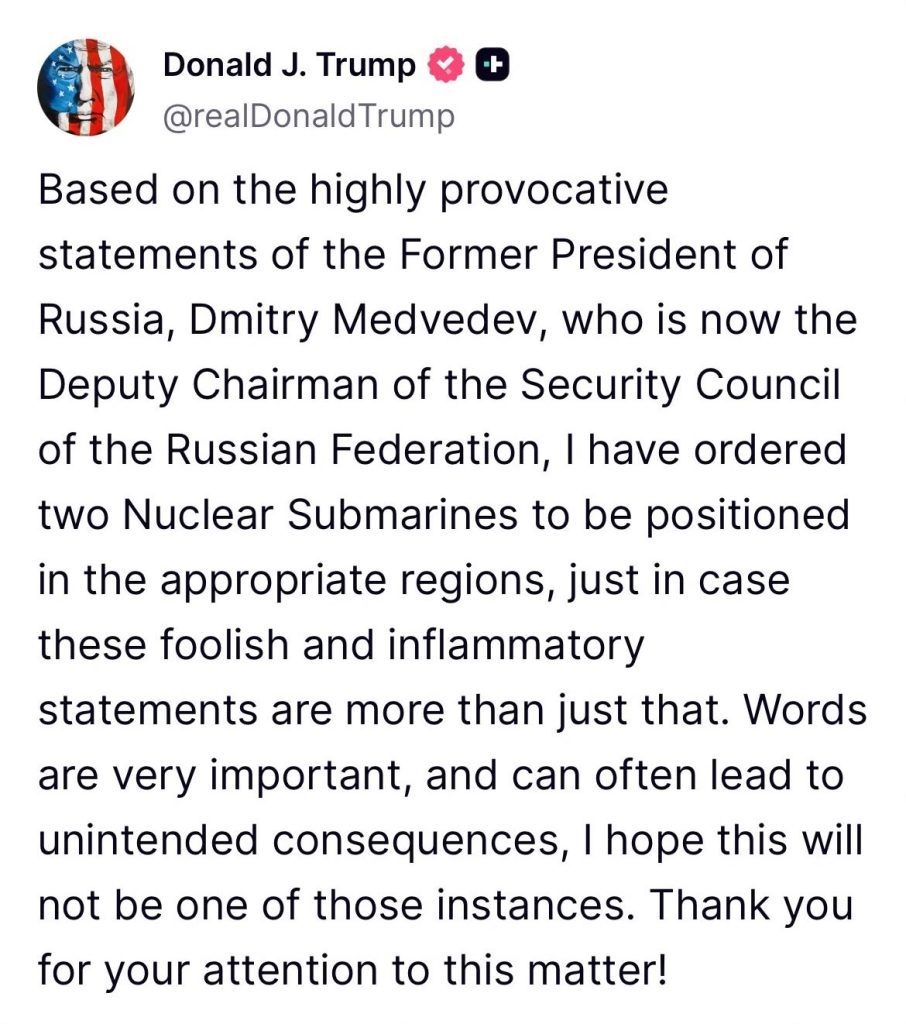
“Based on the highly provocative statements of the former president of Russia, Dmitry Medvedev, […] I have ordered two nuclear submarines to be positioned in the appropriate regions,” Trump wrote on Truth Social.

He added that “Words are very important and can often lead to unintended consequences. I hope this will not be one of those instances.”

Bitcoin’s price decline followed these remarks from Trump, reflecting broader investor anxiety as tensions between nuclear powers rise.

Friday’s market reaction also follows Trump’s public attacks on U.S. economic institutions. The former president accused Erika McEntarfer, Commissioner of Labor Statistics, of manipulating jobs data ahead of the 2024 election to help Kamala Harris.

He called for her immediate removal and claimed the Bureau had “faked the jobs numbers” by overstating employment growth.

“We need accurate Jobs Numbers,” Trump wrote. “She will be replaced with someone much more competent and qualified.”

He also turned his attention to the Federal Reserve, sharply criticizing its chair, Jerome Powell. Trump claimed the Fed’s pre-election rate cuts were politically motivated and called Powell “a stubborn MORON.”

“Jerome ‘Too Late’ Powell must substantially lower interest rates NOW,” he wrote. “IF HE CONTINUES TO REFUSE, THE BOARD SHOULD ASSUME CONTROL AND DO WHAT EVERYONE KNOWS HAS TO BE DONE!”

While presidents traditionally avoid interfering with central bank decisions, Trump urged Fed officials to overrule Powell and slash rates to support what he described as a booming economy under his leadership.

The Fed has held rates steady for five consecutive meetings, citing inflation concerns. But Trump, in a flurry of posts, accused Powell of damaging the economy and failing to act on the consequences of new tariffs.

Fed Governor Adriana Kugler Resigns, Opening Key Seat for Trump

Amid the political pressure, Federal Reserve Governor Adriana Kugler announced her resignation on Friday, creating a key vacancy at the central bank. Kugler, a Biden appointee, joined the Fed’s Board of Governors in 2023 and was a permanent voting member on the Federal Open Market Committee.

She did not give a reason for her early departure but stated she would return to Georgetown University in the fall.

“It has been an honor of a lifetime to serve,” Kugler wrote in a letter addressed to Trump. Her exit, nearly 18 months before her term was set to expire, clears a path for Trump to nominate a replacement.

Kugler had recently voiced support for keeping rates steady, pending a clearer picture of how tariffs are affecting inflation. She was absent during this week’s policy vote, where two Trump-appointed members dissented, favoring a rate cut.

Fed Chair Jerome Powell thanked Kugler for her service, noting her contributions brought “impressive experience and academic insights” to the Board.

Bitcoin Slides as Political Tensions and Market Jitters Weigh on Sentiment

Bitcoin slipped further on Friday as rising geopolitical tensions and cautious investor sentiment added pressure to already fragile markets. The cryptocurrency is now trading just 7% below its all-time high of $123,182 set in mid-July, though momentum in derivatives markets is showing signs of cooling.

Notably, the monthly futures premium for Bitcoin has narrowed to 6%, down from earlier highs this month. Analysts say the drop reflects reduced appetite for leveraged long positions, suggesting traders are becoming more risk-averse despite ongoing institutional interest.

Source: Laevitas.ch

Bitcoin’s recent price behavior has also contributed to uncertainty. Rather than acting as a hedge, the asset has moved in step with tech stocks, exposing it to broader macro and political shocks. With tensions between the U.S. and Russia flaring again this week, risk appetite appears to be shifting.

The political back-and-forth added to a market already grappling with trade friction and weak economic data. While gold has remained stable around $3,350, it has offered little relief for those hoping Bitcoin would act as a safe-haven alternative. Traders appear to be rotating into cash and short-term government bonds as volatility increases.

Despite the decline, Bitcoin remains well above its January levels. However, with global uncertainty rising, traders may remain cautious in the short term.

Amid the broader pullback, some investors are reassessing Bitcoin’s long-term role. Bridgewater Associates founder Ray Dalio, previously skeptical, has updated his outlook. Speaking on a recent podcast, Dalio recommended allocating up to 15% of a portfolio to gold or Bitcoin as a hedge against U.S. debt and inflation.

“The U.S. is entering a debt doom loop,” he said, referencing Treasury forecasts of $12 trillion in new debt within the next year.

Dalio noted that while Bitcoin remains volatile and faces regulatory questions, its role as a store of value is becoming harder to ignore.

Market Opportunity
OFFICIAL TRUMP Logo
OFFICIAL TRUMP Price(TRUMP)
$4.226
$4.226$4.226
-0.21%
USD
OFFICIAL TRUMP (TRUMP) Live Price Chart
Disclaimer: The articles reposted on this site are sourced from public platforms and are provided for informational purposes only. They do not necessarily reflect the views of MEXC. All rights remain with the original authors. If you believe any content infringes on third-party rights, please contact service@support.mexc.com for removal. MEXC makes no guarantees regarding the accuracy, completeness, or timeliness of the content and is not responsible for any actions taken based on the information provided. The content does not constitute financial, legal, or other professional advice, nor should it be considered a recommendation or endorsement by MEXC.

You May Also Like

Regulatory Clarity Could Drive 40% of Americans to Adopt DeFi Protocols, Survey Shows

Regulatory Clarity Could Drive 40% of Americans to Adopt DeFi Protocols, Survey Shows

Over 40% of Americans express willingness to use decentralized finance (DeFi) protocols once regulatory clarity on crypto privacy emerges, according to a recent survey from crypto advocacy organization the DeFi Education Fund (DEF). The survey, released on September 18, revealed that many Americans feel frustrated with traditional financial institutions and seek greater control over their financial assets and data. Respondents believe DeFi innovations can deliver this change by providing affordability, equity, and consumer protection. The survey was conducted with Ipsos on KnowledgePanel and included supplementary in-depth interviews in the Bronx and Queens between August 18 and 21, polling 1,321 US adults. Survey Results Show Americans Ready to Adopt DeFi Protocols The findings demonstrate that many Americans are curious about DeFi despite its early stage. 42% of Americans indicated they would likely try DeFi if proposed legislation becomes law (9% extremely/very likely and 33% somewhat likely). 84% said they would use it to “make purchases online,” while 78% would use it to “pay bills.” According to the survey, 77% would use DeFi protocols to “save money,” and 12% of Americans are “extremely” and “very” interested in learning about DeFi. Moreover, nearly 4 in 10 Americans believe that DeFi can address high transaction and service fees found in traditional finance (39%). Consistent with other probability-based sample surveys, the Ipsos x DEF research shows that almost 1 in 5 Americans (18%) have owned or used crypto at some point in their lifetime. Nearly a quarter of Americans (22%) said they’re interested in learning more about nontraditional forms of finance, such as blockchain, crypto, or decentralized finance.Source: DEF The research shows that more than half (56%) of Americans want to reclaim control of their finances. Americans are interested in having control over their money at all times, and many seek ways to send or receive money without intermediaries. One Bronx, NY resident shared his experience of needing to transfer money between accounts, but the bank required him to certify the transfer and visit in person because he couldn’t move the amount he needed remotely. He expressed frustration about the situation because “it was my money… I didn’t understand why I was given a hard time.“ More than half of surveyed Americans agree there should be a way to digitally send money to people without third-party involvement, and this number rises notably for foreign-born Americans (66%). The researchers concluded that Americans are interested in DeFi and believe DeFi can reduce friction points in today’s financial system. Regulatory Developments on DeFi Adoption in the U.S Last month, DeFi Education Fund called on the US Senate Banking Committee to rethink how it plans to regulate the decentralized finance industry after reviewing its recently published discussion draft on a key crypto market-structure bill. The response, signed on behalf of DeFi Education Fund (DEF) members including a16z Crypto, Uniswap Labs, and Paradigm, argued the Responsible Financial Innovation Act of 2025 (RFA) bill should be crafted in a more tech-neutral manner. The group also emphasized that crypto developers should be protected from “inappropriate regulation meant for intermediaries,” and that self-custody rights for all Americans are “essential.” The banking committee is now working on the discussion draft to help ensure it builds on the Digital Asset Market Clarity Act of 2025. The goal is to promote innovation in the $162 billion DeFi industry without compromising consumer protections or financial stability. On September 5, US Federal Reserve Governor Christopher Waller said there was “nothing to be afraid of” about crypto payments operating outside the traditional banking system. This statement has raised hopes among many that DeFi would soon become the new financial infrastructure for Americans and the world
Share
CryptoNews2025/09/18 21:29
Michael Burry’s Bitcoin Warning: Crypto Crash Could Drag Down Gold and Silver Markets

Michael Burry’s Bitcoin Warning: Crypto Crash Could Drag Down Gold and Silver Markets

TLDR Michael Burry warned that bitcoin’s drop below $73,000 may have forced institutions to sell up to $1 billion in gold and silver to cover crypto losses Burry
Share
Coincentral2026/02/04 15:28
Michelin-starred dimsum chain Tim Ho Wan doubles HK footprint with 10th store

Michelin-starred dimsum chain Tim Ho Wan doubles HK footprint with 10th store

For Tim Ho Wan’s chief executive officer Young Sheng Lee, the brand’s aggressive expansion in its home turf helped create a proven growth model that can be replicated
Share
Rappler2026/02/04 15:27
