Ethereum's native token Ether fell 7% in 24 hours following Vitalik Buterin's $500,000 ETH sale and his post challenging the long-standing Layer 2 scaling strategyEthereum's native token Ether fell 7% in 24 hours following Vitalik Buterin's $500,000 ETH sale and his post challenging the long-standing Layer 2 scaling strategy

Ethereum Price Down 10% Since Vitalik Sold $500K of ETH, Questions L2s Role

3 min read

The price of Ethereum’s native token, Ether, is down 7% in a 24-hour time frame, happening after Vitalik Buterin sold $500,000 worth of ETH and made a post questioning the role of Layer 2s (L2s) in scaling Ethereum.

On Feb. 2, Lookonchain posted an analysis claiming Vitalik Buterin, Ethereum creator, sold 211.84 ETH for 500,000 USDC and moved the half million dollars to Kanro. Interestingly, the Kanro Fund has a token, KANRO, that operates as a memecoin with a charitable purpose—where a percentage of every transaction is allocated to fund global health, AI safety, and open-source research through the Kanro charity, founded by Buterin himself.

Data gathered from CoinMarketCap shows that 25 hours after this post, ETH is down nearly 10% in the day, trading at $2,117 per token. This is a significant 24-hour drop for the second-largest cryptocurrency by market cap, currently valued at $255 billion.

Nevertheless, the Ethereum ETH $2 298 24h volatility: 0.8% Market cap: $277.44 B Vol. 24h: $45.15 B trading volume is down 31% from what was seen yesterday, suggesting low-liquidity-driven volatility.
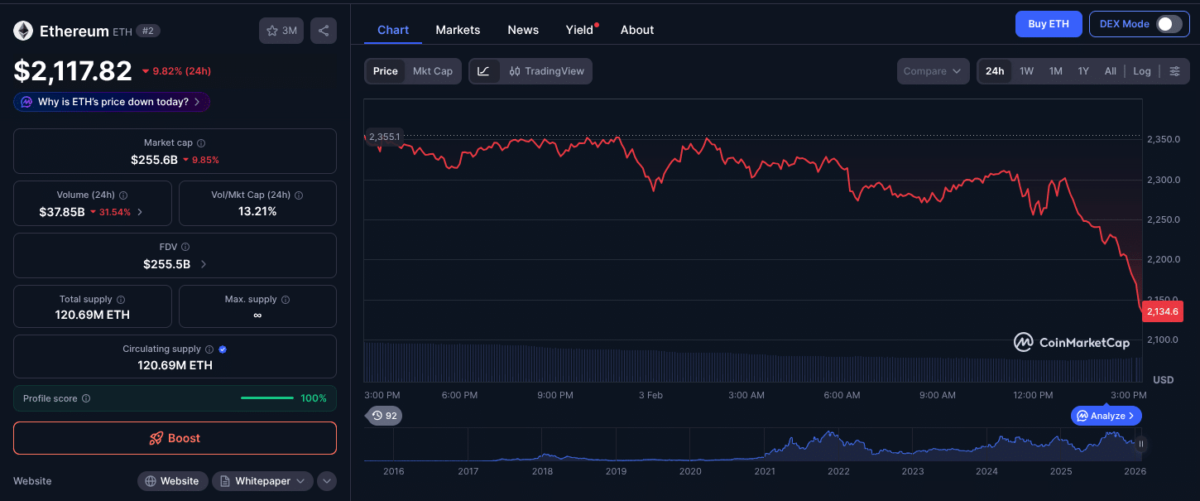
Ethereum (ETH) 24-hour price chart, as of Feb. 3, 2026 | Source: CoinMarketCap

Ethereum (ETH) 24-hour price chart, as of Feb. 3, 2026 | Source: CoinMarketCap

Vitalik Buterin Questions Role of L2s for Scaling Ethereum

In an interesting turn of events, a recent post from Vitalik Buterin added fuel to ETH’s drop, launching doubts on a narrative the Ethereum community had been pushing for years: the need for second layers (L2s) to scale Ethereum and blockchains in general.

Essentially, Buterin argued that the original “rollup-centric” vision for L2s as the primary way to scale Ethereum no longer fully aligns with current realities. “This vision no longer makes sense,” he repeated a few times in the post.

Instead, he proposed treating L2s as a broad spectrum of solutions—ranging from fully Ethereum-secured chains with unique features to looser-connected options—where users can choose based on their own trust and performance requirements.

For L2 teams, Buterin recommended focusing on differentiated value beyond pure scaling, such as privacy-focused VMs, application-specific efficiency, ultra-high throughput, low-latency sequencing, or non-financial use cases like social networks or AI.

The sudden narrative shift surfaces uncertainties in an industry that has been building and investing in layer-two solutions focused on scaling Ethereum. It adds to the Ethereum co-founder selling significant amounts of the token for charity—although this is typical behavior for him—and overall macro and microeconomic uncertainties, negatively affecting all cryptocurrencies, especially altcoins, as Coinspeaker reported.

Yet at the institutional level, interest in large-cap cryptocurrencies continues to grow, with Bitcoin and Ethereum ETF products seeing inflows.

next

The post Ethereum Price Down 10% Since Vitalik Sold $500K of ETH, Questions L2s Role appeared first on Coinspeaker.

Disclaimer: The articles reposted on this site are sourced from public platforms and are provided for informational purposes only. They do not necessarily reflect the views of MEXC. All rights remain with the original authors. If you believe any content infringes on third-party rights, please contact service@support.mexc.com for removal. MEXC makes no guarantees regarding the accuracy, completeness, or timeliness of the content and is not responsible for any actions taken based on the information provided. The content does not constitute financial, legal, or other professional advice, nor should it be considered a recommendation or endorsement by MEXC.

You May Also Like

‘Big Short’ Michael Burry flags key levels on the Bitcoin chart

‘Big Short’ Michael Burry flags key levels on the Bitcoin chart

The post ‘Big Short’ Michael Burry flags key levels on the Bitcoin chart appeared on BitcoinEthereumNews.com. The famous ‘Big Short’ investor Michael Burry made
Share
BitcoinEthereumNews2026/02/05 21:54
Solana Price Prediction: SOL Tipped for 3x Boom While Little Pepe (LILPEPE) Gains 100x Speculation

Solana Price Prediction: SOL Tipped for 3x Boom While Little Pepe (LILPEPE) Gains 100x Speculation

Right now, the crypto community is buzzing with excitement as Solana (SOL) keeps gaining steam. Little Pepe (LILPEPE), a Layer 2 meme coin, is also on the rise in the market due to speculation about 100x returns. It’s clear that investors are watching a wide range of opportunities, given Solana’s impressive price hike over the
Share
Coinstats2025/09/19 04:30
New Zealand Dollar declines to near 0.5650 as dovish RBNZ overshadows US tariff relief

New Zealand Dollar declines to near 0.5650 as dovish RBNZ overshadows US tariff relief

The post New Zealand Dollar declines to near 0.5650 as dovish RBNZ overshadows US tariff relief appeared on BitcoinEthereumNews.com. The NZD/USD pair drifts lower to around 0.5655 during the Asian trading hours on Tuesday. The New Zealand Dollar (NZD) softens against the US Dollar (USD) amid an imminent rate cut from the Reserve Bank of New Zealand (RBNZ). Traders await the release of the US September Nonfarm Payrolls (NFP) report later on Thursday.  The RBNZ cut the Official Cash Rate (OCR) to 2.5% at its October meeting after a larger-than-expected 0.9% contraction in Gross Domestic Product (GDP) for the second quarter of 2025. A further reduction of 25 basis points (bps) to 2.25% is widely anticipated at the next meeting on November 26, 2025. The RBNZ has already delivered a series of rate cuts throughout 2025 in an attempt to stimulate a struggling economy.  The prospect of the RBNZ’s aggressive rate-cutting policy overshadowed the US decision to roll back tariffs on Kiwi exports. This, in turn, could exert some selling pressure on the NZD and acts as a tailwind for the pair. In the near term Meanwhile, US President Donald Trump lifted tariffs on more than 200 food products in response to rising US grocery prices. On Sunday, New Zealand welcomed the announcement that it would remove additional tariffs on a range of New Zealand agricultural products, including beef, offal, and kiwi fruit.  Trump removed tariffs on New Zealand exports on more than 200 food products, including beef, amid consumer concerns about rising US grocery prices. It is worth about NZ$2.21 billion ($1.25 billion) annually.  Hawkish remarks from Fed policymakers ahead of a deluge of US economic data spooked traders and could weigh on the USD. Kansas City Fed President Jeffery Schmid said on Friday that monetary policy should lean against demand growth, adding that current Fed policy is “modestly restrictive,” which he believes is appropriate.  New Zealand Dollar FAQs The New…
Share
BitcoinEthereumNews2025/11/18 10:59