A sea of red dominated the crypto market today, July 25, as Bitcoin and most altcoins continued their pullback.A sea of red dominated the crypto market today, July 25, as Bitcoin and most altcoins continued their pullback.

Here’s why Bitcoin and crypto like Pepe, Jasmy, Stellar plummeted

3 min read

A sea of red dominated the crypto market today, July 25, as Bitcoin and most altcoins continued their pullback. 

Summary
  • Bitcoin and most altcoins pulled back this week as investors booked profits.
  • The tokens also dropped due to mean reversion, where assets tend to revert to their historical averages.
  • Cryptocurrencies are also falling ahead of Trump’s tariff deadline.

Bitcoin (BTC) is down by about $8,200 from its all-time high. The total market capitalization of all cryptocurrencies dropped from the year-to-date high of $4 trillion to $3.89 trillion. 

Most altcoins were in the red, with popular tokens like Pepe (PEPE), Jasmy Coin (JASMY), and Stellar (XLM) falling by over 15% from their highest level this week.

Crypto crash happens amid profit-taking

A potential catalyst for the ongoing crypto market crash is profit-taking among investors after Bitcoin and most altcoins surged by double and even triple digits. 

Some notable cryptocurrency investors have dumped their tokens recently. For example, Galaxy Digital sold Bitcoin worth over $500 million this week. Similarly, Chris Larsen, a co-founder of Ripple Labs, sold XRP tokens worth over $140 million. 

It is common for experienced and retail investors to book profits after a prolonged rally. Doing that helps them to protect their investments during a downturn. 

A closer look at Nansen and other analytics platforms reveals that whales and smart money investors have reduced their investments over the past few days. Whales hold 8.84 trillion Pepe tokens, down from this week’s high of 8.88 trillion.

Mean reversion and overbought conditions

From a technical standpoint, the pullback in crypto prices was driven by mean reversion and overbought signals.

Mean revision is a theory that suggests that asset prices tend to revert to their historical mean or average. In this case, most cryptocurrencies jumped significantly above their averages. 

For example, the chart below shows that the Stellar Lumens token was trading at $0.4160 on Friday, much higher than the 100-day moving average of $0.3145. Its standard deviation jumped to the December high of 0.1015. 

Therefore, the concept of mean reversion suggests that the XLM price should drop so that it can align with the moving average. 

At the same time, the coin was extremely overbought, with the Relative Strength Index jumping to 89.30. It is common for highly overbought tokens to pull back.
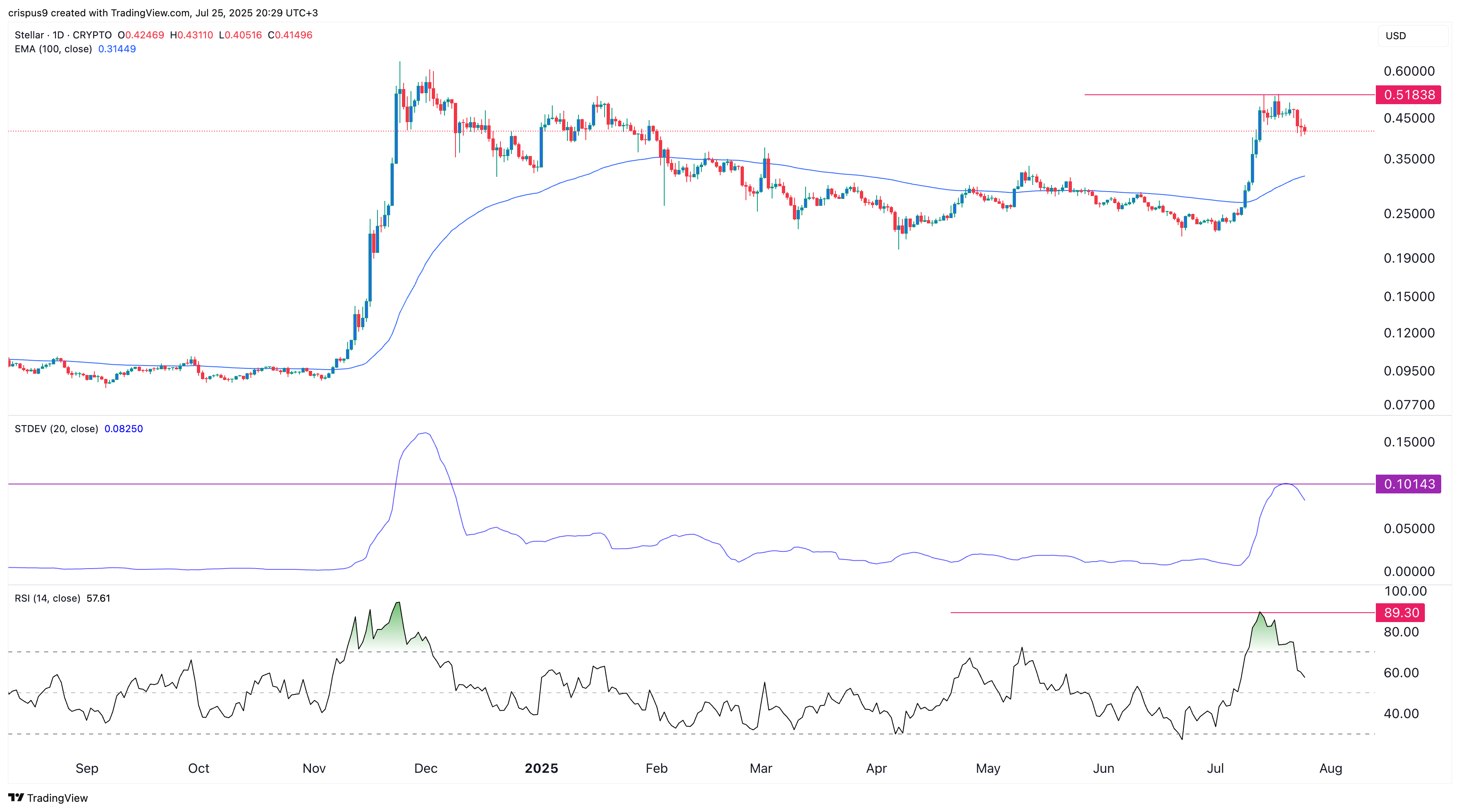
XLM price

Other reasons why cryptocurrencies are going down

The crypto crash was also likely exacerbated by the upcoming Federal Reserve interest rate decision and the deadline for President Trump’s tariffs. 

Economists expect the Fed to leave interest rates unchanged, and possibly point to just two cuts for the year. Cryptocurrencies and other assets often fluctuate in the lead-up to the Fed decision.

The Fed meeting will coincide with the Aug. 1 deadline, in which the U.S. will implement higher tariffs on most countries unless they reach a deal.

Market Opportunity
Wink Logo
Wink Price(LIKE)
$0.001952
$0.001952$0.001952
+0.61%
USD
Wink (LIKE) Live Price Chart
Disclaimer: The articles reposted on this site are sourced from public platforms and are provided for informational purposes only. They do not necessarily reflect the views of MEXC. All rights remain with the original authors. If you believe any content infringes on third-party rights, please contact service@support.mexc.com for removal. MEXC makes no guarantees regarding the accuracy, completeness, or timeliness of the content and is not responsible for any actions taken based on the information provided. The content does not constitute financial, legal, or other professional advice, nor should it be considered a recommendation or endorsement by MEXC.

You May Also Like

Cashing In On University Patents Means Giving Up On Our Innovation Future

Cashing In On University Patents Means Giving Up On Our Innovation Future

The post Cashing In On University Patents Means Giving Up On Our Innovation Future appeared on BitcoinEthereumNews.com. “It’s a raid on American innovation that would deliver pennies to the Treasury while kneecapping the very engine of our economic and medical progress,” writes Pipes. Getty Images Washington is addicted to taxing success. Now, Commerce Secretary Howard Lutnick is floating a plan to skim half the patent earnings from inventions developed at universities with federal funding. It’s being sold as a way to shore up programs like Social Security. In reality, it’s a raid on American innovation that would deliver pennies to the Treasury while kneecapping the very engine of our economic and medical progress. Yes, taxpayer dollars support early-stage research. But the real payoff comes later—in the jobs created, cures discovered, and industries launched when universities and private industry turn those discoveries into real products. By comparison, the sums at stake in patent licensing are trivial. Universities collectively earn only about $3.6 billion annually in patent income—less than the federal government spends on Social Security in a single day. Even confiscating half would barely register against a $6 trillion federal budget. And yet the damage from such a policy would be anything but trivial. The true return on taxpayer investment isn’t in licensing checks sent to Washington, but in the downstream economic activity that federally supported research unleashes. Thanks to the bipartisan Bayh-Dole Act of 1980, universities and private industry have powerful incentives to translate early-stage discoveries into real-world products. Before Bayh-Dole, the government hoarded patents from federally funded research, and fewer than 5% were ever licensed. Once universities could own and license their own inventions, innovation exploded. The result has been one of the best returns on investment in government history. Since 1996, university research has added nearly $2 trillion to U.S. industrial output, supported 6.5 million jobs, and launched more than 19,000 startups. Those companies pay…
Share
BitcoinEthereumNews2025/09/18 03:26
VectorUSA Achieves Fortinet’s Engage Preferred Services Partner Designation

VectorUSA Achieves Fortinet’s Engage Preferred Services Partner Designation

TORRANCE, Calif., Feb. 3, 2026 /PRNewswire/ — VectorUSA, a trusted technology solutions provider, specializes in delivering integrated IT, security, and infrastructure
Share
AI Journal2026/02/05 00:02
Top Solana Treasury Firm Forward Industries Unveils $4 Billion Capital Raise To Buy More SOL ⋆ ZyCrypto

Top Solana Treasury Firm Forward Industries Unveils $4 Billion Capital Raise To Buy More SOL ⋆ ZyCrypto

The post Top Solana Treasury Firm Forward Industries Unveils $4 Billion Capital Raise To Buy More SOL ⋆ ZyCrypto appeared on BitcoinEthereumNews.com. Advertisement &nbsp &nbsp Forward Industries, the largest publicly traded Solana treasury company, has filed a $4 billion at-the-market (ATM) equity offering program with the U.S. SEC  to raise more capital for additional SOL accumulation. Forward Strategies Doubles Down On Solana Strategy In a Wednesday press release, Forward Industries revealed that the 4 billion ATM equity offering program will allow the company to issue and sell common stock via Cantor Fitzgerald under a sales agreement dated Sept. 16, 2025. Forward said proceeds will go toward “general corporate purposes,” including the pursuit of its Solana balance sheet and purchases of income-generating assets. The sales of the shares are covered by an automatic shelf registration statement filed with the US Securities and Exchange Commission that is already effective – meaning the shares will be tradable once they’re sold. An automatic shelf registration allows certain publicly listed companies to raise capital with flexibility swiftly.  Kyle Samani, Forward’s chairman, astutely described the ATM offering as “a flexible and efficient mechanism” to raise and deploy capital for the company’s Solana strategy and bolster its balance sheet.  Advertisement &nbsp Though the maximum amount is listed as $4 billion, the firm indicated that sales may or may not occur depending on existing market conditions. “The ATM Program enhances our ability to continue scaling that position, strengthen our balance sheet, and pursue growth initiatives in alignment with our long-term vision,” Samani said. Forward Industries kicked off its Solana treasury strategy on Sept. 8. The Wednesday S-3 form follows Forward’s $1.65 billion private investment in public equity that closed last week, led by crypto heavyweights like Galaxy Digital, Jump Crypto, and Multicoin Capital. The company started deploying that capital this week, announcing it snatched up 6.8 million SOL for approximately $1.58 billion at an average price of $232…
Share
BitcoinEthereumNews2025/09/18 03:42