Stablecoin risks to banks could amount to the trillions. Illustration: Gwen P; Source: ShutterstockStablecoin risks to banks could amount to the trillions. Illustration: Gwen P; Source: Shutterstock

Four risks from stablecoins that drain $1.5tn from banks, says Standard Chartered

2026/01/28 01:10
3 min read

Stablecoins are coming for bank deposits — and traditional lenders aren’t happy about it.

Stablecoins settle instantly, work around the clock, and increasingly offer better returns than traditional savings accounts.

It’s that last point that poses the most risk for banks that rely on customer deposits.

Now, UK-based Standard Chartered has quantified the damage.

Analysts expect roughly $500 billion to leave developed-market banks in the US by the end of 2028, with another $1 trillion to flee emerging-market banks.

That assessment from Geoffrey Kendrick, Standard Chartered’s global head of digital assets research, comes just as the Clarity Act stalls over whether stablecoins should pay yield directly to holders.

As of writing, the draft bill bans digital asset service providers from paying interest to stablecoin holders — a provision that has pitted major banks against Coinbase and other crypto companies, delaying the legislation’s approval.

Here are the four risks outlined by Standard Chartered for US banks.

Difference between loans and deposits

For Kendrick, the clearest measure of risk from stablecoins to banks’ business models comes from the difference between what banks earn on loans and what they pay on deposits.

It’s called the net interest margin income, or NIM.

Banks may pay customers, say, 2% on their deposits, then lend out that money at 5%. The 3% spread is the bank’s profit.

If those deposits leave for stablecoins, that profit disappears, Kendrick said.

Regional US banks are the most vulnerable to this capital flight, with NIM representing up to 80% of total revenue for some institutions.

Investment banks like Goldman Sachs and Morgan Stanley, on the other hand, are less exposed, with NIM comprising less than 30% of their revenue.

Limited redepositing cushion

If stablecoin issuers held their reserves in bank deposits, the outflow would be cushioned.

But they don’t, Kendrick argued.

“The two dominant stablecoin issuers — Tether and Circle — hold just 0.02% and 14.5% of their reserves in bank deposits, respectively, so very little re-depositing is happening," Kendrick said.

Instead, both issuers hold their reserves in US Treasury bills and money market funds.

That means that if users convert $100 to stablecoins, nearly all of that money leaves the traditional banking system entirely, typically flowing into US Treasury bills and money market funds.

Geographic concentration

Roughly one-third of all stablecoin demand comes from developed markets, with the broad majority originating in emerging economies.

And since more than 95% of stablecoins are denominated in US dollars, US banks would bear the brunt of any deposit flight.

Although Australian banks show levels of vulnerability to deposit flight similar to those of US regional banks, the risks to non-US banks remain pretty limited for now, according to Kendrick

Retail versus wholesale

Kendrick explained another problem.

Banks pay lower interest rates on regular customers’ savings accounts because those deposits are insured by the Federal Deposit Insurance Corporation, or FDIC.

But if those customers move their money into stablecoins, banks will have to replace that funding by borrowing from other sources — such as institutional investors — that charge much higher rates.

Even if a bank’s total deposits stay the same, its costs go up.

“Stablecoins are the first big blockchain-based disrupter of financial markets”, concluded Kendrick.

Pedro Solimano is a markets correspondent based in Buenos Aires. Got a tip? Email him at psolimano@dlnews.com.

Disclaimer: The articles reposted on this site are sourced from public platforms and are provided for informational purposes only. They do not necessarily reflect the views of MEXC. All rights remain with the original authors. If you believe any content infringes on third-party rights, please contact service@support.mexc.com for removal. MEXC makes no guarantees regarding the accuracy, completeness, or timeliness of the content and is not responsible for any actions taken based on the information provided. The content does not constitute financial, legal, or other professional advice, nor should it be considered a recommendation or endorsement by MEXC.

You May Also Like

Three dormant wallets, suspected to belong to the same entity, purchased 5,970 ETH eight hours ago.
Three dormant wallets, suspected to belong to the same entity, purchased 5,970 ETH eight hours ago.

PANews reported on February 4 that, according to Lookonchain monitoring, three wallets that had been dormant for four years (likely controlled by the same entity
Share
PANews2026/02/04 11:36
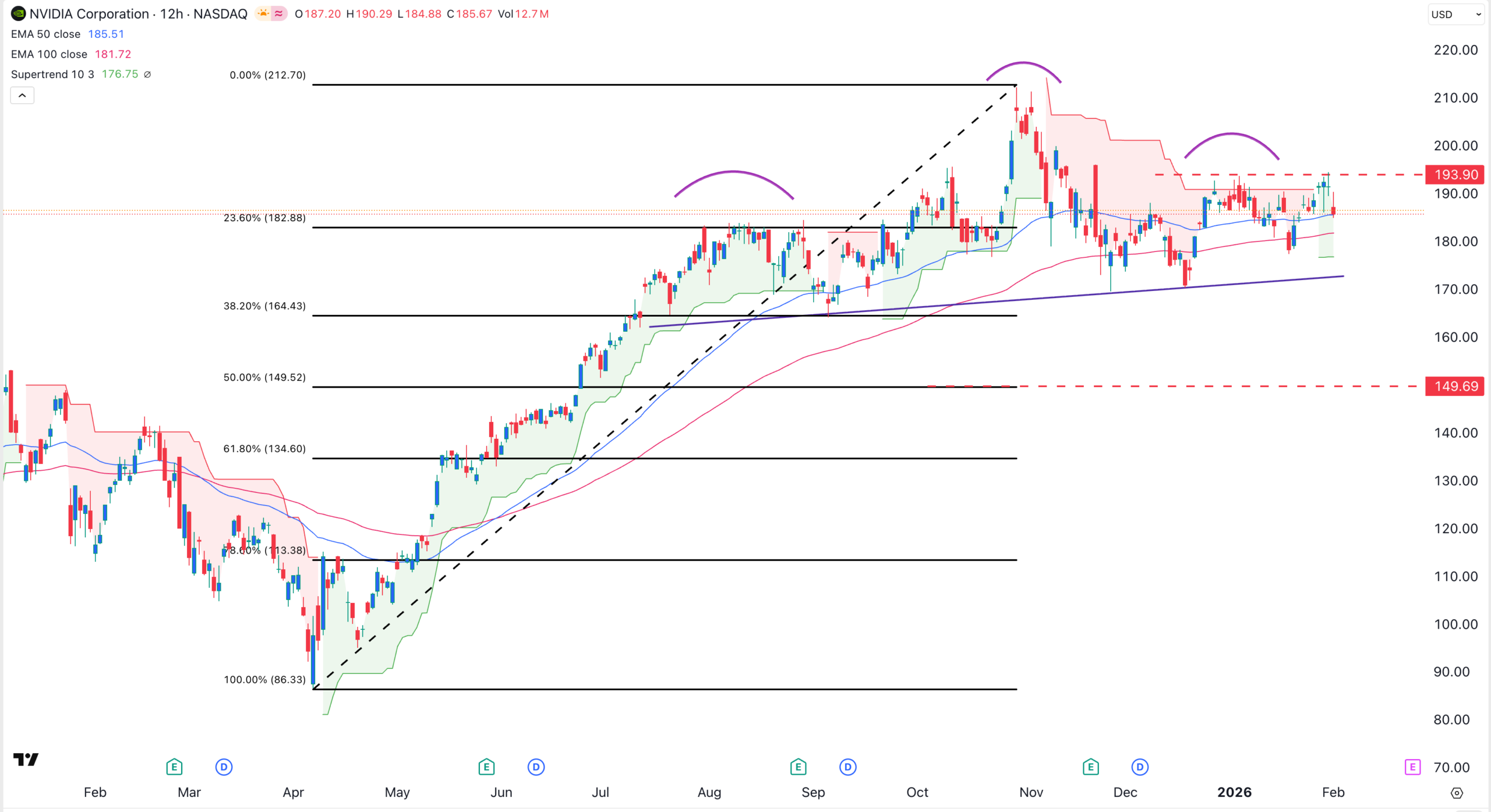
NVIDIA Stock Price Analysis as OpenAI Issues Concerns About its Chips

NVIDIA Stock Price Analysis as OpenAI Issues Concerns About its Chips

Key Insights NVIDIA stock started the week in the red. It crashed by over 2%. Meanwhile, the S&P 500, Dow Jones, and Nasdaq 100 moved close to their all-time highs
Share
Themarketperiodical2026/02/04 11:27
Ondo Finance Launches USDY Yieldcoin on Stellar, Bringing Tokenized U.S. Treasuries to Users

Ondo Finance Launches USDY Yieldcoin on Stellar, Bringing Tokenized U.S. Treasuries to Users

Ondo Finance, a U.S.-based digital asset firm specializing in bringing traditional financial products on-chain through tokenization, is expanding its yieldcoin USDY to the Stellar network. This lates update marks a step forward in merging tokenized real-world assets with a global payments infrastructure, unlocking new opportunities for users worldwide. The announcement was made at the Stellar Meridian event in Copacabana, Rio de Janeiro, on September 17. USDY Joins the Stellar Ecosystem Ondo Finance, a recognized leader in tokenized real-world assets, announced the deployment of United States Dollar Yield (USDY) on Stellar, the payments-focused blockchain known for speed and low transaction costs. USDY is the most widely available “yieldcoin,” offering investors access to onchain assets backed by U.S. Treasuries. This launch allows Stellar’s global user base to tap into permissionless, yield-bearing assets tied to one of the safest financial instruments in the world. It also aligns with Stellar’s mission of driving fast, affordable cross-border payments. Combining Yield with Payments Infrastructure “Stablecoins unlocked global access to the U.S. dollar. With USDY, we’re taking the next step by bringing U.S. Treasuries onchain in a form that combines stability, liquidity, and yield,” said Ian De Bode, Chief Strategy Officer at Ondo Finance. “Fast, affordable cross-border payments are at the center of what Stellar was designed to do. The global reach of the Stellar ecosystem combined with a yield-bearing asset like USDY levels up what is possible onchain, allowing wallets and businesses to offer yield opportunities to their users,” said Denelle Dixon, CEO of the Stellar Development Foundation. Ondo claims by pairing USDY with Stellar’s infrastructure, new possibilities open up in treasury management, collateralization, and everyday financial applications. Unlocking Institutional and Retail Use Cases USDY currently manages over $650 million in total value locked (TVL) across nine blockchains and offers a 5.3% APY. By launching on Stellar, Ondo Finance extends these benefits to global retail and institutional users. The firm explains balances on Stellar can now become productive, supporting use cases such as onchain savings, institutional treasury strategies, cost-efficient collateral for DeFi protocols, and remittance flows that carry yield rather than remaining static. A Milestone for Tokenized Treasuries With the integration of USDY, Stellar users gain more than just access to stable-value assets—they gain access to institutional-grade yield. For investors outside the U.S., the launch represents a new way to combine the safety of Treasuries with the accessibility of blockchain technology. As tokenization accelerates globally, Ondo Finance’s decision to deploy USDY on Stellar reinforces the narrative that blockchain is not just about speculation, but about reimagining the global financial system through secure, yield-bearing digital assets
Share
CryptoNews2025/09/18 00:46
