The post US Dollar Index hovers near 97.50 as 10-year yield rises, Fed outlook shifts appeared on BitcoinEthereumNews.com. The US Dollar Index (DXY), which measuresThe post US Dollar Index hovers near 97.50 as 10-year yield rises, Fed outlook shifts appeared on BitcoinEthereumNews.com. The US Dollar Index (DXY), which measures

US Dollar Index hovers near 97.50 as 10-year yield rises, Fed outlook shifts

The US Dollar Index (DXY), which measures the value of the US Dollar (USD) against six major currencies, is edging lower after two days of gains and trading near 97.50 during the Asian hours on Tuesday.

The Greenback received support as the yield on the 10-year US Treasury bond hovered near 4.27% on Tuesday after a nearly 1% rise in the prior session, underpinned by strong US economic data and shifting Federal Reserve (Fed) policy expectations toward hawkish.

Data on Monday showed an unexpected rebound in US factory activity, underscoring economic resilience, as the Institute for Supply Management’s (ISM) Manufacturing Purchasing Managers’ Index (PMI) rose to 52.6 from 47.9 in December, beating market expectations of 48.5.

Last week, US President Donald Trump nominated Kevin Warsh as the next Federal Reserve (Fed) Chair. Markets interpreted Warsh’s appointment as signaling a more disciplined and cautious approach to monetary easing.

The US Dollar gained traction as risk sentiment improved after the US Senate reached an agreement to advance a government funding package, thereby averting a shutdown. Trump also announced a trade deal with India, lowering tariffs on both sides in return for New Delhi halting purchases of Russian Oil.

St. Louis Fed President Alberto Musalem said further rate cuts are unwarranted, calling the 3.50%–3.75% policy range broadly neutral, while Atlanta Fed President Raphael Bostic urged patience, saying policy should stay modestly restrictive.

US Dollar FAQs

The US Dollar (USD) is the official currency of the United States of America, and the ‘de facto’ currency of a significant number of other countries where it is found in circulation alongside local notes. It is the most heavily traded currency in the world, accounting for over 88% of all global foreign exchange turnover, or an average of $6.6 trillion in transactions per day, according to data from 2022.
Following the second world war, the USD took over from the British Pound as the world’s reserve currency. For most of its history, the US Dollar was backed by Gold, until the Bretton Woods Agreement in 1971 when the Gold Standard went away.

The most important single factor impacting on the value of the US Dollar is monetary policy, which is shaped by the Federal Reserve (Fed). The Fed has two mandates: to achieve price stability (control inflation) and foster full employment. Its primary tool to achieve these two goals is by adjusting interest rates.
When prices are rising too quickly and inflation is above the Fed’s 2% target, the Fed will raise rates, which helps the USD value. When inflation falls below 2% or the Unemployment Rate is too high, the Fed may lower interest rates, which weighs on the Greenback.

In extreme situations, the Federal Reserve can also print more Dollars and enact quantitative easing (QE). QE is the process by which the Fed substantially increases the flow of credit in a stuck financial system.
It is a non-standard policy measure used when credit has dried up because banks will not lend to each other (out of the fear of counterparty default). It is a last resort when simply lowering interest rates is unlikely to achieve the necessary result. It was the Fed’s weapon of choice to combat the credit crunch that occurred during the Great Financial Crisis in 2008. It involves the Fed printing more Dollars and using them to buy US government bonds predominantly from financial institutions. QE usually leads to a weaker US Dollar.

Quantitative tightening (QT) is the reverse process whereby the Federal Reserve stops buying bonds from financial institutions and does not reinvest the principal from the bonds it holds maturing in new purchases. It is usually positive for the US Dollar.

Source: https://www.fxstreet.com/news/us-dollar-index-hovers-near-9750-as-10-year-yield-rises-fed-outlook-shifts-202602030403
Disclaimer: The articles reposted on this site are sourced from public platforms and are provided for informational purposes only. They do not necessarily reflect the views of MEXC. All rights remain with the original authors. If you believe any content infringes on third-party rights, please contact service@support.mexc.com for removal. MEXC makes no guarantees regarding the accuracy, completeness, or timeliness of the content and is not responsible for any actions taken based on the information provided. The content does not constitute financial, legal, or other professional advice, nor should it be considered a recommendation or endorsement by MEXC.

You May Also Like

Market Records Largest Long-Term Bitcoin Supply Release In History, Here’s What It Means For BTC

Market Records Largest Long-Term Bitcoin Supply Release In History, Here’s What It Means For BTC

Bitcoin has recorded what analysts describe as the largest long-term supply release in its history, coinciding with a sharp rise in leverage across derivatives
Share
Coinstats2026/02/08 07:06
Bitcoin Cash’s rally faces KEY test – Can BCH hold above $500?

Bitcoin Cash’s rally faces KEY test – Can BCH hold above $500?

On-chain activity points to improving conditions that could support further gains in Bitcoin Cash, though the outlook remains mixed.
Share
Coinstats2026/02/08 07:00
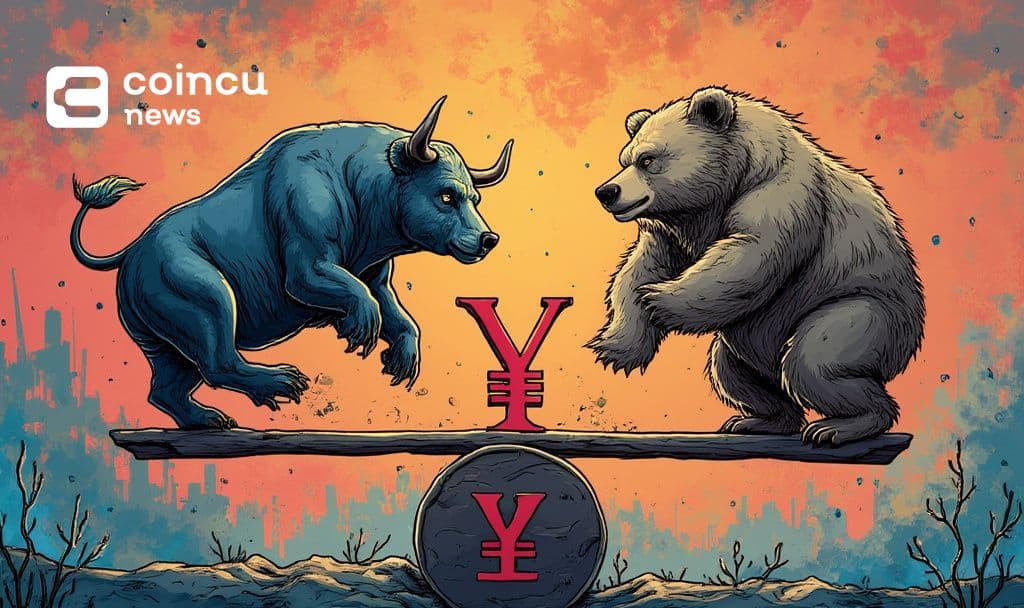
Bank of Japan Interest Rates Hold Impacts USD/JPY and Crypto Markets

Bank of Japan Interest Rates Hold Impacts USD/JPY and Crypto Markets

The post Bank of Japan Interest Rates Hold Impacts USD/JPY and Crypto Markets appeared on BitcoinEthereumNews.com. Key Points:The Bank of Japan has maintained its interest rates, affecting USD/JPY.Subsequent market reactions include a 20-point surge in USD/JPY.No direct link to crypto markets, but risk sentiment shifts observed. The Bank of Japan maintained its interest rates, leading to an immediate surge in the USD/JPY exchange rate, currently at 147.84, impacting digital market sentiment. This decision reflects broader financial stability concerns, influencing risk sentiment, and linking to potential market shifts in crypto and real-world asset landscapes. Key Points: The Bank of Japan kept its interest rates unchanged in line with market expectations, prompting a quick surge in USD/JPY by more than 20 points. This decision further validates their cautious monetary approach amid global economic uncertainty. The stable interest rate environment set by the Bank is consistent with past policies aimed at supporting economic recovery. Though this decision is not directly linked to crypto assets, the associated market reactions highlight a shift toward a risk-on environment among investors. The rise in USD/JPY suggests a temporary shift in currency dynamics, with potential ripple effects on global markets. According to Christine Kim, Former Vice President of Research at Galaxy Digital, “Ethereum developers’ conference call ACDC #165 made an important decision… The Fusaka mainnet upgrade is scheduled for December 3 this year at Epoch 411392.” Bank of Japan’s Decision Sparks USD/JPY Surge Did you know? The Bank of Japan’s rate hold mirrors its post-2016 approach that often historically corresponds with increased stability and recovery of various asset classes, suggesting a broader alignment of risk appetites across both conventional and digital markets. According to CoinMarketCap, Ethereum (ETH) is currently priced at $4,541.00, with a market cap of $548.12 billion. Recent trading volume reached $30.47 billion, reflecting a 36.33% decrease. Despite a 1.65% decrease over the past 24 hours, Ethereum experienced notable gains of 87.16%…
Share
BitcoinEthereumNews2025/09/19 12:33