

HYPE Price Target Hits $50 as Hyperliquid Slashes Team Token Unlock by 90% — Is the Rally Sustainable?
Hyperliquid’s HYPE token has returned to the center of market attention after the project sharply reduced its monthly team token unlocks, a move that renewed discussion around whether the token could revisit the $50 level seen during its previous peak.
The team has presented the change in the unlock schedule as a way of dilution reduction and alleviation of the pressure on the supply at a point when competition in the perpetual futures market is still high.
Information provided by the Hyperliquid team indicates that the February 2026 group of Hyperliquid was reduced to approximately 140,000 HYPE tokens, compared to approximately 1.2 million released in January, which constitutes nearly 90% of monthly team releases.
Core contributors were allocated around 23.8% of HYPE’s 1 billion maximum supply, subject to a one-year cliff and a 24-month vesting period, with distributions now confirmed to take place on the 6th of each month.
HYPE Rallies 55% in a Week as Hyperliquid Tightens Token Supply
The decision comes as Hyperliquid navigates softer decentralized exchange revenue and growing competition among perpetual DEX platforms.
By slowing the pace of team unlocks, the project has reduced near-term sell pressure, a factor that market participants have closely watched since HYPE’s launch via a community airdrop in November 2024.
More than 61% of the total supply remains locked, while the circulating supply currently stands at roughly 238 million tokens.
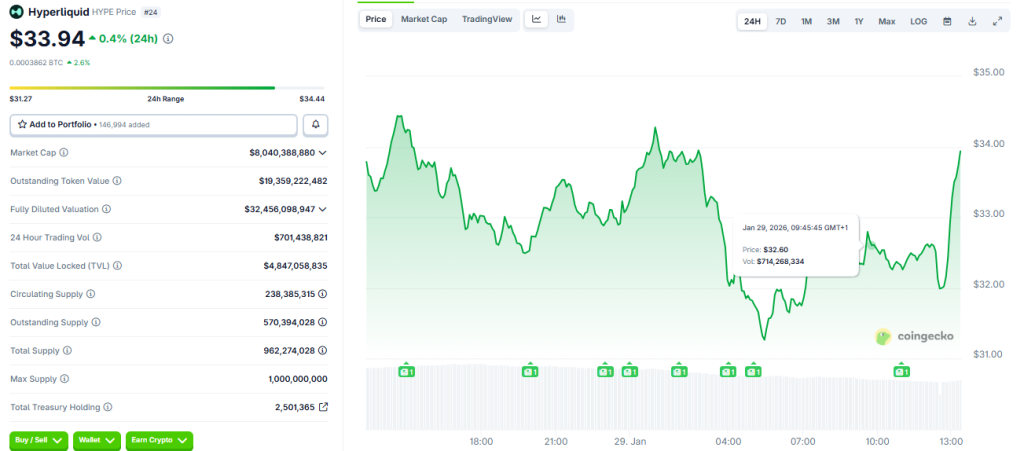
HYPE was trading around $33.9 at the time of writing, up modestly on the day but posting a weekly gain of more than 55%.
 Source: Coingecko
The token is still about 43% below its all-time high of $59.30, reached during a surge last year, with the market capitalization climbing to just over $8 billion.
At the same time, overall protocol usage metrics have not shown a dramatic shift.
The company announced this week that HIP-3 open interest (OI) hit a record $790 million, fueled by a recent surge in commodities trading. HIP-3 OI has been setting new weekly highs, up sharply from $260 million just a month ago.
Additionally, the platform founder, Jeff Yan, said Bitcoin futures liquidity on Hyperliquid had surpassed Binance in certain order book comparisons.
Hyperliquid has processed more than $25 billion in cumulative trading volume since launch, according to Flow Scan data, with the majority coming from futures markets built by third-party teams using the HIP-3 framework.
Hyperliquid’s total value locked stands near $4.6 billion, with annualized protocol revenue estimated at roughly $714 million, a portion of which is used for buybacks and burns that remove HYPE from circulation.
HYPE Reclaims 50-Day Moving Average After Months Below
From a technical perspective, analysts have highlighted a key change in HYPE’s price structure.
After months of trading below its 50-day moving average on the three-day timeframe, the token recently broke above that level, ending a sequence of lower highs that had defined the downtrend since November.
The area between roughly $28 and $29, which previously acted as resistance, is now being watched as potential support.
 Source: X/Batman
If that zone holds on a retest, technicians see room for continuation toward the mid-$30s and low-$40s.
Going back to $50 would take a much bigger move, which would be an increase of approximately 80% of the previous support area.
This rally would rely on a sustained volume and a sustained defense of the reclaimed moving average and the overall market conditions being favorable.
Analysts have observed that failure to overcome the 50-day average will nullify the bullish setup, and HYPE will be prone to a fall to lows around the $20s.
You May Also Like

Polygon: Bulls defend $0.10 demand zone – Can POL rally 15%?

Headwind Helps Best Wallet Token
