Decentralized Finance is reshaping global finance. Learn how DeFi works, why it matters, and what comes next.Decentralized Finance is reshaping global finance. Learn how DeFi works, why it matters, and what comes next.

DeFi: The Next Generation of Finance
2025/12/26 15:06
5 min read
DeFi: The Next Generation of Finance

Traditional finance was built for a world of borders, intermediaries, and closed systems. Decentralized Finance is being built for a global, digital, and permissionless economy. Decentralized Finance, commonly known as DeFi, proposes a radically different model. One where financial services are built on open blockchains, governed by code, and accessible to anyone with an internet connection.

DeFi is not simply an upgrade to existing financial rails. It represents a rethinking of how money moves, how risk is priced, and who gets access to financial tools. In this article, you will learn what DeFi is, why it matters in 2025, how it works under the hood, and where infrastructure providers like OnFinality fit into the evolving DeFi ecosystem.

DeFi: The Next Generation of Finance

Traditional finance was built for a world of borders, intermediaries, and closed systems. Decentralized Finance is being built for a global, digital, and permissionless economy. Decentralized Finance, commonly known as DeFi, proposes a radically different model. One where financial services are built on open blockchains, governed by code, and accessible to anyone with an internet connection. 

DeFi is not simply an upgrade to existing financial rails. It represents a rethinking of how money moves, how risk is priced, and who gets access to financial tools. In this article, you will learn what DeFi is, why it matters in 2025, how it works under the hood, and where infrastructure providers like OnFinality fit into the evolving DeFi ecosystem.

Table of Content

  • What Is Decentralized Finance?
  • Why Decentralized Finance Matters in 2025
  • Key Benefits and Use Cases of Decentralized Finance
  • How Decentralized Finance Works
  • Common Questions About Decentralized Finance
  • Key Takeaway
  • About OnFinality

What is Decentralized Finance?

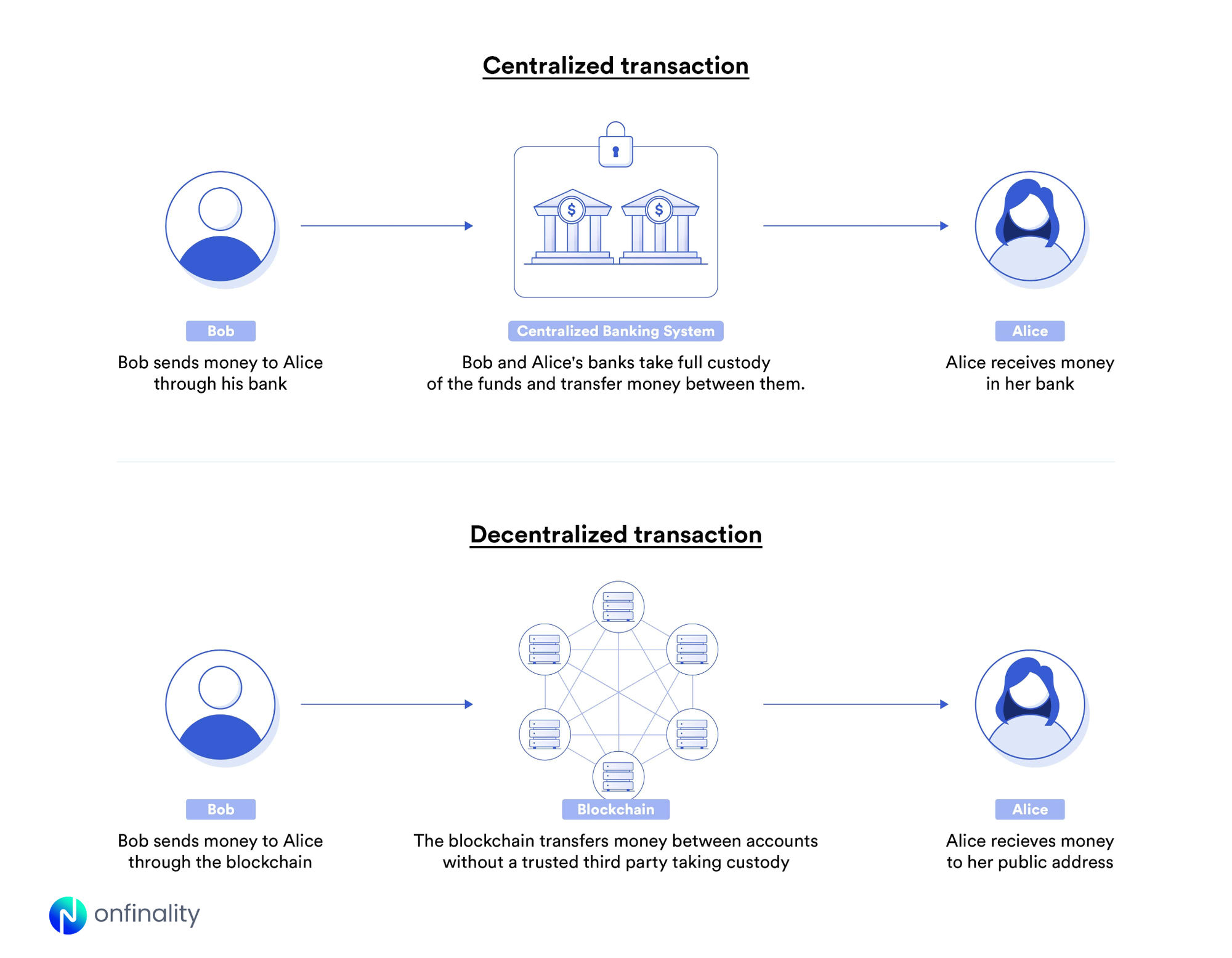
Decentralized Finance is a blockchain based financial system that replaces traditional intermediaries with smart contracts. Instead of banks, brokers, or clearing houses, DeFi protocols execute financial logic automatically on public networks.

Users interact with DeFi protocols through non custodial wallets, retaining full control of their assets. Common DeFi ecosystem components include decentralized exchanges, lending protocols, stablecoins, and derivatives platforms.

At its core, DeFi infrastructure enables trust minimization, transparency, and composability across financial services.
DeFi: The Next Generation of Finance

Why Decentralized Finance Matters in 2025

By 2025, DeFi is no longer experimental. It is becoming a financial infrastructure.

According to data from DeFiLlama, total value locked across DeFi protocols consistently measures in the hundreds of billions of dollars, despite market cycles. Major financial institutions are also exploring onchain settlement, tokenized assets, and blockchain based yield products, signaling convergence rather than replacement.

Key trends driving DeFi adoption include:

  • Growth of stablecoin based payments globally
  • Institutional interest in onchain yield and settlement
  • Demand for transparent and real time financial systems

As noted by the World Economic Forum and reports from major financial publications, blockchain based finance is increasingly viewed as a foundational layer for future markets.

Reliable RPC access, indexing, and data availability are critical here, which is why production grade infrastructure remains a bottleneck and an opportunity.

Key Benefits and Use Cases of Decentralized Finance

  • Lending and borrowing: Earn yield or access liquidity without selling assets. Example, Aave, Morpho
  • Decentralized exchanges: Trade assets directly from wallets without custodians. Example, Uniswap, Pancakeswap
  • Stablecoins: Enable price stable, programmable money for global payments. Example, USDC, USDT
  • Derivatives and structured products: Create onchain exposure and hedging strategies. Example, LIDO, Beefy
  • Cross border finance: Faster and cheaper global settlement. Example, CopperX, TransaK

Each use case depends heavily on uptime, data accuracy, and network reliability.

DeFi: The Next Generation of Finance

How Decentralized Finance Works

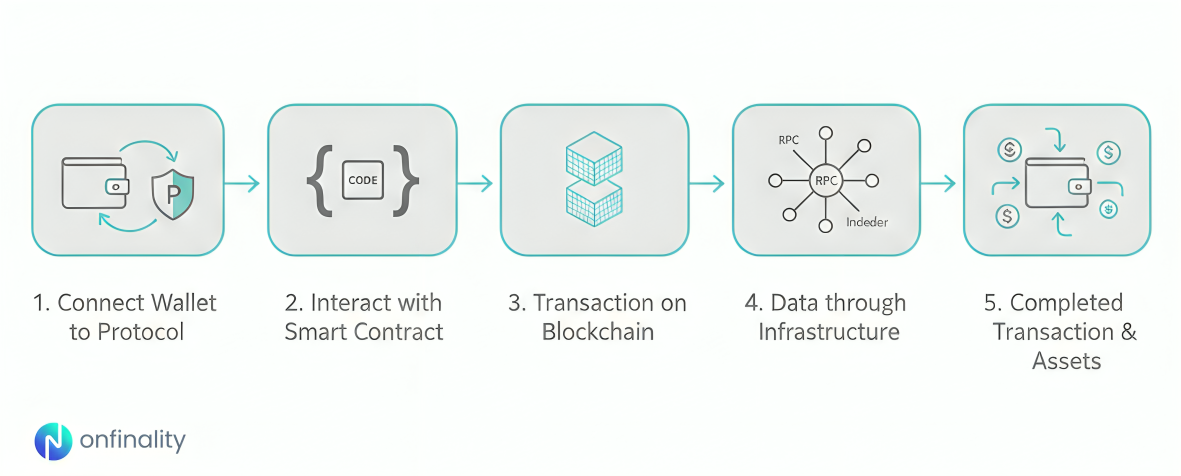
  1. Users connect a non custodial wallet to a DeFi protocol
  2. Smart contracts define financial logic and risk parameters
  3. Transactions are executed and settled on a blockchain
  4. The funds are moved from one account to another depending on the action performed by the user
  5. User can withdraw their funds anytime as it is fully onchain
  6. Data is fetched through RPCs and indexed services

At scale, DeFi applications rely on high throughput RPC infrastructure, fast indexing, and consistent uptime to support real time financial activity.
DeFi: The Next Generation of Finance

Common Questions About Decentralized Finance

Is DeFi safe to use?

DeFi security depends on smart contract audits, protocol design, and infrastructure reliability. Risks still exist, but transparency allows users to assess them directly.

How is DeFi different from traditional finance?

DeFi removes intermediaries, operates 24/7, and allows direct asset ownership without centralized custody.

Can institutions use DeFi?

Yes. Many institutions are exploring permissioned DeFi models, tokenized assets, and onchain settlement layers.

What role does infrastructure play in DeFi?

Without reliable RPCs, indexing, and data access, DeFi applications cannot scale or operate safely.

Key Takeaway

  • Decentralized Finance is redefining how financial systems are built
  • DeFi enables open, transparent, and programmable finance
  • Infrastructure reliability is essential for DeFi at scale
  • The future of finance is increasingly onchain

Decentralized Finance is not a passing trend. It is the foundation of the next generation of financial systems.

About Onfinality

OnFinality is a blockchain infrastructure platform that serves hundreds of billions of API requests monthly across more than 130 networks, including Avalanche, BNB Chain, Cosmos, Polkadot, Ethereum, and Polygon. It provides scalable APIs, RPC endpoints, node hosting, and indexing tools to help developers launch and grow blockchain networks efficiently. OnFinality’s mission is to make Web3 infrastructure effortless so developers can focus on building the future of decentralised applications.

App | Website | Twitter | Telegram | LinkedIn | YouTube

Disclaimer: The articles reposted on this site are sourced from public platforms and are provided for informational purposes only. They do not necessarily reflect the views of MEXC. All rights remain with the original authors. If you believe any content infringes on third-party rights, please contact service@support.mexc.com for removal. MEXC makes no guarantees regarding the accuracy, completeness, or timeliness of the content and is not responsible for any actions taken based on the information provided. The content does not constitute financial, legal, or other professional advice, nor should it be considered a recommendation or endorsement by MEXC.

You May Also Like

Ethereum unveils roadmap focusing on scaling, interoperability, and security at Japan Dev Conference

Ethereum unveils roadmap focusing on scaling, interoperability, and security at Japan Dev Conference

The post Ethereum unveils roadmap focusing on scaling, interoperability, and security at Japan Dev Conference appeared on BitcoinEthereumNews.com. Key Takeaways Ethereum’s new roadmap was presented by Vitalik Buterin at the Japan Dev Conference. Short-term priorities include Layer 1 scaling and raising gas limits to enhance transaction throughput. Vitalik Buterin presented Ethereum’s development roadmap at the Japan Dev Conference today, outlining the blockchain platform’s priorities across multiple timeframes. The short-term goals focus on scaling solutions and increasing Layer 1 gas limits to improve transaction capacity. Mid-term objectives target enhanced cross-Layer 2 interoperability and faster network responsiveness to create a more seamless user experience across different scaling solutions. The long-term vision emphasizes building a secure, simple, quantum-resistant, and formally verified minimalist Ethereum network. This approach aims to future-proof the platform against emerging technological threats while maintaining its core functionality. The roadmap presentation comes as Ethereum continues to compete with other blockchain platforms for market share in the smart contract and decentralized application space. Source: https://cryptobriefing.com/ethereum-roadmap-scaling-interoperability-security-japan/
Share
BitcoinEthereumNews2025/09/18 00:25
CEO Sandeep Nailwal Shared Highlights About RWA on Polygon

CEO Sandeep Nailwal Shared Highlights About RWA on Polygon

The post CEO Sandeep Nailwal Shared Highlights About RWA on Polygon appeared on BitcoinEthereumNews.com. Polygon CEO Sandeep Nailwal highlighted Polygon’s lead in global bonds, Spiko US T-Bill, and Spiko Euro T-Bill. Polygon published an X post to share that its roadmap to GigaGas was still scaling. Sentiments around POL price were last seen to be bearish. Polygon CEO Sandeep Nailwal shared key pointers from the Dune and RWA.xyz report. These pertain to highlights about RWA on Polygon. Simultaneously, Polygon underlined its roadmap towards GigaGas. Sentiments around POL price were last seen fumbling under bearish emotions. Polygon CEO Sandeep Nailwal on Polygon RWA CEO Sandeep Nailwal highlighted three key points from the Dune and RWA.xyz report. The Chief Executive of Polygon maintained that Polygon PoS was hosting RWA TVL worth $1.13 billion across 269 assets plus 2,900 holders. Nailwal confirmed from the report that RWA was happening on Polygon. The Dune and https://t.co/W6WSFlHoQF report on RWA is out and it shows that RWA is happening on Polygon. Here are a few highlights: – Leading in Global Bonds: Polygon holds 62% share of tokenized global bonds (driven by Spiko’s euro MMF and Cashlink euro issues) – Spiko U.S.… — Sandeep | CEO, Polygon Foundation (※,※) (@sandeepnailwal) September 17, 2025 The X post published by Polygon CEO Sandeep Nailwal underlined that the ecosystem was leading in global bonds by holding a 62% share of tokenized global bonds. He further highlighted that Polygon was leading with Spiko US T-Bill at approximately 29% share of TVL along with Ethereum, adding that the ecosystem had more than 50% share in the number of holders. Finally, Sandeep highlighted from the report that there was a strong adoption for Spiko Euro T-Bill with 38% share of TVL. He added that 68% of returns were on Polygon across all the chains. Polygon Roadmap to GigaGas In a different update from Polygon, the community…
Share
BitcoinEthereumNews2025/09/18 01:10
Kalshi debuts ecosystem hub with Solana and Base

Kalshi debuts ecosystem hub with Solana and Base

The post Kalshi debuts ecosystem hub with Solana and Base appeared on BitcoinEthereumNews.com. Kalshi, the US-regulated prediction market exchange, rolled out a new program on Wednesday called KalshiEco Hub. The initiative, developed in partnership with Solana and Coinbase-backed Base, is designed to attract builders, traders, and content creators to a growing ecosystem around prediction markets. By combining its regulatory footing with crypto-native infrastructure, Kalshi said it is aiming to become a bridge between traditional finance and onchain innovation. The hub offers grants, technical assistance, and marketing support to selected projects. Kalshi also announced that it will support native deposits of Solana’s SOL token and USDC stablecoin, making it easier for users already active in crypto to participate directly. Early collaborators include Kalshinomics, a dashboard for market analytics, and Verso, which is building professional-grade tools for market discovery and execution. Other partners, such as Caddy, are exploring ways to expand retail-facing trading experiences. Kalshi’s move to embrace blockchain partnerships comes at a time when prediction markets are drawing fresh attention for their ability to capture sentiment around elections, economic policy, and cultural events. Competitor Polymarket recently acquired QCEX — a derivatives exchange with a CFTC license — to pave its way back into US operations under regulatory compliance. At the same time, platforms like PredictIt continue to push for a clearer regulatory footing. The legal terrain remains complex, with some states issuing cease-and-desist orders over whether these event contracts count as gambling, not finance. This is a developing story. This article was generated with the assistance of AI and reviewed by editor Jeffrey Albus before publication. Get the news in your inbox. Explore Blockworks newsletters: Source: https://blockworks.co/news/kalshi-ecosystem-hub-solana-base
Share
BitcoinEthereumNews2025/09/18 04:40