The post Wall Street boosts trading desks to exploit pricing gaps in prediction markets appeared on BitcoinEthereumNews.com. Wall Street is staffing up its tradingThe post Wall Street boosts trading desks to exploit pricing gaps in prediction markets appeared on BitcoinEthereumNews.com. Wall Street is staffing up its trading

Wall Street boosts trading desks to exploit pricing gaps in prediction markets

4 min read

Wall Street is staffing up its trading floors to go after pricing gaps across prediction markets, targeting spreads between contracts tied to things like sports and elections.

Traders are hired to catch split-second price differences on platforms like Polymarket and Kalshi, and flip them for profit.

Both platforms have moved toward sports-heavy contracts after first getting really popular during the 2024 presidential election, and trading volume has exploded.

Back in early 2024, they were pulling in under $100 million a month. By December 2025, that shot up to over $8 billion.

Trading companies ramp up hiring for dedicated prediction desks

One of the most aggressive is DRW, Don Wilson’s company. They’re offering up to $200,000 in base pay for a trader to handle markets on Polymarket and Kalshi in real time. The posting says they’re building a “dedicated prediction markets desk.”

Susquehanna, which already runs a sports trading desk, is also expanding. They’re hiring people to spot “incorrect fair values,” catch “unusual behaviors”, and flag “inefficiencies.” The company wants traders who know how to read noise and turn it into edge.

Tyr Capital, a crypto hedge fund, is going after people who are already running “sophisticated strategies.” They’re not teaching. They want people who can walk in and plug into their system. Ed Hindi, their CIO, said they’re “extremely bullish on prediction markets’ prospects, especially the monetary policy and economics data side of it over the coming couple of years.”

Madison Zitzner, vice president of quantitative research and prop trading at Selby Jennings, said companies are clearly in “growth mode.” She added, “They really want to understand the liquidity, the scalability that these types of strategies can bring.”

New players are popping up too.

Start-ups like Kirin and Anti Capital in New York, crypto investor Sfermion in Chicago, and Swiss-based G-20 Advisors are all hiring. G-20 wants a quantitative engineer to “design models that estimate event probabilities, detect mispricing” and manage risk.

The activity is high, but it’s not wild betting. Analysts say companies are skipping the weird contracts, like when President Donald Trump might buy Greenland, or who’ll win the Oscars. Instead, they’re focusing on arbitrage; buying low on one platform, selling high on another. Just like high-frequency traders do with stocks.

Joseph Saluzzi, co-founder of Themis Trading, said, “The big guys are going to be trading one market versus another, they’re not going to be throwing darts at a dartboard, betting that Trump will invade whichever country.” He added, “In a market like this that’s so new, where different platforms are so siloed, there will be so many arbitrage opportunities.”

Wall Street sees arbitrage potential despite liquidity issues

Some are still cautious. Boaz Weinstein, founder of Saba Capital, spoke at a closed-door conference in October and said prediction markets can help hedge portfolios more precisely.

Standing beside Polymarket CEO Shayne Coplan, he said managers could go “bigger” on trades when they’re sure of the odds.

He gave one example: Polymarket showed a 50% chance of a recession, while credit markets showed just 2%.

That kind of gap, he said, creates “an infinite number of pair trades that you couldn’t do before.” Still, someone close to Saba said the fund had “done nothing yet in prediction markets but watch.”

Most large hedge funds are still on the sidelines. It’s mostly because of the liquidity gap. Compared to trillions in other markets, prediction markets are still small, and that makes it hard to allocate serious cash.

But market-makers don’t care. They’ve already jumped in. Susquehanna, led by Jeff Yass, was Kalshi’s first market-maker. They also have a deal with Robinhood for event contracts. Kalshi gives market-makers perks: lower fees, special limits, better access. The full terms aren’t public.

Other trading giants are scaling up too. Jump Trading and Flow Traders, based in Amsterdam, are active.

There’s also been controversy. A mystery trader on Polymarket made over $400,000 betting on Nicolás Maduro being captured by the US military in early January.

Last fall, a new user placed winning trades predicting María Corina Machado would win the Nobel Peace Prize, hours before it was announced.

Congress has noticed. Ritchie Torres, a member of the House, has proposed a bill that would ban insiders from trading on prediction markets. The bill would stop those with non-public info from engaging in “covered transactions involving prediction market contracts.”

Claim your free seat in an exclusive crypto trading community – limited to 1,000 members.

Source: https://www.cryptopolitan.com/wall-street-pricing-gaps-prediction-markets/

Market Opportunity
Wink Logo
Wink Price(LIKE)
$0.002004
$0.002004$0.002004
-1.62%
USD
Wink (LIKE) Live Price Chart
Disclaimer: The articles reposted on this site are sourced from public platforms and are provided for informational purposes only. They do not necessarily reflect the views of MEXC. All rights remain with the original authors. If you believe any content infringes on third-party rights, please contact service@support.mexc.com for removal. MEXC makes no guarantees regarding the accuracy, completeness, or timeliness of the content and is not responsible for any actions taken based on the information provided. The content does not constitute financial, legal, or other professional advice, nor should it be considered a recommendation or endorsement by MEXC.

You May Also Like

Three dormant wallets, suspected to belong to the same entity, purchased 5,970 ETH eight hours ago.

Three dormant wallets, suspected to belong to the same entity, purchased 5,970 ETH eight hours ago.

PANews reported on February 4 that, according to Lookonchain monitoring, three wallets that had been dormant for four years (likely controlled by the same entity
Share
PANews2026/02/04 11:36
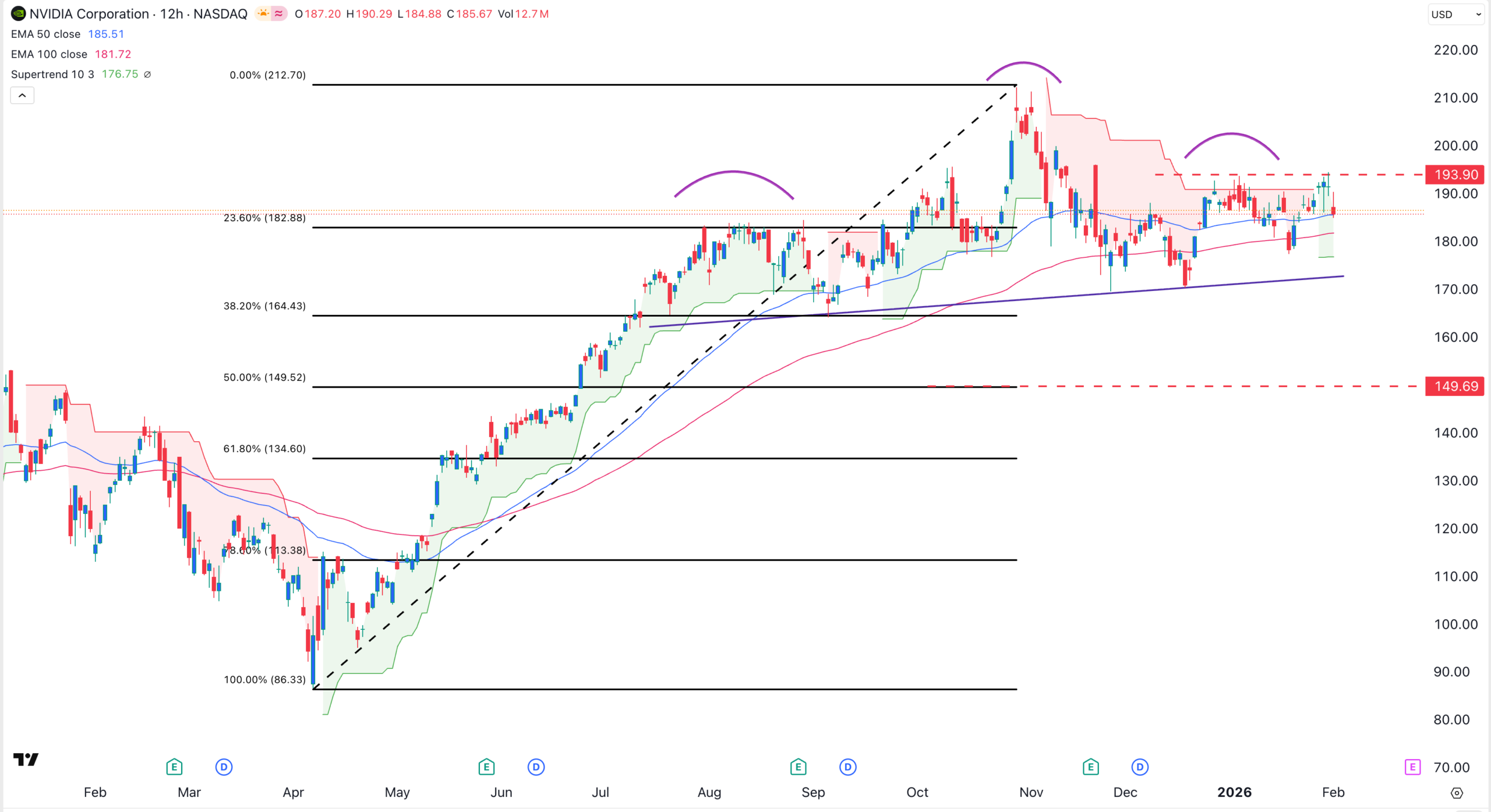
NVIDIA Stock Price Analysis as OpenAI Issues Concerns About its Chips

NVIDIA Stock Price Analysis as OpenAI Issues Concerns About its Chips

Key Insights NVIDIA stock started the week in the red. It crashed by over 2%. Meanwhile, the S&P 500, Dow Jones, and Nasdaq 100 moved close to their all-time highs
Share
Themarketperiodical2026/02/04 11:27
Ondo Finance Launches USDY Yieldcoin on Stellar, Bringing Tokenized U.S. Treasuries to Users

Ondo Finance Launches USDY Yieldcoin on Stellar, Bringing Tokenized U.S. Treasuries to Users

Ondo Finance, a U.S.-based digital asset firm specializing in bringing traditional financial products on-chain through tokenization, is expanding its yieldcoin USDY to the Stellar network. This lates update marks a step forward in merging tokenized real-world assets with a global payments infrastructure, unlocking new opportunities for users worldwide. The announcement was made at the Stellar Meridian event in Copacabana, Rio de Janeiro, on September 17. USDY Joins the Stellar Ecosystem Ondo Finance, a recognized leader in tokenized real-world assets, announced the deployment of United States Dollar Yield (USDY) on Stellar, the payments-focused blockchain known for speed and low transaction costs. USDY is the most widely available “yieldcoin,” offering investors access to onchain assets backed by U.S. Treasuries. This launch allows Stellar’s global user base to tap into permissionless, yield-bearing assets tied to one of the safest financial instruments in the world. It also aligns with Stellar’s mission of driving fast, affordable cross-border payments. Combining Yield with Payments Infrastructure “Stablecoins unlocked global access to the U.S. dollar. With USDY, we’re taking the next step by bringing U.S. Treasuries onchain in a form that combines stability, liquidity, and yield,” said Ian De Bode, Chief Strategy Officer at Ondo Finance. “Fast, affordable cross-border payments are at the center of what Stellar was designed to do. The global reach of the Stellar ecosystem combined with a yield-bearing asset like USDY levels up what is possible onchain, allowing wallets and businesses to offer yield opportunities to their users,” said Denelle Dixon, CEO of the Stellar Development Foundation. Ondo claims by pairing USDY with Stellar’s infrastructure, new possibilities open up in treasury management, collateralization, and everyday financial applications. Unlocking Institutional and Retail Use Cases USDY currently manages over $650 million in total value locked (TVL) across nine blockchains and offers a 5.3% APY. By launching on Stellar, Ondo Finance extends these benefits to global retail and institutional users. The firm explains balances on Stellar can now become productive, supporting use cases such as onchain savings, institutional treasury strategies, cost-efficient collateral for DeFi protocols, and remittance flows that carry yield rather than remaining static. A Milestone for Tokenized Treasuries With the integration of USDY, Stellar users gain more than just access to stable-value assets—they gain access to institutional-grade yield. For investors outside the U.S., the launch represents a new way to combine the safety of Treasuries with the accessibility of blockchain technology. As tokenization accelerates globally, Ondo Finance’s decision to deploy USDY on Stellar reinforces the narrative that blockchain is not just about speculation, but about reimagining the global financial system through secure, yield-bearing digital assets
Share
CryptoNews2025/09/18 00:46