Ukraine has gone ahead to restrict entry into Polymarket, which is further escalating an expanding global crackdown on prediction markets that regulators are increasinglyUkraine has gone ahead to restrict entry into Polymarket, which is further escalating an expanding global crackdown on prediction markets that regulators are increasingly

Ukraine Blocks Polymarket Over ‘War Bets’ as Global Crackdown Widens

3 min read

Ukraine has gone ahead to restrict entry into Polymarket, which is further escalating an expanding global crackdown on prediction markets that regulators are increasingly considering to be illegal gambling or derivatives trading.

The ruling has drawn fresh scrutiny to the fast-growing crypto platform, raising questions about whether markets tied to real-world events can operate alongside national gambling, financial, and public policy rules, especially on matters involving war and geopolitics.

The ban was issued on Dec. 10, 2025, by Ukraine’s National Commission for the Regulation of Electronic Communications under Resolution No. 695.

The order requires internet service providers to restrict access to online resources that organize, conduct, or facilitate gambling activities without a valid domestic license.

War-Linked Bets Push Ukraine to Ban Polymarket

As part of the enforcement, the domain polymarket.com was added to Ukraine’s public register of blocked websites, effectively cutting off access for users inside the country.

Local media reported the enforcement on Monday, confirming that the block is now active.

Ukrainian officials have pointed to Polymarket’s role in facilitating wagers on geopolitical outcomes linked to Russia’s invasion as a key factor behind the move.

While Polymarket does not offer fixed odds like traditional sportsbooks, regulators argue that the distinction is largely technical.

The platform allows users to buy and sell shares linked to specific outcomes, with prices reflecting the market’s implied probability.

In Ukraine’s view, this structure still constitutes gambling when offered without authorization, especially when the underlying events involve an active military conflict.

Polymarket, founded in 2020 by Shane Coplan, has grown into one of the most prominent prediction platforms globally, with an estimated valuation of around $8 billion.

All activity on the platform is conducted using the USDC stablecoin on the Polygon blockchain, making transactions and settlements publicly visible.

Supporters often point to this transparency as a key difference from offshore betting sites, but regulators across multiple jurisdictions have remained unconvinced.

Ukraine’s action places it among a growing list of jurisdictions that have restricted or fully blocked Polymarket.

The platform is currently inaccessible in at least 33 countries, including the United States, the United Kingdom, France, Germany, Italy, Poland, Singapore, Australia, Iran, and Russia.
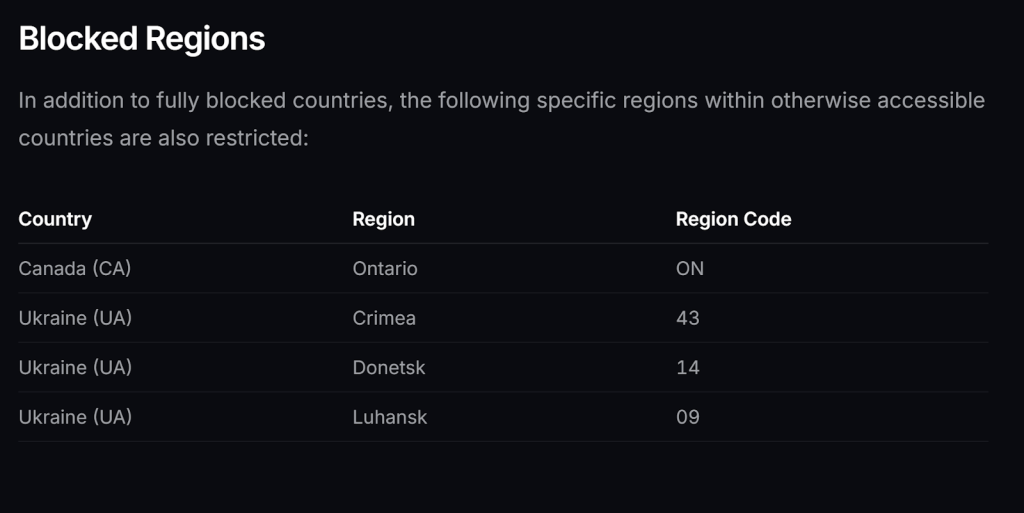
Source: Polymarket

In some regions, access is partially restricted, allowing users only to close existing positions while barring new trades.

Polymarket’s own documentation attributes these limits to a mix of international sanctions, local gambling laws, financial regulations, and anti-money laundering requirements.

Prediction Markets Face Growing Global Crackdown

The Ukrainian block also reflects a broader global push to rein in prediction markets as their reach and influence expand. In the United States, scrutiny has intensified in recent weeks.

On Jan. 9, the Tennessee Sports Wagering Council issued cease-and-desist letters to Polymarket, Kalshi, and Crypto.com.

Regulators accused the platforms of operating unlicensed sports wagering products in violation of state law, despite their registration with the Commodity Futures Trading Commission as designated contract markets.

At the federal level, concerns have extended beyond licensing into questions of public integrity. On Jan. 6, New York Representative Ritchie Torres announced plans to introduce the Public Integrity in Financial Prediction Markets Act of 2026.

The enforcement actions come at a time when Polymarket is attempting to reestablish a foothold in the U.S. market.

After exiting the country in 2022 and paying a $1.4 million penalty to settle CFTC allegations, the platform has been testing a limited U.S. exchange following its acquisition of QCX LLC and the securing of a designated contract market license.

Disclaimer: The articles reposted on this site are sourced from public platforms and are provided for informational purposes only. They do not necessarily reflect the views of MEXC. All rights remain with the original authors. If you believe any content infringes on third-party rights, please contact service@support.mexc.com for removal. MEXC makes no guarantees regarding the accuracy, completeness, or timeliness of the content and is not responsible for any actions taken based on the information provided. The content does not constitute financial, legal, or other professional advice, nor should it be considered a recommendation or endorsement by MEXC.

You May Also Like

Three dormant wallets, suspected to belong to the same entity, purchased 5,970 ETH eight hours ago.
Three dormant wallets, suspected to belong to the same entity, purchased 5,970 ETH eight hours ago.

PANews reported on February 4 that, according to Lookonchain monitoring, three wallets that had been dormant for four years (likely controlled by the same entity
Share
PANews2026/02/04 11:36
NVIDIA Stock Price Analysis as OpenAI Issues Concerns About its Chips

NVIDIA Stock Price Analysis as OpenAI Issues Concerns About its Chips

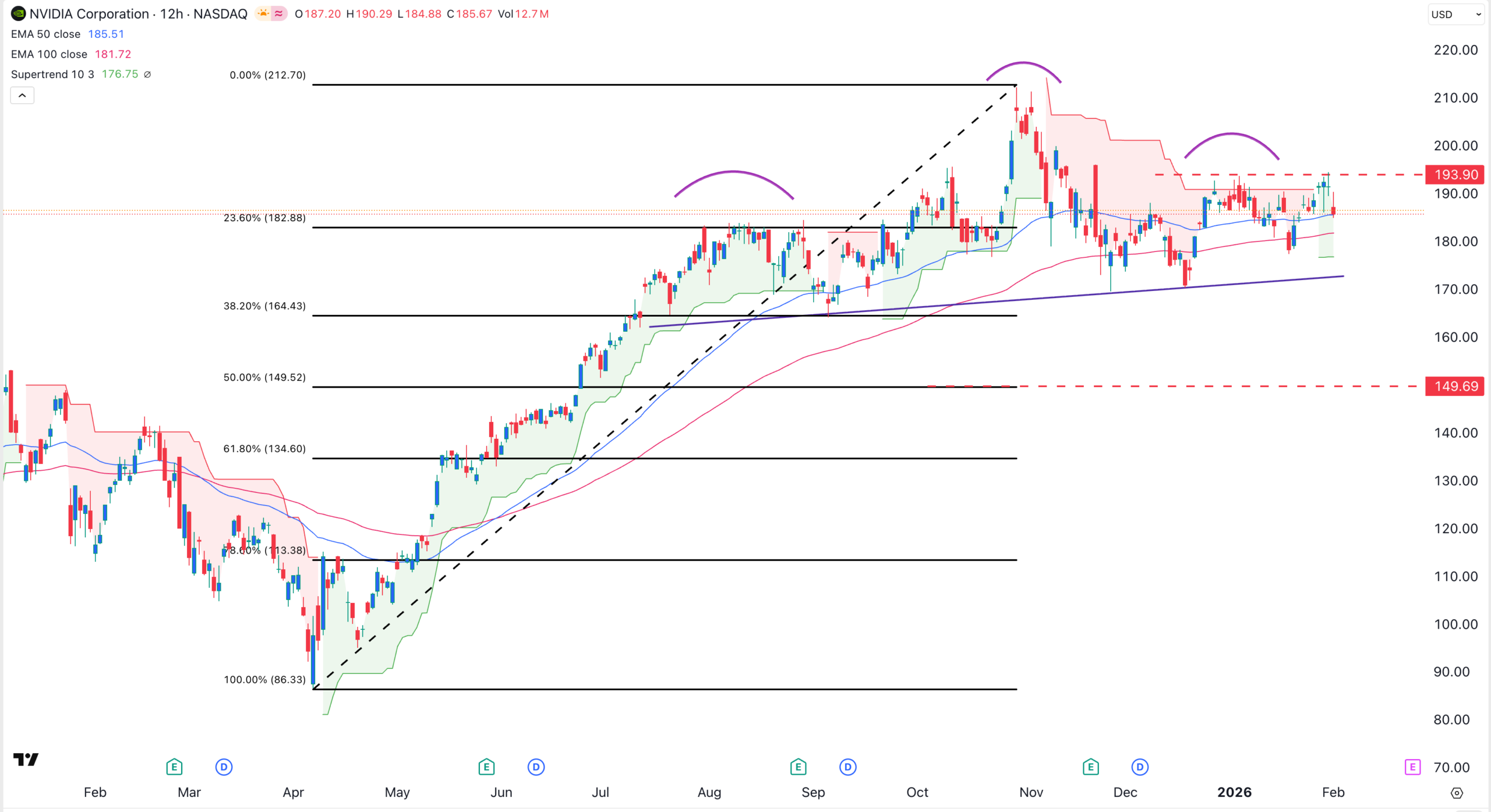
Key Insights NVIDIA stock started the week in the red. It crashed by over 2%. Meanwhile, the S&P 500, Dow Jones, and Nasdaq 100 moved close to their all-time highs
Share
Themarketperiodical2026/02/04 11:27
Ondo Finance Launches USDY Yieldcoin on Stellar, Bringing Tokenized U.S. Treasuries to Users

Ondo Finance Launches USDY Yieldcoin on Stellar, Bringing Tokenized U.S. Treasuries to Users

Ondo Finance, a U.S.-based digital asset firm specializing in bringing traditional financial products on-chain through tokenization, is expanding its yieldcoin USDY to the Stellar network. This lates update marks a step forward in merging tokenized real-world assets with a global payments infrastructure, unlocking new opportunities for users worldwide. The announcement was made at the Stellar Meridian event in Copacabana, Rio de Janeiro, on September 17. USDY Joins the Stellar Ecosystem Ondo Finance, a recognized leader in tokenized real-world assets, announced the deployment of United States Dollar Yield (USDY) on Stellar, the payments-focused blockchain known for speed and low transaction costs. USDY is the most widely available “yieldcoin,” offering investors access to onchain assets backed by U.S. Treasuries. This launch allows Stellar’s global user base to tap into permissionless, yield-bearing assets tied to one of the safest financial instruments in the world. It also aligns with Stellar’s mission of driving fast, affordable cross-border payments. Combining Yield with Payments Infrastructure “Stablecoins unlocked global access to the U.S. dollar. With USDY, we’re taking the next step by bringing U.S. Treasuries onchain in a form that combines stability, liquidity, and yield,” said Ian De Bode, Chief Strategy Officer at Ondo Finance. “Fast, affordable cross-border payments are at the center of what Stellar was designed to do. The global reach of the Stellar ecosystem combined with a yield-bearing asset like USDY levels up what is possible onchain, allowing wallets and businesses to offer yield opportunities to their users,” said Denelle Dixon, CEO of the Stellar Development Foundation. Ondo claims by pairing USDY with Stellar’s infrastructure, new possibilities open up in treasury management, collateralization, and everyday financial applications. Unlocking Institutional and Retail Use Cases USDY currently manages over $650 million in total value locked (TVL) across nine blockchains and offers a 5.3% APY. By launching on Stellar, Ondo Finance extends these benefits to global retail and institutional users. The firm explains balances on Stellar can now become productive, supporting use cases such as onchain savings, institutional treasury strategies, cost-efficient collateral for DeFi protocols, and remittance flows that carry yield rather than remaining static. A Milestone for Tokenized Treasuries With the integration of USDY, Stellar users gain more than just access to stable-value assets—they gain access to institutional-grade yield. For investors outside the U.S., the launch represents a new way to combine the safety of Treasuries with the accessibility of blockchain technology. As tokenization accelerates globally, Ondo Finance’s decision to deploy USDY on Stellar reinforces the narrative that blockchain is not just about speculation, but about reimagining the global financial system through secure, yield-bearing digital assets
Share
CryptoNews2025/09/18 00:46
