The US Treasury Department officially scrapped crypto broker reporting rules on Thursday, following a vote by Congress to revoke them under the Congressional Review Act, which President Trump signed in April. 💥 BREAKING: CRYPTO TAXES The US Treasury has removed crypto broker reporting rules — including Form 1099‑DA It was designed to require crypto brokers, including DeFi platforms, to report users’ digital asset transactions to the IRS for tax compliance Let’s gooo! 🔥 pic.twitter.com/dpGOASbW3Y — Real World Asset Watchlist (@RWAwatchlist_) July 10, 2025 The regulation titled “Gross Proceeds Reporting by Brokers that Regularly Provide Services Effectuating Digital Asset Sales” was published December 30, 2024, and is intended to require certain decentralized finance industry participants to file information returns as brokers effective February 28, 2025. Source: federalregister.gov Under Public Law 119-5 and the Congressional Review Act, the final rule has no legal force or effect and is considered null and void, as if it had never taken effect. The Treasury is removing the rule from the Code of Federal Regulations and reverting to the previous text, which excluded entities solely engaged in validating distributed ledger transactions or selling hardware for private key control from broker reporting requirements. Republicans in Congress successfully challenged the Biden-era rule that would have classified DeFi platforms as brokers, requiring extensive data collection and reporting obligations. The Treasury estimated that billions in crypto-related taxes were going uncollected annually, but industry advocates argued that the requirements were technically impossible for decentralized platforms to implement. The regulation faced widespread criticism for misunderstanding decentralized technology and potentially driving innovation overseas, prompting legal challenges from the Blockchain Association and Texas Blockchain Council . Congressional Battle Over DeFi Innovation and Tax Compliance Senator Ted Cruz led the Congressional Review Act resolution alongside Representative Mike Carey, arguing the rule represented government overreach that would stifle American cryptocurrency innovation. Cruz stated the regulation “ directly and immediately would harm American cryptocurrency innovation and drive development overseas. “ 1/ @SenTedCruz ’s CRA resolution to roll back the DeFi Broker Rule – anti-crypto, anti-privacy IRS midnight rulemaking – is critical to providing clarity for crypto and DeFi in the US. Congress should vote YES on the CRA. This has been a long battle… How did we get here? 👇 — Kristin Smith (@KMSmithDC) February 12, 2025 The Joint Committee on Taxation estimated repealing the rule could cost the government nearly $4 billion over ten years in lost tax revenue. Despite projected losses, lawmakers supporting repeal prioritized privacy, technical feasibility, and innovation over tax collection efficiency. House Financial Services Committee Chairman French Hill also condemned the proposal as excessive government intervention, arguing that defining DeFi software providers as brokers would create costly reporting obligations for entities that never take custody of user funds. The regulation threatened to push American digital asset development overseas while undermining technological progress. White House Crypto Czar David Sacks supported the repeal effort, calling the regulation an “ 11th-hour attack on the crypto community by the Biden administration. ” The White House is pleased to announce its support for the CRA introduced by @SenTedCruz and @RepMikeCarey to rescind the so-called Broker DeFi Rule, an 11th hour attack on the crypto community by the Biden administration. pic.twitter.com/T7Hxasb4aC — David Sacks (@davidsacks47) March 4, 2025 The administration positioned itself as strongly supportive of crypto industry concerns while establishing federal working groups on digital asset regulation. The successful repeal prevents the IRS from reintroducing similar proposals in the future, marking a significant victory for DeFi advocates. Broader Regulatory Shifts Signal Pro-Crypto Policy Direction The Treasury Department separately announced exemptions that will free banks and brokerage firms from reporting customers’ crypto holdings on financial statements, contingent upon demonstrating effective digital asset risk management capabilities. The SEC began issuing guidance clarifying that some crypto arrangements might not qualify as liabilities for reporting purposes. These regulatory relief measures came amid sustained Congressional pressure to revise the controversial SAB 121 accounting bulletin. While the Senate voted to overturn SAB 121 in May with 60 senators supporting repeal, President Biden’s veto prevented the measure from taking effect. States continue advancing Bitcoin legislation independently of federal action, with 23 states introducing Bitcoin reserve bills and 35 proposals under consideration. In fact, following that, Kentucky Governor Andy Beshear signed the “Bitcoin Rights” bill into law . Beyond the United States, Japan’s Senate has also recently approved legal amendments that give crypto brokerage firms increased operational freedom through new “intermediary business” categories, which come with reduced regulatory barriers. The legislation creates customer safeguards while promoting innovation, requiring the Prime Minister’s approval for crypto operators to hold assets domestically.The US Treasury Department officially scrapped crypto broker reporting rules on Thursday, following a vote by Congress to revoke them under the Congressional Review Act, which President Trump signed in April. 💥 BREAKING: CRYPTO TAXES The US Treasury has removed crypto broker reporting rules — including Form 1099‑DA It was designed to require crypto brokers, including DeFi platforms, to report users’ digital asset transactions to the IRS for tax compliance Let’s gooo! 🔥 pic.twitter.com/dpGOASbW3Y — Real World Asset Watchlist (@RWAwatchlist_) July 10, 2025 The regulation titled “Gross Proceeds Reporting by Brokers that Regularly Provide Services Effectuating Digital Asset Sales” was published December 30, 2024, and is intended to require certain decentralized finance industry participants to file information returns as brokers effective February 28, 2025. Source: federalregister.gov Under Public Law 119-5 and the Congressional Review Act, the final rule has no legal force or effect and is considered null and void, as if it had never taken effect. The Treasury is removing the rule from the Code of Federal Regulations and reverting to the previous text, which excluded entities solely engaged in validating distributed ledger transactions or selling hardware for private key control from broker reporting requirements. Republicans in Congress successfully challenged the Biden-era rule that would have classified DeFi platforms as brokers, requiring extensive data collection and reporting obligations. The Treasury estimated that billions in crypto-related taxes were going uncollected annually, but industry advocates argued that the requirements were technically impossible for decentralized platforms to implement. The regulation faced widespread criticism for misunderstanding decentralized technology and potentially driving innovation overseas, prompting legal challenges from the Blockchain Association and Texas Blockchain Council . Congressional Battle Over DeFi Innovation and Tax Compliance Senator Ted Cruz led the Congressional Review Act resolution alongside Representative Mike Carey, arguing the rule represented government overreach that would stifle American cryptocurrency innovation. Cruz stated the regulation “ directly and immediately would harm American cryptocurrency innovation and drive development overseas. “ 1/ @SenTedCruz ’s CRA resolution to roll back the DeFi Broker Rule – anti-crypto, anti-privacy IRS midnight rulemaking – is critical to providing clarity for crypto and DeFi in the US. Congress should vote YES on the CRA. This has been a long battle… How did we get here? 👇 — Kristin Smith (@KMSmithDC) February 12, 2025 The Joint Committee on Taxation estimated repealing the rule could cost the government nearly $4 billion over ten years in lost tax revenue. Despite projected losses, lawmakers supporting repeal prioritized privacy, technical feasibility, and innovation over tax collection efficiency. House Financial Services Committee Chairman French Hill also condemned the proposal as excessive government intervention, arguing that defining DeFi software providers as brokers would create costly reporting obligations for entities that never take custody of user funds. The regulation threatened to push American digital asset development overseas while undermining technological progress. White House Crypto Czar David Sacks supported the repeal effort, calling the regulation an “ 11th-hour attack on the crypto community by the Biden administration. ” The White House is pleased to announce its support for the CRA introduced by @SenTedCruz and @RepMikeCarey to rescind the so-called Broker DeFi Rule, an 11th hour attack on the crypto community by the Biden administration. pic.twitter.com/T7Hxasb4aC — David Sacks (@davidsacks47) March 4, 2025 The administration positioned itself as strongly supportive of crypto industry concerns while establishing federal working groups on digital asset regulation. The successful repeal prevents the IRS from reintroducing similar proposals in the future, marking a significant victory for DeFi advocates. Broader Regulatory Shifts Signal Pro-Crypto Policy Direction The Treasury Department separately announced exemptions that will free banks and brokerage firms from reporting customers’ crypto holdings on financial statements, contingent upon demonstrating effective digital asset risk management capabilities. The SEC began issuing guidance clarifying that some crypto arrangements might not qualify as liabilities for reporting purposes. These regulatory relief measures came amid sustained Congressional pressure to revise the controversial SAB 121 accounting bulletin. While the Senate voted to overturn SAB 121 in May with 60 senators supporting repeal, President Biden’s veto prevented the measure from taking effect. States continue advancing Bitcoin legislation independently of federal action, with 23 states introducing Bitcoin reserve bills and 35 proposals under consideration. In fact, following that, Kentucky Governor Andy Beshear signed the “Bitcoin Rights” bill into law . Beyond the United States, Japan’s Senate has also recently approved legal amendments that give crypto brokerage firms increased operational freedom through new “intermediary business” categories, which come with reduced regulatory barriers. The legislation creates customer safeguards while promoting innovation, requiring the Prime Minister’s approval for crypto operators to hold assets domestically.

US Treasury Officially Scraps Crypto Broker Reporting Rules After Congressional Vote

4 min read

The US Treasury Department officially scrapped crypto broker reporting rules on Thursday, following a vote by Congress to revoke them under the Congressional Review Act, which President Trump signed in April.

The regulation titled “Gross Proceeds Reporting by Brokers that Regularly Provide Services Effectuating Digital Asset Sales” was published December 30, 2024, and is intended to require certain decentralized finance industry participants to file information returns as brokers effective February 28, 2025.
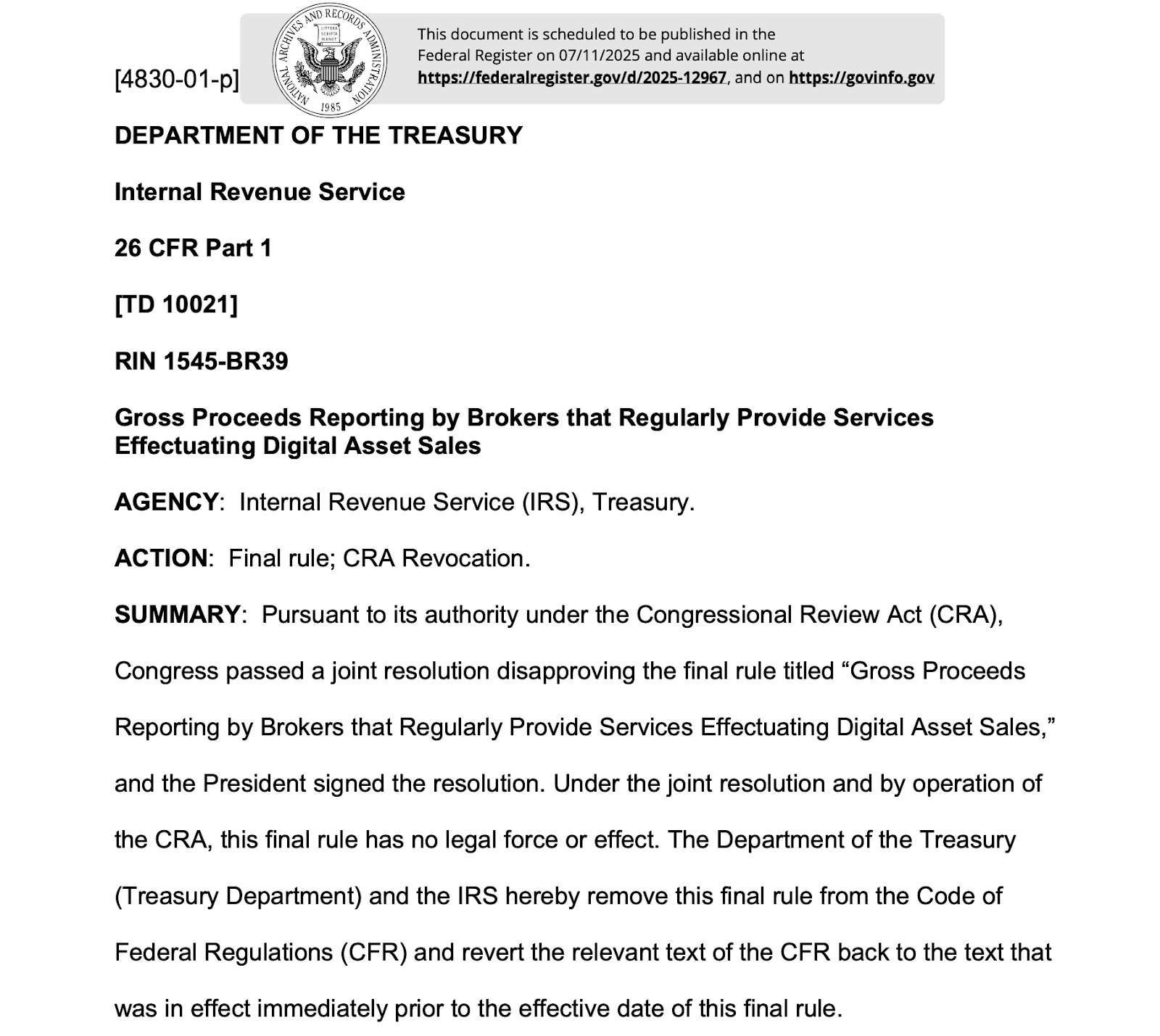
US Treasury Officially Scraps Crypto Broker Reporting Rules After Congressional VoteSource: federalregister.gov

Under Public Law 119-5 and the Congressional Review Act, the final rule has no legal force or effect and is considered null and void, as if it had never taken effect.

The Treasury is removing the rule from the Code of Federal Regulations and reverting to the previous text, which excluded entities solely engaged in validating distributed ledger transactions or selling hardware for private key control from broker reporting requirements.

Republicans in Congress successfully challenged the Biden-era rule that would have classified DeFi platforms as brokers, requiring extensive data collection and reporting obligations.

The Treasury estimated that billions in crypto-related taxes were going uncollected annually, but industry advocates argued that the requirements were technically impossible for decentralized platforms to implement.

The regulation faced widespread criticism for misunderstanding decentralized technology and potentially driving innovation overseas, prompting legal challenges from the Blockchain Association and Texas Blockchain Council.

Congressional Battle Over DeFi Innovation and Tax Compliance

Senator Ted Cruz led the Congressional Review Act resolution alongside Representative Mike Carey, arguing the rule represented government overreach that would stifle American cryptocurrency innovation.

Cruz stated the regulation “directly and immediately would harm American cryptocurrency innovation and drive development overseas.

The Joint Committee on Taxation estimated repealing the rule could cost the government nearly $4 billion over ten years in lost tax revenue.

Despite projected losses, lawmakers supporting repeal prioritized privacy, technical feasibility, and innovation over tax collection efficiency.

House Financial Services Committee Chairman French Hill also condemned the proposal as excessive government intervention, arguing that defining DeFi software providers as brokers would create costly reporting obligations for entities that never take custody of user funds.

The regulation threatened to push American digital asset development overseas while undermining technological progress.

White House Crypto Czar David Sacks supported the repeal effort, calling the regulation an “11th-hour attack on the crypto community by the Biden administration.

The administration positioned itself as strongly supportive of crypto industry concerns while establishing federal working groups on digital asset regulation.

The successful repeal prevents the IRS from reintroducing similar proposals in the future, marking a significant victory for DeFi advocates.

Broader Regulatory Shifts Signal Pro-Crypto Policy Direction

The Treasury Department separately announced exemptions that will free banks and brokerage firms from reporting customers’ crypto holdings on financial statements, contingent upon demonstrating effective digital asset risk management capabilities.

The SEC began issuing guidance clarifying that some crypto arrangements might not qualify as liabilities for reporting purposes.

These regulatory relief measures came amid sustained Congressional pressure to revise the controversial SAB 121 accounting bulletin.

While the Senate voted to overturn SAB 121 in May with 60 senators supporting repeal, President Biden’s veto prevented the measure from taking effect.

States continue advancing Bitcoin legislation independently of federal action, with 23 states introducing Bitcoin reserve bills and 35 proposals under consideration.

In fact, following that, Kentucky Governor Andy Beshear signed the “Bitcoin Rights” bill into law.

Beyond the United States, Japan’s Senate has also recently approved legal amendments that give crypto brokerage firms increased operational freedom through new “intermediary business” categories, which come with reduced regulatory barriers.

The legislation creates customer safeguards while promoting innovation, requiring the Prime Minister’s approval for crypto operators to hold assets domestically.


Market Opportunity
Whiterock Logo
Whiterock Price(WHITE)
$0.0001239
$0.0001239$0.0001239
-3.65%
USD
Whiterock (WHITE) Live Price Chart
Disclaimer: The articles reposted on this site are sourced from public platforms and are provided for informational purposes only. They do not necessarily reflect the views of MEXC. All rights remain with the original authors. If you believe any content infringes on third-party rights, please contact service@support.mexc.com for removal. MEXC makes no guarantees regarding the accuracy, completeness, or timeliness of the content and is not responsible for any actions taken based on the information provided. The content does not constitute financial, legal, or other professional advice, nor should it be considered a recommendation or endorsement by MEXC.

You May Also Like

XERO Price Crash: Shares Sink 16% to Three-Year Low

XERO Price Crash: Shares Sink 16% to Three-Year Low

Xero Ltd shares trade near $80.82 as of writing, down almost 16% on the session and hovering near their lowest levels since early 2023. Early trading briefly pushed
Share
Coinstats2026/02/04 16:55
YwinCap View On Whether The Gold Market Is In A Bubble

YwinCap View On Whether The Gold Market Is In A Bubble

Singapore (PinionNewswire) — In early 2026, a central question for investors and traders alike is whether the dramatic rise in gold prices represents a speculative
Share
Blocktelegraph2026/02/04 17:12
Foreigner’s Lou Gramm Revisits The Band’s Classic ‘4’ Album, Now Reissued

Foreigner’s Lou Gramm Revisits The Band’s Classic ‘4’ Album, Now Reissued

The post Foreigner’s Lou Gramm Revisits The Band’s Classic ‘4’ Album, Now Reissued appeared on BitcoinEthereumNews.com. American-based rock band Foreigner performs onstage at the Rosemont Horizon, Rosemont, Illinois, November 8, 1981. Pictured are, from left, Mick Jones, on guitar, and vocalist Lou Gramm. (Photo by Paul Natkin/Getty Images) Getty Images Singer Lou Gramm has a vivid memory of recording the ballad “Waiting for a Girl Like You” at New York City’s Electric Lady Studio for his band Foreigner more than 40 years ago. Gramm was adding his vocals for the track in the control room on the other side of the glass when he noticed a beautiful woman walking through the door. “She sits on the sofa in front of the board,” he says. “She looked at me while I was singing. And every now and then, she had a little smile on her face. I’m not sure what that was, but it was driving me crazy. “And at the end of the song, when I’m singing the ad-libs and stuff like that, she gets up,” he continues. “She gives me a little smile and walks out of the room. And when the song ended, I would look up every now and then to see where Mick [Jones] and Mutt [Lange] were, and they were pushing buttons and turning knobs. They were not aware that she was even in the room. So when the song ended, I said, ‘Guys, who was that woman who walked in? She was beautiful.’ And they looked at each other, and they went, ‘What are you talking about? We didn’t see anything.’ But you know what? I think they put her up to it. Doesn’t that sound more like them?” “Waiting for a Girl Like You” became a massive hit in 1981 for Foreigner off their album 4, which peaked at number one on the Billboard chart for 10 weeks and…
Share
BitcoinEthereumNews2025/09/18 01:26