Chainlink said it has strengthened its position as the industry-standard infrastructure for on-chain finance in 2025, as governments, banks, and asset managers Chainlink said it has strengthened its position as the industry-standard infrastructure for on-chain finance in 2025, as governments, banks, and asset managers

Chainlink Extends Lead in On-chain Finance as Institutional Adoption Grows

2026/01/02 00:21
3 min read

Chainlink said it has strengthened its position as the industry-standard infrastructure for on-chain finance in 2025, as governments, banks, and asset managers increasingly adopted its technology to move real-world financial activity onto blockchains, according to a blog post published by the company.

The report emphasized 2025 as an important year in which Chainlink’s oracle and interoperability standards became embedded across public- and private-sector financial systems used for everything from government data publication to institutional tokenized funds.

Government Adoption Accelerates

Government use of blockchain infrastructure marked progress during the year. Chainlink said the U.S. Department of Commerce partnered with the network to publish macroeconomic data on-chain using Chainlink Data Feeds sourced from the Bureau of Economic Analysis.
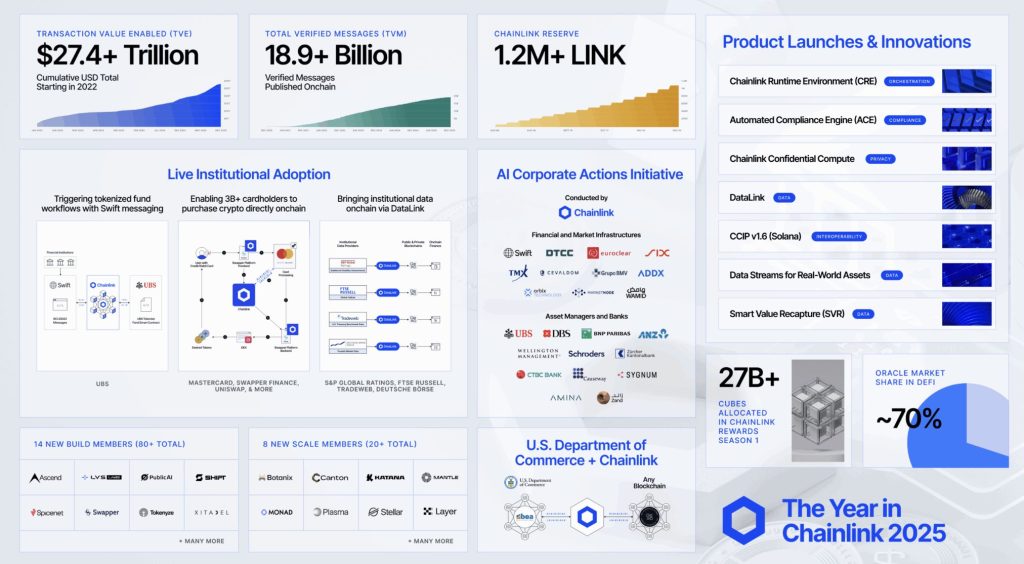
Chainlink co-founder Sergey Nazarov also participated in high-level policy discussions in Washington, including the White House Digital Asset Summit, as U.S. President Donald Trump signed the GENIUS Act into law.

The engagement reflects growing coordination between policymakers and blockchain infrastructure providers as regulatory clarity improves.

Banks and Capital Markets Move On-chain

In banking and capital markets, global financial institutions increasingly relied on Chainlink to execute production-grade on-chain workflows.

The research cites a partnership with Mastercard allowing more than three billion cardholders to purchase crypto assets directly on-chain via a Chainlink-powered application.

Asset managers also expanded tokenized offerings. UBS completed what Chainlink described as the world’s first live, end-to-end tokenized fund workflow using its Digital Transfer Agent standard, while firms such as WisdomTree and FTSE Russell began publishing institutional-grade net asset value and index data on-chain.

Financial market infrastructures, including DTCC, Euroclear, and SWIFT, collaborated with Chainlink to streamline corporate actions processing and cross-chain settlement using standardized messaging formats.

DeFi and Tokenization Scale Up

Decentralized finance and tokenization platforms also adopted Chainlink at scale in 2025. Coinbase selected Chainlink’s Cross-Chain Interoperability Protocol (CCIP) as the exclusive bridge infrastructure for its wrapped assets, while DeFi protocols, including Aave and Lido, upgraded their oracle and cross-chain infrastructure to support institutional-grade use cases.

Chainlink said the expansion of CCIP to non-EVM blockchains, including Solana, unlocked access to tens of billions of dollars in assets across multiple ecosystems.

Infrastructure Push Sets Stage for 2026

Beyond adoption, Chainlink said it also introduced new platform capabilities in 2025, including its Runtime Environment, Automated Compliance Engine, and Confidential Compute service intended to support privacy-preserving and compliant on-chain applications.

The report concludes that 2025 marked a turning point for on-chain finance, with 2026 expected to see tokenization adoption accelerate further as institutions standardize around shared infrastructure.

“Governments, financial institutions, and market infrastructures are increasingly aligning around Chainlink standards,” the company said, positioning its network as core plumbing for the global shift toward on-chain capital markets.

Disclaimer: The articles reposted on this site are sourced from public platforms and are provided for informational purposes only. They do not necessarily reflect the views of MEXC. All rights remain with the original authors. If you believe any content infringes on third-party rights, please contact service@support.mexc.com for removal. MEXC makes no guarantees regarding the accuracy, completeness, or timeliness of the content and is not responsible for any actions taken based on the information provided. The content does not constitute financial, legal, or other professional advice, nor should it be considered a recommendation or endorsement by MEXC.

You May Also Like

Pi Network Targets Open Mainnet 2026, Millions Prepare as Utility and Migration Accelerate

Pi Network Targets Open Mainnet 2026, Millions Prepare as Utility and Migration Accelerate

The Pi Network community is once again buzzing with renewed optimism following a powerful message circulating on social media regarding the project’s roadmap t
Share
Hokanews2026/02/07 20:41
Bitcoin Rainbow chart predicts BTC price for October 1, 2025

Bitcoin Rainbow chart predicts BTC price for October 1, 2025

The post Bitcoin Rainbow chart predicts BTC price for October 1, 2025 appeared on BitcoinEthereumNews.com. The Bitcoin (BTC) Rainbow Chart has outlined potential price ranges for October 1, 2025, as the asset seeks to reclaim the $120,000 resistance. Throughout September, the maiden cryptocurrency has struggled to push past the $115,000 support zone. At press time, Bitcoin was trading at $115,950, up 0.15% in the past 24 hours and gaining a modest 0.5% over the past week. Bitcoin seven-day price chart. Source: Finbold Looking ahead to October 1, the Rainbow Chart projects that Bitcoin’s price could fall within a broad band of $36,628 to $409,726, depending on prevailing market sentiment. The Rainbow Chart, a long-term valuation model often used to track Bitcoin’s price cycles, is built as a logarithmic regression chart. It color-codes Bitcoin’s valuation bands, offering investors a simplified way to gauge whether the market is undervalued or overheated. Bitcoin price prediction  The lowest tier, labeled “Basically a Fire Sale,” spans from $36,628 to $47,947. Above that, the “BUY!” zone ranges from $47,947 to $64,777, while “Accumulate” covers $64,777 to $83,811. The “Still Cheap” band sets Bitcoin between $83,811 and $108,471, followed by the neutral “HODL!” zone at $108,471 to $142,332. Bitcoin Rainbow chart. Source: BlockhainCenter Cautionary levels emerge as prices climb higher. In this case, the “Is this a bubble?” range extends from $142,332 to $181,644, while “FOMO intensifies” lies between $181,644 and $233,215. On the other hand, the red zones, seen as overheated territory, start with “Sell. Seriously, SELL!” at $233,215 to $304,169 and peak with “Maximum Bubble Territory” from $304,169 to $409,726. With Bitcoin trading around $116,000 as of September 20, the Rainbow Chart suggests that by October 1, 2025, the asset will most likely fall within the “Still Cheap” or “HODL!” bands, implying a fair value between $83,811 and $142,332. This outlook indicates that despite Bitcoin’s strong gains, the model places…
Share
BitcoinEthereumNews2025/09/21 01:51
White House Schedules Tuesday Stablecoin Talks as Banks Enter the Room

White House Schedules Tuesday Stablecoin Talks as Banks Enter the Room

The White House will host crypto firms and banks on February 10 to continue talks on stablecoin rules and advance the crypto market bill. The White House has set
Share
LiveBitcoinNews2026/02/07 19:45