Crypto.com is moving deeper into prediction markets with plans to staff an internal market-making desk, a step that is drawing renewed attention to how these platformsCrypto.com is moving deeper into prediction markets with plans to staff an internal market-making desk, a step that is drawing renewed attention to how these platforms

Crypto.com Hires Internal Market Maker for Predictions – Is the Exchange Trading Against Users?

4 min read

Crypto.com is moving deeper into prediction markets with plans to staff an internal market-making desk, a step that is drawing renewed attention to how these platforms operate and whether exchanges may end up trading directly against their own users.

The Singapore-based cryptocurrency exchange is recruiting a quantitative trader to join a team responsible for buying and selling financial contracts tied to the outcomes of sporting events on its prediction market platform.

Liquidity or Conflict? Crypto.com’s Market-Making Role Sparks Debate

According to a recent Bloomberg report, the role would sit on Crypto.com’s market-making desk and involve actively trading against customer orders to support liquidity across sports contracts and other derivatives offered on the company’s U.S. platform.

The hiring effort comes as prediction markets expand rapidly across both crypto and traditional finance.

These platforms allow users to trade contracts that settle based on real-world outcomes, such as sports results or political events, with prices reflecting the market’s implied probability.

While prediction markets have long presented themselves as neutral venues where participants trade against each other, the use of in-house market makers has raised questions about conflicts of interest.

Market making has become a sensitive issue for event-contract exchanges, particularly those operating under U.S. federal oversight.

Critics argue that when an exchange or its affiliate takes the opposite side of customer trades, the structure begins to resemble a traditional sportsbook that profits from customer losses.

Those concerns have already surfaced elsewhere in the industry. Kalshi, one of the most prominent regulated prediction market operators, runs an internal unit known as Kalshi Trading.

Polymarket, a major decentralized platform, is also reported to be building its own internal market-making team.

Crypto.com’s job listing states that the new hire would seek to “maximize profits while carefully managing risks,” language that has fueled debate over whether the firm is effectively trading against its users.

In response, in a report, a Crypto.com spokesperson said the company does not rely on proprietary trading as a revenue source and described its business model as providing customer access to digital assets and event contracts for a fee while remaining risk neutral.

The spokesperson added that the internal market maker does not receive preferential access to customer order flow or proprietary data and operates under rules disclosed to the Commodity Futures Trading Commission, which oversees derivatives markets in the U.S.

Prediction Markets Hit Record Volumes, but Trading Rules Stir Concerns

The exchange has also taken steps to attract external liquidity providers. Like its competitors, Crypto.com has sought to bring in professional trading firms to ensure continuous buying and selling, particularly in high-volume sports markets.

However, company rules grant designated market makers on sports contracts a three-second head start over smaller traders, a policy that has drawn scrutiny for potentially allowing large participants to adjust prices ahead of retail users.

The broader industry continues to grow despite these concerns, with prediction markets linked to sports and politics having driven much of the recent surge in activity.

Platforms including Kalshi, Polymarket, and Limitless recorded a combined $44 billion in trading volume this year, with Kalshi reaching roughly $1 billion in weekly volume at its peak.
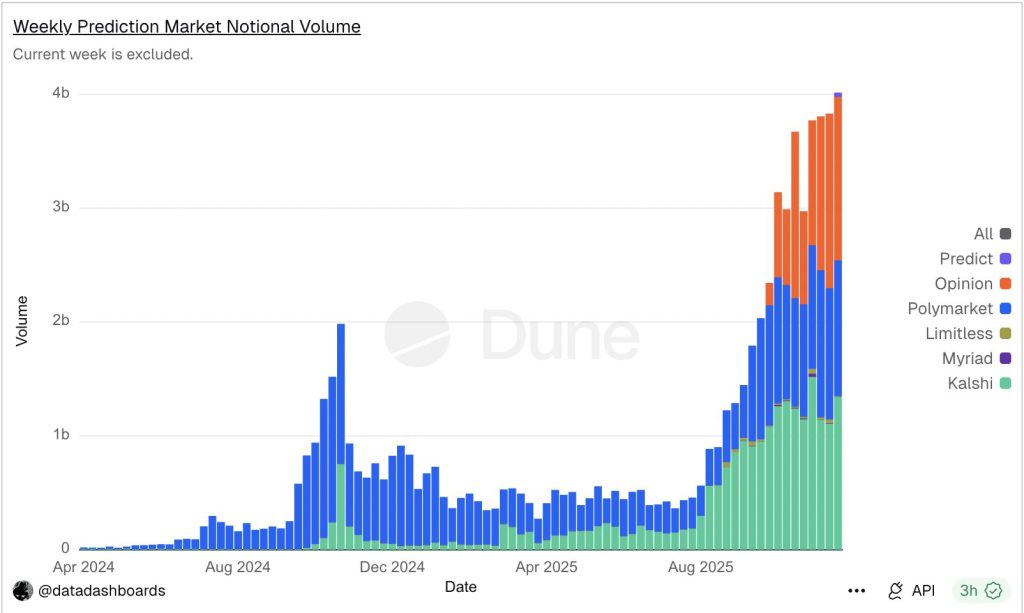
Source: Dune Analytics

On-chain prediction markets have expanded even faster, with monthly volume climbing from under $100 million in early 2024 to more than $13 billion, according to joint research from Keyrock and Dune Analytics.

Major crypto firms are also entering the space. Coinbase recently rolled out prediction market trading on its platform and agreed to acquire The Clearing Company as part of its push to scale regulated event-based markets. The move followed Kalshi’s $300 million Series D raise at a $5 billion valuation, showing investor interest in the sector.

Disclaimer: The articles reposted on this site are sourced from public platforms and are provided for informational purposes only. They do not necessarily reflect the views of MEXC. All rights remain with the original authors. If you believe any content infringes on third-party rights, please contact service@support.mexc.com for removal. MEXC makes no guarantees regarding the accuracy, completeness, or timeliness of the content and is not responsible for any actions taken based on the information provided. The content does not constitute financial, legal, or other professional advice, nor should it be considered a recommendation or endorsement by MEXC.

You May Also Like

MoneyGram launches stablecoin-powered app in Colombia

MoneyGram launches stablecoin-powered app in Colombia

The post MoneyGram launches stablecoin-powered app in Colombia appeared on BitcoinEthereumNews.com. MoneyGram has launched a new mobile application in Colombia that uses USD-pegged stablecoins to modernize cross-border remittances. According to an announcement on Wednesday, the app allows customers to receive money instantly into a US dollar balance backed by Circle’s USDC stablecoin, which can be stored, spent, or cashed out through MoneyGram’s global retail network. The rollout is designed to address the volatility of local currencies, particularly the Colombian peso. Built on the Stellar blockchain and supported by wallet infrastructure provider Crossmint, the app marks MoneyGram’s most significant move yet to integrate stablecoins into consumer-facing services. Colombia was selected as the first market due to its heavy reliance on inbound remittances—families in the country receive more than 22 times the amount they send abroad, according to Statista. The announcement said future expansions will target other remittance-heavy markets. MoneyGram, which has nearly 500,000 retail locations globally, has experimented with blockchain rails since partnering with the Stellar Development Foundation in 2021. It has since built cash on and off ramps for stablecoins, developed APIs for crypto integration, and incorporated stablecoins into its internal settlement processes. “This launch is the first step toward a world where every person, everywhere, has access to dollar stablecoins,” CEO Anthony Soohoo stated. The company emphasized compliance, citing decades of regulatory experience, though stablecoin oversight remains fluid. The US Congress passed the GENIUS Act earlier this year, establishing a framework for stablecoin regulation, which MoneyGram has pointed to as providing clearer guardrails. This is a developing story. This article was generated with the assistance of AI and reviewed by editor Jeffrey Albus before publication. Get the news in your inbox. Explore Blockworks newsletters: Source: https://blockworks.co/news/moneygram-stablecoin-app-colombia
Share
BitcoinEthereumNews2025/09/18 07:04
Solana Treasury Firm Holdings Could Double as Forward Industries Unveils $4 Billion Raise

Solana Treasury Firm Holdings Could Double as Forward Industries Unveils $4 Billion Raise

The post Solana Treasury Firm Holdings Could Double as Forward Industries Unveils $4 Billion Raise appeared on BitcoinEthereumNews.com. In brief Forward Industries, the largest publicly traded Solana treasury company, filed to raise $4 billion through an at-the-market equity offering to expand its SOL holdings. The company’s stock (FORD) fell 8.2% following the announcement, while the proceeds could more than double the $3.1 billion currently held in Solana treasuries. DeFi Development Corp. also registered a preferred stock offering with the SEC, following similar funding tactics used by Bitcoin treasury companies like MicroStrategy. Forward Industries, the newest and largest publicly traded Solana treasury company, has filed to raise $4 billion through an at-the-market equity offering. For the sake of comparison, this $4 billion raise is nearly the same size as Bitcoin treasury Strategy’s Stride preferred stock raise in July. And it’s double the size of the Strife preferred stock offering the company did in May. The proceeds would be used for working capital; pursuit of its Solana token strategy, and “the purchase of income-generating assets to grow its business,” the company said in a press release. Forward Industries declined to comment to Decrypt on what other income-generating assets it’s considering adding to its balance sheet.  As markets opened Wednesday morning, Forward saw its stock price take a dive. The shares, which trade under the FORD ticker on the Nasdaq, dipped to $31.29 before rebounding to $34.28 at the time of writing—marking a 8.2% fall for the session. If the company sells all the shares and spends the bulk of the proceeds on buying Solana, it could more than double the amount of SOL being held in treasuries. At the time of writing, there’s already $3.1 billion in Solana treasuries, according to crypto price aggregator CoinGecko. Users on Myriad, a prediction market owned by Decrypt parent company DASTAN, have been growing more confident that SOL will reach $250 sooner than…
Share
BitcoinEthereumNews2025/09/18 12:43
Microsoft plans to invest $4 billion in building a second AI data center in Wisconsin

Microsoft plans to invest $4 billion in building a second AI data center in Wisconsin

Microsoft will invest $4 billion to build a second AI data center in Wisconsin, bringing its total investment in the region to over $7 billion.
Share
Cryptopolitan2025/09/19 03:05