Stripe and Paradigm opened Tempo's public testnet, inviting companies to build stablecoin payment apps with fixed 0.1-cent fees and predictable settlement. The post Stripe, Paradigm Open Tempo Blockchain to Public as Stablecoin Demand Accelerates appeared first on Coinspeaker.Stripe and Paradigm opened Tempo's public testnet, inviting companies to build stablecoin payment apps with fixed 0.1-cent fees and predictable settlement. The post Stripe, Paradigm Open Tempo Blockchain to Public as Stablecoin Demand Accelerates appeared first on Coinspeaker.

Stripe, Paradigm Open Tempo Blockchain to Public as Stablecoin Demand Accelerates

3 min read

Stripe and Paradigm opened Tempo’s public testnet on Tuesday, expanding the operational capacity of the payments-focused blockchain unveiled in September. A Bloomberg report on Tuesday detailed how the rollout invites any company to begin building stablecoin payment applications on the network.

The companies confirmed that Tempo’s newest group of partners includes UBS, Cross River Bank, and prediction-market operator Kalshi.

They join existing participants such as Deutsche Bank, Nubank, OpenAI, and Anthropic, which have been testing live workloads to validate the chain’s performance. Other partners mentioned include DoorDash, Shopify, Standard Chartered, Visa, Coupang, and Revolut, with more firms like Klarna, Brex, Coastal, Mastercard, Ramp, Payoneer, Persona, and Figure joining after the initial announcement.

According to details, the Tempo blockchain applies a payments-first architecture that separates transaction lanes from the broader network to avoid congestion common on public blockchains. The design targets predictable settlement times and fee stability, aiming to prevent disruptions often triggered by spikes in speculative trading.

With a fixed fee of one-tenth of a cent per transaction, Tempo offers an alternative to traditional card rails that charge between one and three percent plus fixed costs.

This model also aligns with rising interest in microtransactions across fintech and AI firms, which increasingly prefer usage-based fees instead of monthly billing. Tempo also accepts any dollar-denominated stablecoin for transaction costs, including USDT and USDC, the two largest tokens in circulation.

Companies building on the Tempo blockchain can begin testing integrations today, according to project documentation.

Coastal Bank President Brian Hamilton said his institution is testing how the network’s structure could unlock new capabilities across fintech and embedded-finance partners.

Matt Huang, managing partner at Paradigm, which leads the project’s development effort, told Bloomberg his team will focus on real-world use cases for stablecoins.

The move continues a year-long trend of US institutional participation in crypto, further accelerated by the GENIUS ACT regulatory framework signed into law by President Donald Trump in July 2025.

Pepe Node Presale Nears $2.5M Target as Institutional Demand

As Tempo blockchain launch accelerates crypto adoption in the US, early-stage projects like PEPENODE are receiving speculative demand.

Pepe Node allows users to own virtual meme coin mining rigs, combine nodes for higher yields, and earn bonus rewards from network participation.
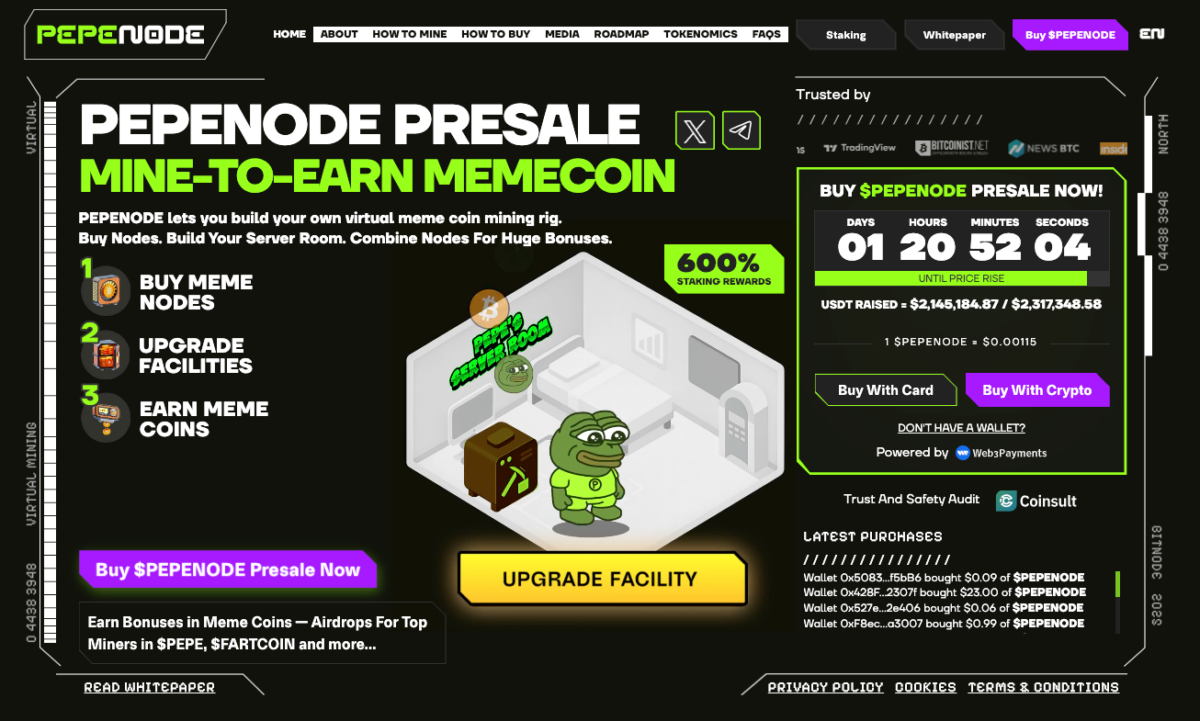
Pepe Node Presale

Pepe Node Presale

Currently priced at $0.0010, the Pepe Node presale has already raised over $2.3 million of its $2.5 million target. Investors can still join through the official Pepe Node website before the next price tier unlocks.

next

The post Stripe, Paradigm Open Tempo Blockchain to Public as Stablecoin Demand Accelerates appeared first on Coinspeaker.

Market Opportunity
OpenLedger Logo
OpenLedger Price(OPEN)
$0.16537
$0.16537$0.16537
+2.30%
USD
OpenLedger (OPEN) Live Price Chart
Disclaimer: The articles reposted on this site are sourced from public platforms and are provided for informational purposes only. They do not necessarily reflect the views of MEXC. All rights remain with the original authors. If you believe any content infringes on third-party rights, please contact service@support.mexc.com for removal. MEXC makes no guarantees regarding the accuracy, completeness, or timeliness of the content and is not responsible for any actions taken based on the information provided. The content does not constitute financial, legal, or other professional advice, nor should it be considered a recommendation or endorsement by MEXC.

You May Also Like

MoneyGram Taps Stablecoins To Shield Colombians From Peso Weakness

MoneyGram Taps Stablecoins To Shield Colombians From Peso Weakness

According to multiple reports, MoneyGram is rolling out a new mobile app in Colombia that lets users receive, hold and move money using USD-backed stablecoins, specifically USDC. Related Reading: Ethereum Giant The Ether Machine Aims For US Public Debut The service is being positioned as a hybrid: a stored-value USD balance that can be funded, […]
Share
Bitcoinist2025/09/18 20:30
BDACS Launches KRW1 Stablecoin Backed by the Won

BDACS Launches KRW1 Stablecoin Backed by the Won

The post BDACS Launches KRW1 Stablecoin Backed by the Won appeared on BitcoinEthereumNews.com. BDACS Launches KRW1 Stablecoin Backed by South Korean Won Custody service provider BDACS has launched KRW1, a new stablecoin pegged 1:1 to the South Korean won (KRW). The regulated custodian focuses on institutional clients and offers services including crypto asset custody and transaction infrastructure supporting multiple blockchains. The KRW1 project recently completed its proof-of-concept (PoC) phase, with the stablecoin launching on the Avalanche blockchain. Each KRW1 token is fully backed by fiat currency, with reserves held at Woori Bank, one of South Korea’s largest financial institutions. Transparency and Platform Features BDACS emphasizes full transparency: holders can monitor reserves in real time via banking API integration, although no dedicated portal is currently available. According to the press release, “The KRW1 launch goes far beyond token issuance. BDACS has developed a comprehensive platform, including issuance and governance systems, as well as a user application supporting peer-to-peer transfers and transaction verification.” The stablecoin is positioned for global use, with potential expansion through new network integrations and collaborations with dollar-pegged stablecoins like USDC and USDT. BDACS also plans to integrate KRW1 into government initiatives, though negotiations or official involvement have not been confirmed. Current Status and Market Outlook KRW1 remains in the concept stage and is not yet publicly traded or available to retail consumers, as South Korea currently lacks a stablecoin framework. However, the launch is reportedly supported by the country’s new president, Lee Je-moon. In related news, Kakao is also reportedly considering a won-pegged stablecoin, highlighting growing interest in this emerging asset class. Source: https://coinpaper.com/11089/bdacs-launches-krw-1-stablecoin-backed-by-the-won
Share
BitcoinEthereumNews2025/09/18 21:28
Exclusive interview with Smokey The Bera, co-founder of Berachain: How the innovative PoL public chain solves the liquidity problem and may be launched in a few months

Exclusive interview with Smokey The Bera, co-founder of Berachain: How the innovative PoL public chain solves the liquidity problem and may be launched in a few months

Recently, PANews interviewed Smokey The Bera, co-founder of Berachain, to unravel the background of the establishment of this anonymous project, Berachain's PoL mechanism, the latest developments, and answered widely concerned topics such as airdrop expectations and new opportunities in the DeFi field.
Share
PANews2024/07/03 13:00