Galaxy Digital CEO Mike Novogratz says the October 10th crash in crypto was far more than a routine shakeout, claiming that roughly a third of market makers in parts of the ecosystem were effectively wiped out. “We had a flash crash and it did a lot of damage to the fabric of the market,” Novogratz told Anthony Scaramucci on the first-ever episode of “All Things Markets,” recorded November 26. “Even on Hyperliquid, the market makers, you know, 30 percent of them went out of business. Got zeroed.” Scaramucci framed the last 20 trading days as another brutal reminder of crypto’s structural volatility. “I know I have a trap door on my portfolio,” he said. “Once in a while I’ll be walking across the living room feeling beautiful about myself. And then, boom, a trap door opens and I have fallen into the basement of the house.” Related Reading: Will Crypto Explode If Kevin Hassett Takes Over The Fed In 2026? According to Novogratz, this particular trap door opened at Binance. “It started really by, you know, at Binance, they had an oracle which set price misfunction,” he said. That error hit a synthetic stablecoin and “created a cascade where people were getting stopped out because there was the wrong price.” The dislocation then bled into levered perpetual markets “like Hyperliquid, like Uniswap,” where “as prices went down, people started getting liquidated.” He argued that the way crypto participants use leverage turned a technical glitch into a systemic event. “What people don’t understand about crypto is that the crypto investor doesn’t play for 10, 11, 12 percent returns,” he said. “Crypto investor call themselves degens with pride. They want to turn one into 15. And so they trade a very volatile asset with a lot of leverage.” Perpetual futures make that leverage particularly dangerous for liquidity providers. “Perpetual futures are not normal futures,” Novogratz said, crediting “the genius that Arthur Hayes and his group of people” for a design where “as longs get liquidated, they’re paired off against shorts.” In a fast collapse, “you could be short and you lose your short position. Well, if you’re long on another exchange against that short position, you’re shit out of luck. And that happened to a lot of market makers.” Will The Crypto Market Recover? The result, he said, was a sharp loss of liquidity and retail capital. “We lost a lot of liquidity in the market. We lost a lot of retail punters who lost their stack,” he noted, adding that after such a wipeout “it takes a while for Humpty Dumpty to get put back together again.” Novogratz said he initially expected higher levels to hold. “I actually, to be fair, thought we were going to hold at higher levels at $90,000,” he admitted. “And we went all the way to $80,000. $80,000 was a maximum pain point… Got to $1.80 on XRP. We got to $125 on Solana. Real pain points.” He links the subsequent rebound to macro tailwinds, not healed sentiment. “Now we bounce up. We bounce because of the Fed. But we’re not out of the woods,” he said. “I do think Bitcoin will climb back towards $100,000 by the end of the year, but there’ll be sellers waiting there. We’ve done some medium-term damage to the psychology of the market.” Related Reading: Crypto Has Entered Late-Cycle Territory, Says Global Liquidity Veteran On the spot side, he highlighted massive profit-taking by early holders against ETF-driven inflows. “We had one $9 billion seller,” he said. “That’s one-third of all of IBIT’s flows of the year.” As US wealth channels move “from a zero weighting to a 3 to 4 percent weighting” in Bitcoin, that “was met with OG sellers.” “In the long run, that’s healthy,” he said. “In the short run, that’s painful.” Novogratz also argued that crypto is being repriced as a real business ecosystem rather than a pure story. “It’s a transition from just being a story — ‘we’re the most important industry… we’re going to decentralize the world’ — to ‘show me what crypto actually does,’” he said. “Some businesses are making money. Some businesses aren’t. There are some token ecosystems that make common sense to an investor and there’s some that all feel like they’re just an association.” Overlaying it all is a macro backdrop he views as increasingly supportive. He called the Fed’s recent signals and plans to ease bank cash requirements in repo “a monstrous liquidity boom that’s coming,” adding that “they’re going to bring rates down to 2 percent in the next 16 months” and that inflation will “creep higher,” implying negative real rates. For crypto, the message is double-edged: structurally de-levered, with fewer market makers and wounded sentiment, but still tied to a global liquidity cycle that Novogratz believes is turning in its favor — once Humpty Dumpty gets put back together again. At press time, Bitcoin traded at $91,115. Featured image from YouTube, chart from TradingView.comGalaxy Digital CEO Mike Novogratz says the October 10th crash in crypto was far more than a routine shakeout, claiming that roughly a third of market makers in parts of the ecosystem were effectively wiped out. “We had a flash crash and it did a lot of damage to the fabric of the market,” Novogratz told Anthony Scaramucci on the first-ever episode of “All Things Markets,” recorded November 26. “Even on Hyperliquid, the market makers, you know, 30 percent of them went out of business. Got zeroed.” Scaramucci framed the last 20 trading days as another brutal reminder of crypto’s structural volatility. “I know I have a trap door on my portfolio,” he said. “Once in a while I’ll be walking across the living room feeling beautiful about myself. And then, boom, a trap door opens and I have fallen into the basement of the house.” Related Reading: Will Crypto Explode If Kevin Hassett Takes Over The Fed In 2026? According to Novogratz, this particular trap door opened at Binance. “It started really by, you know, at Binance, they had an oracle which set price misfunction,” he said. That error hit a synthetic stablecoin and “created a cascade where people were getting stopped out because there was the wrong price.” The dislocation then bled into levered perpetual markets “like Hyperliquid, like Uniswap,” where “as prices went down, people started getting liquidated.” He argued that the way crypto participants use leverage turned a technical glitch into a systemic event. “What people don’t understand about crypto is that the crypto investor doesn’t play for 10, 11, 12 percent returns,” he said. “Crypto investor call themselves degens with pride. They want to turn one into 15. And so they trade a very volatile asset with a lot of leverage.” Perpetual futures make that leverage particularly dangerous for liquidity providers. “Perpetual futures are not normal futures,” Novogratz said, crediting “the genius that Arthur Hayes and his group of people” for a design where “as longs get liquidated, they’re paired off against shorts.” In a fast collapse, “you could be short and you lose your short position. Well, if you’re long on another exchange against that short position, you’re shit out of luck. And that happened to a lot of market makers.” Will The Crypto Market Recover? The result, he said, was a sharp loss of liquidity and retail capital. “We lost a lot of liquidity in the market. We lost a lot of retail punters who lost their stack,” he noted, adding that after such a wipeout “it takes a while for Humpty Dumpty to get put back together again.” Novogratz said he initially expected higher levels to hold. “I actually, to be fair, thought we were going to hold at higher levels at $90,000,” he admitted. “And we went all the way to $80,000. $80,000 was a maximum pain point… Got to $1.80 on XRP. We got to $125 on Solana. Real pain points.” He links the subsequent rebound to macro tailwinds, not healed sentiment. “Now we bounce up. We bounce because of the Fed. But we’re not out of the woods,” he said. “I do think Bitcoin will climb back towards $100,000 by the end of the year, but there’ll be sellers waiting there. We’ve done some medium-term damage to the psychology of the market.” Related Reading: Crypto Has Entered Late-Cycle Territory, Says Global Liquidity Veteran On the spot side, he highlighted massive profit-taking by early holders against ETF-driven inflows. “We had one $9 billion seller,” he said. “That’s one-third of all of IBIT’s flows of the year.” As US wealth channels move “from a zero weighting to a 3 to 4 percent weighting” in Bitcoin, that “was met with OG sellers.” “In the long run, that’s healthy,” he said. “In the short run, that’s painful.” Novogratz also argued that crypto is being repriced as a real business ecosystem rather than a pure story. “It’s a transition from just being a story — ‘we’re the most important industry… we’re going to decentralize the world’ — to ‘show me what crypto actually does,’” he said. “Some businesses are making money. Some businesses aren’t. There are some token ecosystems that make common sense to an investor and there’s some that all feel like they’re just an association.” Overlaying it all is a macro backdrop he views as increasingly supportive. He called the Fed’s recent signals and plans to ease bank cash requirements in repo “a monstrous liquidity boom that’s coming,” adding that “they’re going to bring rates down to 2 percent in the next 16 months” and that inflation will “creep higher,” implying negative real rates. For crypto, the message is double-edged: structurally de-levered, with fewer market makers and wounded sentiment, but still tied to a global liquidity cycle that Novogratz believes is turning in its favor — once Humpty Dumpty gets put back together again. At press time, Bitcoin traded at $91,115. Featured image from YouTube, chart from TradingView.com
30% Of Crypto Market Makers Got Wiped, Mike Novogratz Says

2025/11/28 09:00
4 min read

Galaxy Digital CEO Mike Novogratz says the October 10th crash in crypto was far more than a routine shakeout, claiming that roughly a third of market makers in parts of the ecosystem were effectively wiped out.

“We had a flash crash and it did a lot of damage to the fabric of the market,” Novogratz told Anthony Scaramucci on the first-ever episode of “All Things Markets,” recorded November 26. “Even on Hyperliquid, the market makers, you know, 30 percent of them went out of business. Got zeroed.”

Scaramucci framed the last 20 trading days as another brutal reminder of crypto’s structural volatility. “I know I have a trap door on my portfolio,” he said. “Once in a while I’ll be walking across the living room feeling beautiful about myself. And then, boom, a trap door opens and I have fallen into the basement of the house.”

According to Novogratz, this particular trap door opened at Binance. “It started really by, you know, at Binance, they had an oracle which set price misfunction,” he said. That error hit a synthetic stablecoin and “created a cascade where people were getting stopped out because there was the wrong price.” The dislocation then bled into levered perpetual markets “like Hyperliquid, like Uniswap,” where “as prices went down, people started getting liquidated.”

He argued that the way crypto participants use leverage turned a technical glitch into a systemic event. “What people don’t understand about crypto is that the crypto investor doesn’t play for 10, 11, 12 percent returns,” he said. “Crypto investor call themselves degens with pride. They want to turn one into 15. And so they trade a very volatile asset with a lot of leverage.”

Perpetual futures make that leverage particularly dangerous for liquidity providers. “Perpetual futures are not normal futures,” Novogratz said, crediting “the genius that Arthur Hayes and his group of people” for a design where “as longs get liquidated, they’re paired off against shorts.” In a fast collapse, “you could be short and you lose your short position. Well, if you’re long on another exchange against that short position, you’re shit out of luck. And that happened to a lot of market makers.”

Will The Crypto Market Recover?

The result, he said, was a sharp loss of liquidity and retail capital. “We lost a lot of liquidity in the market. We lost a lot of retail punters who lost their stack,” he noted, adding that after such a wipeout “it takes a while for Humpty Dumpty to get put back together again.”

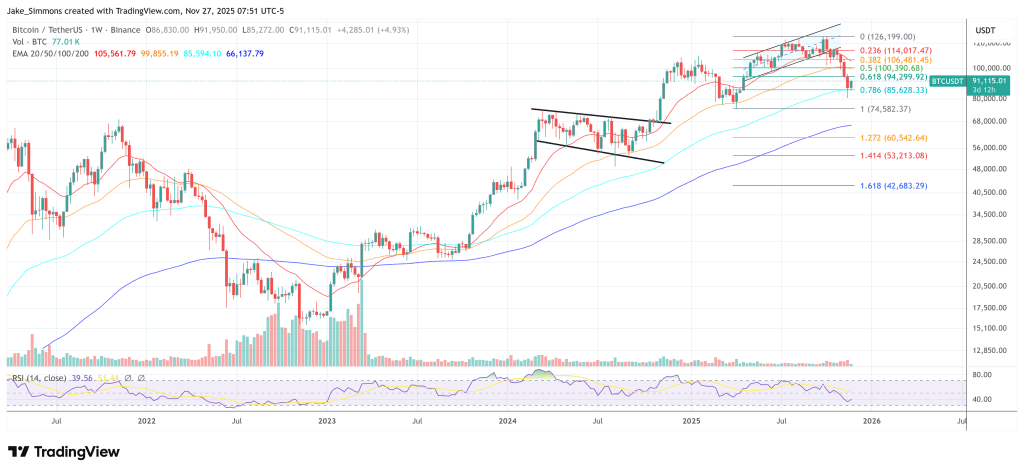
Novogratz said he initially expected higher levels to hold. “I actually, to be fair, thought we were going to hold at higher levels at $90,000,” he admitted. “And we went all the way to $80,000. $80,000 was a maximum pain point… Got to $1.80 on XRP. We got to $125 on Solana. Real pain points.”

He links the subsequent rebound to macro tailwinds, not healed sentiment. “Now we bounce up. We bounce because of the Fed. But we’re not out of the woods,” he said. “I do think Bitcoin will climb back towards $100,000 by the end of the year, but there’ll be sellers waiting there. We’ve done some medium-term damage to the psychology of the market.”

On the spot side, he highlighted massive profit-taking by early holders against ETF-driven inflows. “We had one $9 billion seller,” he said. “That’s one-third of all of IBIT’s flows of the year.” As US wealth channels move “from a zero weighting to a 3 to 4 percent weighting” in Bitcoin, that “was met with OG sellers.” “In the long run, that’s healthy,” he said. “In the short run, that’s painful.”

Novogratz also argued that crypto is being repriced as a real business ecosystem rather than a pure story. “It’s a transition from just being a story — ‘we’re the most important industry… we’re going to decentralize the world’ — to ‘show me what crypto actually does,’” he said. “Some businesses are making money. Some businesses aren’t. There are some token ecosystems that make common sense to an investor and there’s some that all feel like they’re just an association.”

Overlaying it all is a macro backdrop he views as increasingly supportive. He called the Fed’s recent signals and plans to ease bank cash requirements in repo “a monstrous liquidity boom that’s coming,” adding that “they’re going to bring rates down to 2 percent in the next 16 months” and that inflation will “creep higher,” implying negative real rates.

For crypto, the message is double-edged: structurally de-levered, with fewer market makers and wounded sentiment, but still tied to a global liquidity cycle that Novogratz believes is turning in its favor — once Humpty Dumpty gets put back together again.

At press time, Bitcoin traded at $91,115.

Bitcoin price
Market Opportunity
Farcana Logo
Farcana Price(FAR)
$0.00092
$0.00092$0.00092
-0.10%
USD
Farcana (FAR) Live Price Chart
Disclaimer: The articles reposted on this site are sourced from public platforms and are provided for informational purposes only. They do not necessarily reflect the views of MEXC. All rights remain with the original authors. If you believe any content infringes on third-party rights, please contact service@support.mexc.com for removal. MEXC makes no guarantees regarding the accuracy, completeness, or timeliness of the content and is not responsible for any actions taken based on the information provided. The content does not constitute financial, legal, or other professional advice, nor should it be considered a recommendation or endorsement by MEXC.

You May Also Like

Regulatory Clarity Could Drive 40% of Americans to Adopt DeFi Protocols, Survey Shows

Regulatory Clarity Could Drive 40% of Americans to Adopt DeFi Protocols, Survey Shows

Over 40% of Americans express willingness to use decentralized finance (DeFi) protocols once regulatory clarity on crypto privacy emerges, according to a recent survey from crypto advocacy organization the DeFi Education Fund (DEF). The survey, released on September 18, revealed that many Americans feel frustrated with traditional financial institutions and seek greater control over their financial assets and data. Respondents believe DeFi innovations can deliver this change by providing affordability, equity, and consumer protection. The survey was conducted with Ipsos on KnowledgePanel and included supplementary in-depth interviews in the Bronx and Queens between August 18 and 21, polling 1,321 US adults. Survey Results Show Americans Ready to Adopt DeFi Protocols The findings demonstrate that many Americans are curious about DeFi despite its early stage. 42% of Americans indicated they would likely try DeFi if proposed legislation becomes law (9% extremely/very likely and 33% somewhat likely). 84% said they would use it to “make purchases online,” while 78% would use it to “pay bills.” According to the survey, 77% would use DeFi protocols to “save money,” and 12% of Americans are “extremely” and “very” interested in learning about DeFi. Moreover, nearly 4 in 10 Americans believe that DeFi can address high transaction and service fees found in traditional finance (39%). Consistent with other probability-based sample surveys, the Ipsos x DEF research shows that almost 1 in 5 Americans (18%) have owned or used crypto at some point in their lifetime. Nearly a quarter of Americans (22%) said they’re interested in learning more about nontraditional forms of finance, such as blockchain, crypto, or decentralized finance.Source: DEF The research shows that more than half (56%) of Americans want to reclaim control of their finances. Americans are interested in having control over their money at all times, and many seek ways to send or receive money without intermediaries. One Bronx, NY resident shared his experience of needing to transfer money between accounts, but the bank required him to certify the transfer and visit in person because he couldn’t move the amount he needed remotely. He expressed frustration about the situation because “it was my money… I didn’t understand why I was given a hard time.“ More than half of surveyed Americans agree there should be a way to digitally send money to people without third-party involvement, and this number rises notably for foreign-born Americans (66%). The researchers concluded that Americans are interested in DeFi and believe DeFi can reduce friction points in today’s financial system. Regulatory Developments on DeFi Adoption in the U.S Last month, DeFi Education Fund called on the US Senate Banking Committee to rethink how it plans to regulate the decentralized finance industry after reviewing its recently published discussion draft on a key crypto market-structure bill. The response, signed on behalf of DeFi Education Fund (DEF) members including a16z Crypto, Uniswap Labs, and Paradigm, argued the Responsible Financial Innovation Act of 2025 (RFA) bill should be crafted in a more tech-neutral manner. The group also emphasized that crypto developers should be protected from “inappropriate regulation meant for intermediaries,” and that self-custody rights for all Americans are “essential.” The banking committee is now working on the discussion draft to help ensure it builds on the Digital Asset Market Clarity Act of 2025. The goal is to promote innovation in the $162 billion DeFi industry without compromising consumer protections or financial stability. On September 5, US Federal Reserve Governor Christopher Waller said there was “nothing to be afraid of” about crypto payments operating outside the traditional banking system. This statement has raised hopes among many that DeFi would soon become the new financial infrastructure for Americans and the world
Share
CryptoNews2025/09/18 21:29
Michael Burry’s Bitcoin Warning: Crypto Crash Could Drag Down Gold and Silver Markets

Michael Burry’s Bitcoin Warning: Crypto Crash Could Drag Down Gold and Silver Markets

TLDR Michael Burry warned that bitcoin’s drop below $73,000 may have forced institutions to sell up to $1 billion in gold and silver to cover crypto losses Burry
Share
Coincentral2026/02/04 15:28
Michelin-starred dimsum chain Tim Ho Wan doubles HK footprint with 10th store

Michelin-starred dimsum chain Tim Ho Wan doubles HK footprint with 10th store

For Tim Ho Wan’s chief executive officer Young Sheng Lee, the brand’s aggressive expansion in its home turf helped create a proven growth model that can be replicated
Share
Rappler2026/02/04 15:27
