OpenSea, once the face of the NFT boom, has undergone a dramatic transformation as the sector sees trading volumes collapse by more than 90% from their 2021 highs. The NFT marketplace has rebranded itself as a multi-chain crypto trading aggregator, expanding beyond digital collectibles into the wider world of token trading. Under CEO Devin Finzer, OpenSea has pivoted toward becoming a “trade-any-crypto” platform that now supports 22 blockchains. The shift follows one of the sharpest declines in the NFT sector’s history, a market that once reached a $20 billion capitalization in early 2022 before plunging to roughly $4.87 billion by October 2025, according to CoinGecko.Source: CoinGecko Finzer said the shift toward crypto aggregation is both a survival strategy and a bet on where the industry is headed. “You can’t fight the macro trend,” he said. “People want to trade everything—not just digital art.” The new business model aggregates buy and sell orders from decentralized exchanges such as Uniswap and Meteora, generating around $16 million in revenue over the same period through a 0.9% transaction fee. According to him, OpenSea does not perform know-your-customer checks, arguing that they are incompatible with its non-custodial model, though it uses blockchain analytics to flag suspicious transactions. The platform’s evolution into a multi-asset aggregator reflects a wider trend among former NFT-focused firms adapting to the changing crypto economy. Earlier this year, Solana-based marketplace Magic Eden acquired trading platform Slingshot to expand beyond NFTs. OpenSea’s Trading Volume Hits 3-Year High as Platform Reinvents Itself At the height of the NFT frenzy in January 2022, OpenSea generated $125 million in monthly revenue and was valued at $13.3 billion, making it one of the most valuable startups in crypto. But by late 2023, as interest in digital collectibles evaporated, its monthly revenue had fallen to just $3 million. The company was forced to lay off more than half of its staff, shrinking from about 175 employees to around 60 today. The downturn was accelerated by competition from rival marketplace Blur, which captured traders with zero fees and no royalties for creators. OpenSea’s response, loosening its own royalty structure, backfired, sparking backlash from artists and collectors who accused the company of abandoning its roots. Facing dwindling market share and financial strain, Finzer initiated a major reset. The company has since relocated its headquarters to Miami, with most staff working remotely. Additionally, in the first two weeks of October 2025, the company handled $1.6 billion in crypto trades and $230 million in NFT transactions, its biggest month in more than three years. Also, in an X post, Finzer noted that OpenSea saw massive demand with about $2.6 billion in trading volume this month, with over 90% from token trading. OpenSea Prepares Token Launch, Eyes Recovery After NFT Market Collapse OpenSea’s resurgence comes amid shifting investor appetite across the digital asset space. While Bitcoin and other cryptocurrencies have rallied, NFT trading remains a fraction of what it once was. Blue-chip collections such as Bored Ape Yacht Club have seen floor prices tumble from around $400,000 at their peak to about $32,000.Source: CoinGecko Blur, the platform that once dethroned OpenSea, has also seen its activity collapse, from over $1 billion in monthly volume in early 2023 to just $92 million last month, according to DappRadar. Despite the slump, the NFT market has shown intermittent signs of recovery in 2025. DappRadar reported that July saw NFT market capitalization rise 94% to $6.6 billion, driven by renewed interest in blue-chip assets like CryptoPunks and Pudgy Penguins. CryptoPunks alone saw a 53% floor price increase, while Pudgy Penguins overtook Bored Ape Yacht Club by market cap. Even so, trading volumes remain volatile. After a resurgence in mid-2025, NFT sales have slowed again, with daily volumes hovering around $8 million, according to CoinGecko.Source: NFTpulse Base, Coinbase’s Layer-2 network, now dominates NFT activity, accounting for more than half of total transactions across blockchains, followed by Ethereum, Polygon, and Solana. OpenSea’s “2.0” vision includes plans for a mobile app and an independent foundation that will issue an OpenSea token. Finzer says the goal is to make trading as intuitive as Robinhood but fully self-custodial, allowing users to maintain control of their assets across chainsOpenSea, once the face of the NFT boom, has undergone a dramatic transformation as the sector sees trading volumes collapse by more than 90% from their 2021 highs. The NFT marketplace has rebranded itself as a multi-chain crypto trading aggregator, expanding beyond digital collectibles into the wider world of token trading. Under CEO Devin Finzer, OpenSea has pivoted toward becoming a “trade-any-crypto” platform that now supports 22 blockchains. The shift follows one of the sharpest declines in the NFT sector’s history, a market that once reached a $20 billion capitalization in early 2022 before plunging to roughly $4.87 billion by October 2025, according to CoinGecko.Source: CoinGecko Finzer said the shift toward crypto aggregation is both a survival strategy and a bet on where the industry is headed. “You can’t fight the macro trend,” he said. “People want to trade everything—not just digital art.” The new business model aggregates buy and sell orders from decentralized exchanges such as Uniswap and Meteora, generating around $16 million in revenue over the same period through a 0.9% transaction fee. According to him, OpenSea does not perform know-your-customer checks, arguing that they are incompatible with its non-custodial model, though it uses blockchain analytics to flag suspicious transactions. The platform’s evolution into a multi-asset aggregator reflects a wider trend among former NFT-focused firms adapting to the changing crypto economy. Earlier this year, Solana-based marketplace Magic Eden acquired trading platform Slingshot to expand beyond NFTs. OpenSea’s Trading Volume Hits 3-Year High as Platform Reinvents Itself At the height of the NFT frenzy in January 2022, OpenSea generated $125 million in monthly revenue and was valued at $13.3 billion, making it one of the most valuable startups in crypto. But by late 2023, as interest in digital collectibles evaporated, its monthly revenue had fallen to just $3 million. The company was forced to lay off more than half of its staff, shrinking from about 175 employees to around 60 today. The downturn was accelerated by competition from rival marketplace Blur, which captured traders with zero fees and no royalties for creators. OpenSea’s response, loosening its own royalty structure, backfired, sparking backlash from artists and collectors who accused the company of abandoning its roots. Facing dwindling market share and financial strain, Finzer initiated a major reset. The company has since relocated its headquarters to Miami, with most staff working remotely. Additionally, in the first two weeks of October 2025, the company handled $1.6 billion in crypto trades and $230 million in NFT transactions, its biggest month in more than three years. Also, in an X post, Finzer noted that OpenSea saw massive demand with about $2.6 billion in trading volume this month, with over 90% from token trading. OpenSea Prepares Token Launch, Eyes Recovery After NFT Market Collapse OpenSea’s resurgence comes amid shifting investor appetite across the digital asset space. While Bitcoin and other cryptocurrencies have rallied, NFT trading remains a fraction of what it once was. Blue-chip collections such as Bored Ape Yacht Club have seen floor prices tumble from around $400,000 at their peak to about $32,000.Source: CoinGecko Blur, the platform that once dethroned OpenSea, has also seen its activity collapse, from over $1 billion in monthly volume in early 2023 to just $92 million last month, according to DappRadar. Despite the slump, the NFT market has shown intermittent signs of recovery in 2025. DappRadar reported that July saw NFT market capitalization rise 94% to $6.6 billion, driven by renewed interest in blue-chip assets like CryptoPunks and Pudgy Penguins. CryptoPunks alone saw a 53% floor price increase, while Pudgy Penguins overtook Bored Ape Yacht Club by market cap. Even so, trading volumes remain volatile. After a resurgence in mid-2025, NFT sales have slowed again, with daily volumes hovering around $8 million, according to CoinGecko.Source: NFTpulse Base, Coinbase’s Layer-2 network, now dominates NFT activity, accounting for more than half of total transactions across blockchains, followed by Ethereum, Polygon, and Solana. OpenSea’s “2.0” vision includes plans for a mobile app and an independent foundation that will issue an OpenSea token. Finzer says the goal is to make trading as intuitive as Robinhood but fully self-custodial, allowing users to maintain control of their assets across chains

OpenSea Reinvents Itself as Crypto Aggregator Amid 90% NFT Volume Crash

4 min read

OpenSea, once the face of the NFT boom, has undergone a dramatic transformation as the sector sees trading volumes collapse by more than 90% from their 2021 highs.

The NFT marketplace has rebranded itself as a multi-chain crypto trading aggregator, expanding beyond digital collectibles into the wider world of token trading.

Under CEO Devin Finzer, OpenSea has pivoted toward becoming a “trade-any-crypto” platform that now supports 22 blockchains.

The shift follows one of the sharpest declines in the NFT sector’s history, a market that once reached a $20 billion capitalization in early 2022 before plunging to roughly $4.87 billion by October 2025, according to CoinGecko.
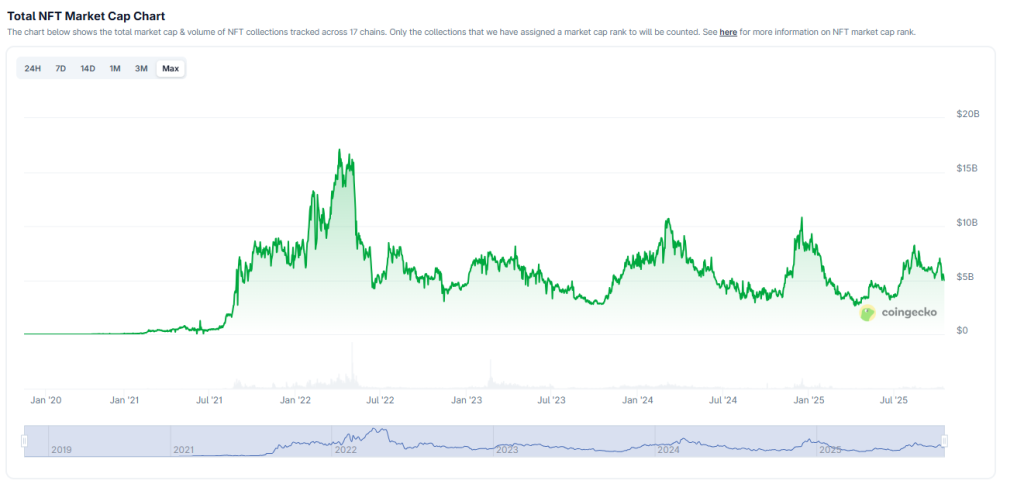
Source: CoinGecko

Finzer said the shift toward crypto aggregation is both a survival strategy and a bet on where the industry is headed. “You can’t fight the macro trend,” he said. “People want to trade everything—not just digital art.”

The new business model aggregates buy and sell orders from decentralized exchanges such as Uniswap and Meteora, generating around $16 million in revenue over the same period through a 0.9% transaction fee.

According to him, OpenSea does not perform know-your-customer checks, arguing that they are incompatible with its non-custodial model, though it uses blockchain analytics to flag suspicious transactions.

The platform’s evolution into a multi-asset aggregator reflects a wider trend among former NFT-focused firms adapting to the changing crypto economy.

Earlier this year, Solana-based marketplace Magic Eden acquired trading platform Slingshot to expand beyond NFTs.

OpenSea’s Trading Volume Hits 3-Year High as Platform Reinvents Itself

At the height of the NFT frenzy in January 2022, OpenSea generated $125 million in monthly revenue and was valued at $13.3 billion, making it one of the most valuable startups in crypto.

But by late 2023, as interest in digital collectibles evaporated, its monthly revenue had fallen to just $3 million. The company was forced to lay off more than half of its staff, shrinking from about 175 employees to around 60 today.

The downturn was accelerated by competition from rival marketplace Blur, which captured traders with zero fees and no royalties for creators.

OpenSea’s response, loosening its own royalty structure, backfired, sparking backlash from artists and collectors who accused the company of abandoning its roots.

Facing dwindling market share and financial strain, Finzer initiated a major reset. The company has since relocated its headquarters to Miami, with most staff working remotely.

Additionally, in the first two weeks of October 2025, the company handled $1.6 billion in crypto trades and $230 million in NFT transactions, its biggest month in more than three years.

Also, in an X post, Finzer noted that OpenSea saw massive demand with about $2.6 billion in trading volume this month, with over 90% from token trading.

OpenSea Prepares Token Launch, Eyes Recovery After NFT Market Collapse

OpenSea’s resurgence comes amid shifting investor appetite across the digital asset space. While Bitcoin and other cryptocurrencies have rallied, NFT trading remains a fraction of what it once was.

Blue-chip collections such as Bored Ape Yacht Club have seen floor prices tumble from around $400,000 at their peak to about $32,000.

Source: CoinGecko

Blur, the platform that once dethroned OpenSea, has also seen its activity collapse, from over $1 billion in monthly volume in early 2023 to just $92 million last month, according to DappRadar.

Despite the slump, the NFT market has shown intermittent signs of recovery in 2025.

DappRadar reported that July saw NFT market capitalization rise 94% to $6.6 billion, driven by renewed interest in blue-chip assets like CryptoPunks and Pudgy Penguins.

CryptoPunks alone saw a 53% floor price increase, while Pudgy Penguins overtook Bored Ape Yacht Club by market cap.

Even so, trading volumes remain volatile. After a resurgence in mid-2025, NFT sales have slowed again, with daily volumes hovering around $8 million, according to CoinGecko.

Source: NFTpulse

Base, Coinbase’s Layer-2 network, now dominates NFT activity, accounting for more than half of total transactions across blockchains, followed by Ethereum, Polygon, and Solana.

OpenSea’s “2.0” vision includes plans for a mobile app and an independent foundation that will issue an OpenSea token.

Finzer says the goal is to make trading as intuitive as Robinhood but fully self-custodial, allowing users to maintain control of their assets across chains.

Market Opportunity
AINFT Logo
AINFT Price(NFT)
$0.0000003419
$0.0000003419$0.0000003419
+1.21%
USD
AINFT (NFT) Live Price Chart
Disclaimer: The articles reposted on this site are sourced from public platforms and are provided for informational purposes only. They do not necessarily reflect the views of MEXC. All rights remain with the original authors. If you believe any content infringes on third-party rights, please contact service@support.mexc.com for removal. MEXC makes no guarantees regarding the accuracy, completeness, or timeliness of the content and is not responsible for any actions taken based on the information provided. The content does not constitute financial, legal, or other professional advice, nor should it be considered a recommendation or endorsement by MEXC.

You May Also Like

nLIGHT to Announce Fourth Quarter and Full Year 2025 Financial Results on February 26th

nLIGHT to Announce Fourth Quarter and Full Year 2025 Financial Results on February 26th

CAMAS, Wash.–(BUSINESS WIRE)–nLIGHT, Inc. (Nasdaq: LASR), a leading provider of high-power lasers for mission critical directed energy, optical sensing, and advanced
Share
AI Journal2026/02/05 21:16
When silver became a meme stock, retail investors ultimately caught the falling knife.

When silver became a meme stock, retail investors ultimately caught the falling knife.

Author: Xu Chao, Wall Street Insights "I lost a whole year's worth of after-tax salary today." This is a desperate cry left by a Reddit user on the forum last
Share
PANews2026/02/05 21:03
Analyst Predicts ‘Uptober’ Rally for BTC Regardless of FOMC Decision

Analyst Predicts ‘Uptober’ Rally for BTC Regardless of FOMC Decision

The post Analyst Predicts ‘Uptober’ Rally for BTC Regardless of FOMC Decision appeared on BitcoinEthereumNews.com. Bitcoin traded at $116,236 as of 14:04 UTC on Sept. 17, up about 1% in the past 24 hours, holding above a key level as markets await the Federal Reserve’s policy announcement. Analysts’ comments Dean Crypto Trades noted on X that bitcoin is only about 7% above its post-election local peak, while the S&P 500 has risen 9% and gold has surged 36% during the same period. He said bitcoin has compressed more than those assets, making it likely to lead the next larger move, though it could form a “lower high” before extending further. He added that ether could join in once it breaks $5,000 and enters price discovery. Lark Davis pointed to bitcoin’s history around September FOMC meetings, saying every September decision since 2020 — except during the 2022 bear market — has preceded a strong rally. He stressed that the pattern is less about the Fed’s rate choice itself and more about seasonal dynamics, arguing that bitcoin tends to thrive in this period heading into “Uptober.” CoinDesk Research’s technical analysis According to CoinDesk Research’s technical analysis data model, bitcoin rose about 0.9% during the Sept. 16–17 analysis window, climbing from $115,461 to $116,520. BTC reached a session high of $117,317 at 07:00 UTC on Sept. 17 before consolidating. Following that peak, bitcoin tested the $116,400–$116,600 range multiple times, confirming it as a short-term support zone. In the final hour of the session, between 11:39 and 12:38 UTC, BTC attempted a breakout: prices moved narrowly between $116,351 and $116,376 before spiking to $116,551 at 12:34 on higher volume. This confirmed a consolidation-breakout pattern, though the gains were modest. Overall, bitcoin remains firm above $116,000, with support around $116,400 and resistance near $117,300. Latest 24-hour and one-month chart analysis The latest 24-hour CoinDesk Data chart, ending 14:04 UTC on…
Share
BitcoinEthereumNews2025/09/18 12:42
