The Dogecoin price slid 5% in the last 24 hours to trade at $0.1964 as of 3:50 a.m. EST on a 21% plunge in trading [...]The Dogecoin price slid 5% in the last 24 hours to trade at $0.1964 as of 3:50 a.m. EST on a 21% plunge in trading [...]

Colossal $300 Trillion Paxos Minting Error Briefly Sends PYUSD Market Cap Past Global GDP

2025/10/16 16:34
3 min read

A blunder by stablecoin issuer Paxos briefly sent the market cap of PayPal USD (PYUSD) to $300 trillion, exceeding global GDP, before the tokens were burned minutes later.

Paxos said in a post on X that the 300 trillion PYUSD mint was caused by a technical error during an internal transfer and was reversed within 22 minutes. It confirmed there was no security breach and that customer funds remain safe.

The minting glitch temporarily disrupted DeFi markets, prompting lending platform Aave to suspend PYUSD transactions as a precaution. Although the issue was quickly resolved, it reignited concerns over the lack of safeguards to prevent stablecoins from issuing token amounts that exceed collateral

“While I appreciate the transparency and the incredibly fast response to burn the excess PYUSD, the initial minting error itself is definitely concerning, given the bedrock trust required for a dollar-backed stablecoin,” said Rui Diao on X. 

On-chain data from Etherscan shows that the tokens were minted at 7:12 pm UTC. 

“Paxos immediately identified the error and burned the excess PYUSD,” the stablecoin issuer said. On-chain data corroborates this, with the entire amount of the PYUSD being burned just 22 minutes after they were minted.

Following the minting error and subsequent burn, Paxos went on to mint 300 million PYUSD as part of its routine operations. 

PYUSD’s Market Cap Exceeded Global GDP, US Debt

Given PYUSD’s 1:1 peg with the US dollar, the incident saw the token’s market cap briefly soar to $300 trillion. This is more than the record US national debt, which stands at more than $37 trillion. It is also more than global gross domestic product (GDP), estimated to be around $117 trillion. 
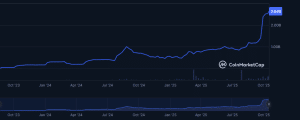
PYUSD market cap

PYUSD market cap (Source: CoinMarketCap)

PYUSD’s market cap stands at around $2.64 billion as of 1:12 a.m. EST, making it the sixth-largest stablecoin. Tether’s USDT is ranked first with its capitalization of more than $181.42 billion, while USD is second with over $76 billion.

Ethena’s USDe token and Dai (DAI) are ranked third and fourth, respectively. Ranked one position above PYUSD is the Trump-linked World Liberty Financial USD (USD1) with its market cap of around $2.68 billion.

PYUSD Mint Raises Community Concerns Around Stablecoin Collateral

The stablecoin market has been gaining momentum since US President Donald Trump signed the GENIUS Act into law in July, providing regulatory clarity for stablecoin issuers.

That sent the stablecoin market cap surging past $300 billion for the first time, data from DefiLlama shows. 
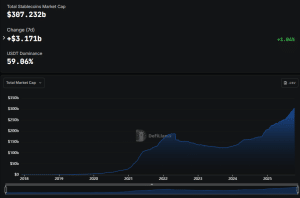
stablecoin market cap

Stablecoin market cap (Source: DefiLlama)

One of the key requirements for the GENIUS Act is that stablecoin issuers must maintain a 1:1 backing with its reserves. These reserves also need to consist of very liquid, low-risk assets.

Without safeguards that prevent stablecoin firms from issuing token amounts that exceed their collateral, crypto community members question how stablecoins differ from fiat currency, which a central bank can print as deemed necessary. 

“It’s not the dollar amount you should be thinking about. It’s the fact that this is a collateralized asset that can be created without the collateral,” said a user on X.

Questions around reserves and liquidity have often been raised in the stablecoin space over the years. For example, Tether has been preparing for a third-party audit of its reserves for USDT for several months now, but no audit has  taken place. 

PYUSD has faced community scrutiny before, most notably after its market cap collapsed 40% about a year ago, raising fears of manipulation. 

Market Opportunity
Capverse Logo
Capverse Price(CAP)
$0,11166
$0,11166$0,11166
+0,87%
USD
Capverse (CAP) Live Price Chart
Disclaimer: The articles reposted on this site are sourced from public platforms and are provided for informational purposes only. They do not necessarily reflect the views of MEXC. All rights remain with the original authors. If you believe any content infringes on third-party rights, please contact service@support.mexc.com for removal. MEXC makes no guarantees regarding the accuracy, completeness, or timeliness of the content and is not responsible for any actions taken based on the information provided. The content does not constitute financial, legal, or other professional advice, nor should it be considered a recommendation or endorsement by MEXC.

You May Also Like

White House adviser: Cryptocurrency bill is "very close" to passage

White House adviser: Cryptocurrency bill is "very close" to passage

PANews reported on June 18 that according to Jinshi, a US White House adviser said that the cryptocurrency bill is "very close" to passage, which will create demand for the
Share
PANews2025/06/18 23:52
Trump caves on his own snubs as retaliation ploy against Dem governors backfires

Trump caves on his own snubs as retaliation ploy against Dem governors backfires

President Donald Trump on Wednesday walked back a snub he gave to two Democratic Governors. Last week, Trump notably did not invite Democratic governors Wes Moore
Share
Rawstory2026/02/12 10:29
Bitcoin devs cheer block reconstruction stats, ignore security budget concerns

Bitcoin devs cheer block reconstruction stats, ignore security budget concerns

The post Bitcoin devs cheer block reconstruction stats, ignore security budget concerns appeared on BitcoinEthereumNews.com. This morning, Bitcoin Core developers celebrated improved block reconstruction statistics for node operators while conveniently ignoring the reason for these statistics — the downward trend in fees for Bitcoin’s security budget. Reacting with heart emojis and thumbs up to a green chart showing over 80% “successful compact block reconstructions without any requested transactions,” they conveniently omitted red trend lines of the fees that Bitcoin users pay for mining security which powered those green statistics. Block reconstructions occur when a node requests additional information about transactions within a compact block. Although compact blocks allow nodes to quickly relay valid bundles of transactions across the internet, the more frequently that nodes can reconstruct without extra, cumbersome transaction requests from their peers is a positive trend. Because so many nodes switched over in August to relay transactions bidding 0.1 sat/vB across their mempools, nodes now have to request less transaction data to reconstruct blocks containing sub-1 sat/vB transactions. After nodes switched over in August to accept and relay pending transactions bidding less than 1 sat/vB, disparate mempools became harmonized as most nodes had a better view of which transactions would likely join upcoming blocks. As a result, block reconstruction times improved, as nodes needed less information about these sub-1 sat/vB transactions. In July, several miners admitted that user demand for Bitcoin blockspace had persisted at such a low that they were willing to accept transaction fees of just 0.1 satoshi per virtual byte — 90% lower than their prior 1 sat/vB minimum. With so many blocks partially empty, they succumbed to the temptation to accept at least something — even 1 billionth of one bitcoin (BTC) — rather than $0 to fill up some of the excess blockspace. Read more: Bitcoin’s transaction fees have fallen to a multi-year low Green stats for block reconstruction after transaction fees crash After…
Share
BitcoinEthereumNews2025/09/18 04:07