The Dogecoin price slid 5% in the last 24 hours to trade at $0.1964 as of 3:50 a.m. EST on a 21% plunge in trading [...]The Dogecoin price slid 5% in the last 24 hours to trade at $0.1964 as of 3:50 a.m. EST on a 21% plunge in trading [...]

Ripple CEO Brad Garlinghouse Calls Banks ‘Hypocritical’ For Blocking Crypto Access

2025/10/16 20:15
3 min read

Ripple CEO Brad Garlinghouse called banks “hypocritical” for demanding crypto firms strictly comply with anti-money laundering rules and other safeguards while also blocking them from banking system infrastructure.

“You can’t say one and then combat the other,” he said, while speaking at DC Fintech Week. ”It’s hypocritical, and I think we all should call them out for being anti-competitive in that regard.”

Ripple has applied for a national trust charter and a Federal Reserve master account, which, if approved, would give it greater access to US banking infrastructure.

Garlinghouse’s remarks come after crypto-native companies including Ripple, Circle, Wise, and Erebor Bank filed for national bank or trust charters. 

A national trust charter would let the companies conduct limited fiduciary and custody activities under the oversight of the Office of the Comptroller of the Currency (OCC) without traditional deposit or lending functions. 

Ripple, through its subsidiary Standard Custody & Trust Company, has gone a step further and also applied for a Federal Reserve master account. If its application is approved, this would give the company direct access to the payments system.

Banking Policy Institute Says Crypto Firms Shouldn’t Get ‘Backdoor Access’

The Banking Policy Institute (BIP), a lobbying group representing big US banks, has raised concerns about granting non-banks and crypto firms access to national bank or trust charters. 

The BIP argues that crypto firms should not get “backdoor access” to the Federal Reserve payments system unless they meet full regulatory requirements. The group has also urged the OCC and Federal Reserve to move cautiously or even reject some applications. 

Garlinghouse said granting crypto firms such as Circle and Ripple master accounts will contribute to more regulatory oversight, more stability and risk mitigation. 

Banks Starting To Take Ripple More Seriously

Still, Garlinghouse said that financial institutions are starting to take Ripple, and other crypto firms, more seriously.

“I had meetings yesterday in New York City, where banks that would not have talked to us three years ago are now leaning in and saying, how could we partner around this?” he said.

That’s as Ripple’s RLUSD stablecoin starts to gain traction following the signing of the GENIUS Act into law in July, providing regulatory clarity for stablecoin firms.

Since that act was signed by US President Trump, the stablecoin market cap has gone on to soar past $300 billion, data from DefiLlama shows. 

The market capitalization of Ripple’s RLUSD stablecoin has soared more than 73% to $840.1 million since the GENIUS Act passed. 
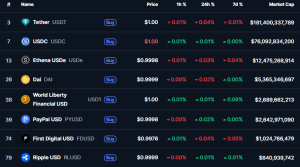
Top stablecoins by market cap

Top stablecoins by market cap (Source: CoinMarketCap)

That ranks it as the eighth-largest stablecoin. 

Market Opportunity
Polytrade Logo
Polytrade Price(TRADE)
$0.03318
$0.03318$0.03318
-0.62%
USD
Polytrade (TRADE) Live Price Chart
Disclaimer: The articles reposted on this site are sourced from public platforms and are provided for informational purposes only. They do not necessarily reflect the views of MEXC. All rights remain with the original authors. If you believe any content infringes on third-party rights, please contact service@support.mexc.com for removal. MEXC makes no guarantees regarding the accuracy, completeness, or timeliness of the content and is not responsible for any actions taken based on the information provided. The content does not constitute financial, legal, or other professional advice, nor should it be considered a recommendation or endorsement by MEXC.

You May Also Like

White House adviser: Cryptocurrency bill is "very close" to passage
White House adviser: Cryptocurrency bill is "very close" to passage

PANews reported on June 18 that according to Jinshi, a US White House adviser said that the cryptocurrency bill is "very close" to passage, which will create demand for the
Share
PANews2025/06/18 23:52
Trump caves on his own snubs as retaliation ploy against Dem governors backfires

Trump caves on his own snubs as retaliation ploy against Dem governors backfires

President Donald Trump on Wednesday walked back a snub he gave to two Democratic Governors. Last week, Trump notably did not invite Democratic governors Wes Moore
Share
Rawstory2026/02/12 10:29
Bitcoin devs cheer block reconstruction stats, ignore security budget concerns

Bitcoin devs cheer block reconstruction stats, ignore security budget concerns

The post Bitcoin devs cheer block reconstruction stats, ignore security budget concerns appeared on BitcoinEthereumNews.com. This morning, Bitcoin Core developers celebrated improved block reconstruction statistics for node operators while conveniently ignoring the reason for these statistics — the downward trend in fees for Bitcoin’s security budget. Reacting with heart emojis and thumbs up to a green chart showing over 80% “successful compact block reconstructions without any requested transactions,” they conveniently omitted red trend lines of the fees that Bitcoin users pay for mining security which powered those green statistics. Block reconstructions occur when a node requests additional information about transactions within a compact block. Although compact blocks allow nodes to quickly relay valid bundles of transactions across the internet, the more frequently that nodes can reconstruct without extra, cumbersome transaction requests from their peers is a positive trend. Because so many nodes switched over in August to relay transactions bidding 0.1 sat/vB across their mempools, nodes now have to request less transaction data to reconstruct blocks containing sub-1 sat/vB transactions. After nodes switched over in August to accept and relay pending transactions bidding less than 1 sat/vB, disparate mempools became harmonized as most nodes had a better view of which transactions would likely join upcoming blocks. As a result, block reconstruction times improved, as nodes needed less information about these sub-1 sat/vB transactions. In July, several miners admitted that user demand for Bitcoin blockspace had persisted at such a low that they were willing to accept transaction fees of just 0.1 satoshi per virtual byte — 90% lower than their prior 1 sat/vB minimum. With so many blocks partially empty, they succumbed to the temptation to accept at least something — even 1 billionth of one bitcoin (BTC) — rather than $0 to fill up some of the excess blockspace. Read more: Bitcoin’s transaction fees have fallen to a multi-year low Green stats for block reconstruction after transaction fees crash After…
Share
BitcoinEthereumNews2025/09/18 04:07