Kalshi, a U.S.-licensed prediction market supervised by the Commodity Futures Trading Commission (CFTC), has secured $300 million in fresh capital, bringing its valuation to $5 billion, The New York Times reported. The news highlights the rapid ascent of prediction markets from niche financial experiments to global investment-grade platforms attracting major institutional capital. Prediction Markets Enter the Spotlight Once a curiosity on the fringes of finance, prediction markets are now attracting millions of users wagering on everything from politics and sports to entertainment and global events. Kalshi, one of the most prominent names in the sector, said it plans to open its platform to customers in more than 140 countries, expanding far beyond its U.S. base. The company’s fundraising announcement comes the same week as Polymarket, its chief rival, revealed that Intercontinental Exchange (ICE) — parent company of the New York Stock Exchange — intends to invest up to $2 billion in its platform. Explosive Growth and Investor Backing Kalshi is also on pace to record $50 billion in annualized trading volume, a sharp increase from about $300 million last year, according to data from Dune. The platform now commands more than 60% of global prediction-market activity, recently surpassing Polymarket. “We did not expect this level of growth,” said Tarek Mansour, Kalshi’s co-founder and CEO. The surge has attracted heavyweight venture capital investors, including Sequoia Capital, Andreessen Horowitz, Paradigm, CapitalG, and Coinbase Ventures. The new round, negotiated just two months after its previous one, more than doubled Kalshi’s valuation. Sports Bets and Retail Access Drive Expansion Kalshi’s entry into sports wagering — including complex bets known as parlays — has shaken up the traditional sports betting landscape. Shares of DraftKings and FanDuel’s parent company have both declined double digits amid concerns over competition. Additionally, Kalshi’s partnerships with Robinhood and Webull have allowed users to trade prediction contracts as seamlessly as they buy stocks, deepening mainstream adoption. Regulatory Questions Loom Despite CFTC approval, Kalshi faces pushback from U.S. state regulators who argue its sports-related contracts resemble unlicensed gambling. Lawsuits have been filed in several states where online sports betting remains illegal. Mansour remains confident, saying, “Every time there’s a new type of financial innovation, there’s always a series of questions around regulation. If there weren’t questions, what you’re doing is probably not meaningful or innovative enough.” As Kalshi’s global reach expands, its battle to balance innovation with compliance may define the future of the regulated prediction market industryKalshi, a U.S.-licensed prediction market supervised by the Commodity Futures Trading Commission (CFTC), has secured $300 million in fresh capital, bringing its valuation to $5 billion, The New York Times reported. The news highlights the rapid ascent of prediction markets from niche financial experiments to global investment-grade platforms attracting major institutional capital. Prediction Markets Enter the Spotlight Once a curiosity on the fringes of finance, prediction markets are now attracting millions of users wagering on everything from politics and sports to entertainment and global events. Kalshi, one of the most prominent names in the sector, said it plans to open its platform to customers in more than 140 countries, expanding far beyond its U.S. base. The company’s fundraising announcement comes the same week as Polymarket, its chief rival, revealed that Intercontinental Exchange (ICE) — parent company of the New York Stock Exchange — intends to invest up to $2 billion in its platform. Explosive Growth and Investor Backing Kalshi is also on pace to record $50 billion in annualized trading volume, a sharp increase from about $300 million last year, according to data from Dune. The platform now commands more than 60% of global prediction-market activity, recently surpassing Polymarket. “We did not expect this level of growth,” said Tarek Mansour, Kalshi’s co-founder and CEO. The surge has attracted heavyweight venture capital investors, including Sequoia Capital, Andreessen Horowitz, Paradigm, CapitalG, and Coinbase Ventures. The new round, negotiated just two months after its previous one, more than doubled Kalshi’s valuation. Sports Bets and Retail Access Drive Expansion Kalshi’s entry into sports wagering — including complex bets known as parlays — has shaken up the traditional sports betting landscape. Shares of DraftKings and FanDuel’s parent company have both declined double digits amid concerns over competition. Additionally, Kalshi’s partnerships with Robinhood and Webull have allowed users to trade prediction contracts as seamlessly as they buy stocks, deepening mainstream adoption. Regulatory Questions Loom Despite CFTC approval, Kalshi faces pushback from U.S. state regulators who argue its sports-related contracts resemble unlicensed gambling. Lawsuits have been filed in several states where online sports betting remains illegal. Mansour remains confident, saying, “Every time there’s a new type of financial innovation, there’s always a series of questions around regulation. If there weren’t questions, what you’re doing is probably not meaningful or innovative enough.” As Kalshi’s global reach expands, its battle to balance innovation with compliance may define the future of the regulated prediction market industry

Kalshi Raises $300M at $5B Valuation Under CFTC Oversight

3 min read

Kalshi, a U.S.-licensed prediction market supervised by the Commodity Futures Trading Commission (CFTC), has secured $300 million in fresh capital, bringing its valuation to $5 billion, The New York Times reported.

The news highlights the rapid ascent of prediction markets from niche financial experiments to global investment-grade platforms attracting major institutional capital.

Prediction Markets Enter the Spotlight

Once a curiosity on the fringes of finance, prediction markets are now attracting millions of users wagering on everything from politics and sports to entertainment and global events.

Kalshi, one of the most prominent names in the sector, said it plans to open its platform to customers in more than 140 countries, expanding far beyond its U.S. base.

The company’s fundraising announcement comes the same week as Polymarket, its chief rival, revealed that Intercontinental Exchange (ICE) — parent company of the New York Stock Exchange — intends to invest up to $2 billion in its platform.

Explosive Growth and Investor Backing

Kalshi is also on pace to record $50 billion in annualized trading volume, a sharp increase from about $300 million last year, according to data from Dune. The platform now commands more than 60% of global prediction-market activity, recently surpassing Polymarket.

“We did not expect this level of growth,” said Tarek Mansour, Kalshi’s co-founder and CEO. The surge has attracted heavyweight venture capital investors, including Sequoia Capital, Andreessen Horowitz, Paradigm, CapitalG, and Coinbase Ventures. The new round, negotiated just two months after its previous one, more than doubled Kalshi’s valuation.

Sports Bets and Retail Access Drive Expansion

Kalshi’s entry into sports wagering — including complex bets known as parlays — has shaken up the traditional sports betting landscape. Shares of DraftKings and FanDuel’s parent company have both declined double digits amid concerns over competition.

Additionally, Kalshi’s partnerships with Robinhood and Webull have allowed users to trade prediction contracts as seamlessly as they buy stocks, deepening mainstream adoption.

Regulatory Questions Loom

Despite CFTC approval, Kalshi faces pushback from U.S. state regulators who argue its sports-related contracts resemble unlicensed gambling. Lawsuits have been filed in several states where online sports betting remains illegal.

Mansour remains confident, saying, “Every time there’s a new type of financial innovation, there’s always a series of questions around regulation. If there weren’t questions, what you’re doing is probably not meaningful or innovative enough.”

As Kalshi’s global reach expands, its battle to balance innovation with compliance may define the future of the regulated prediction market industry.

Disclaimer: The articles reposted on this site are sourced from public platforms and are provided for informational purposes only. They do not necessarily reflect the views of MEXC. All rights remain with the original authors. If you believe any content infringes on third-party rights, please contact service@support.mexc.com for removal. MEXC makes no guarantees regarding the accuracy, completeness, or timeliness of the content and is not responsible for any actions taken based on the information provided. The content does not constitute financial, legal, or other professional advice, nor should it be considered a recommendation or endorsement by MEXC.

You May Also Like

Fed Decides On Interest Rates Today—Here’s What To Watch For

Fed Decides On Interest Rates Today—Here’s What To Watch For

The post Fed Decides On Interest Rates Today—Here’s What To Watch For appeared on BitcoinEthereumNews.com. Topline The Federal Reserve on Wednesday will conclude a two-day policymaking meeting and release a decision on whether to lower interest rates—following months of pressure and criticism from President Donald Trump—and potentially signal whether additional cuts are on the way. President Donald Trump has urged the central bank to “CUT INTEREST RATES, NOW, AND BIGGER” than they might plan to. Getty Images Key Facts The central bank is poised to cut interest rates by at least a quarter-point, down from the 4.25% to 4.5% range where they have been held since December to between 4% and 4.25%, as Wall Street has placed 100% odds of a rate cut, according to CME’s FedWatch, with higher odds (94%) on a quarter-point cut than a half-point (6%) reduction. Fed governors Christopher Waller and Michelle Bowman, both Trump appointees, voted in July for a quarter-point reduction to rates, and they may dissent again in favor of a large cut alongside Stephen Miran, Trump’s Council of Economic Advisers’ chair, who was sworn in at the meeting’s start on Tuesday. It’s unclear whether other policymakers, including Kansas City Fed President Jeffrey Schmid and St. Louis Fed President Alberto Musalem, will favor larger cuts or opt for no reduction. Fed Chair Jerome Powell said in his Jackson Hole, Wyoming, address last month the central bank would likely consider a looser monetary policy, noting the “shifting balance of risks” on the U.S. economy “may warrant adjusting our policy stance.” David Mericle, an economist for Goldman Sachs, wrote in a note the “key question” for the Fed’s meeting is whether policymakers signal “this is likely the first in a series of consecutive cuts” as the central bank is anticipated to “acknowledge the softening in the labor market,” though they may not “nod to an October cut.” Mericle said he…
Share
BitcoinEthereumNews2025/09/18 00:23
While Shiba Inu and Turbo Chase Price, 63% APY Staking Puts APEMARS at the Forefront of the Best Meme Coin Presale 2026 – Stage 6 Ends in 3 Days!
While Shiba Inu and Turbo Chase Price, 63% APY Staking Puts APEMARS at the Forefront of the Best Meme Coin Presale 2026 – Stage 6 Ends in 3 Days!

What if your meme coin investment could generate passive income without selling a single token? Shiba Inu climbed 4.97% as 207 billion tokens left exchanges. Turbo
Share
Coinstats2026/02/04 03:15
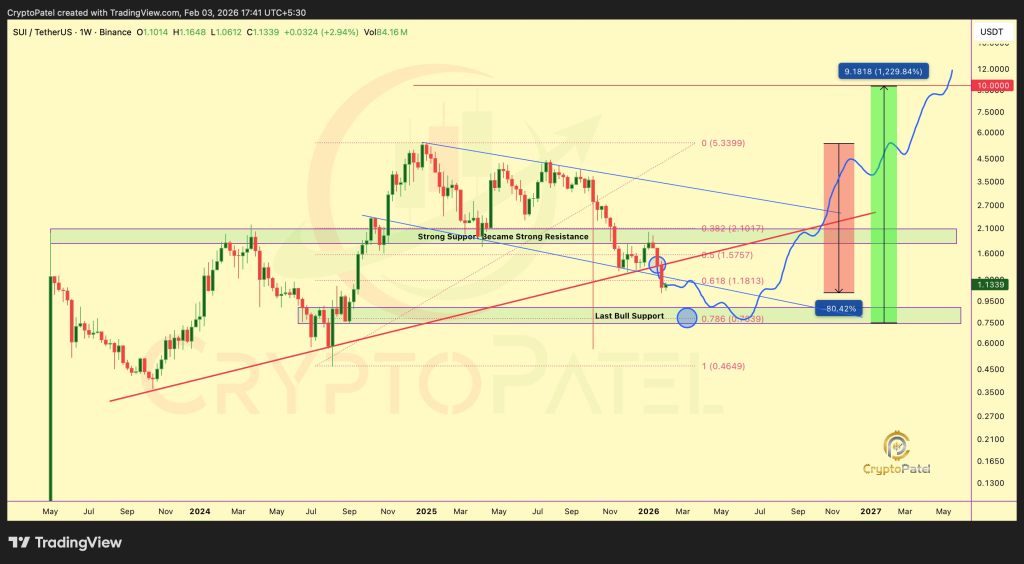
SUI Price Is Down 80%: Price Nears Level Bulls Cannot Afford to Lose

SUI Price Is Down 80%: Price Nears Level Bulls Cannot Afford to Lose

SUI price has quietly slipped into a zone that usually decides everything. Charts show an 80% drop from the peak, yet the market is no longer moving fast. This
Share
Captainaltcoin2026/02/04 03:00