Highlights: Coinbase has defended Base network, as Paul Grewal says sequencers process transactions but do not match trades. Base is exploring a token launch and aims to add a Solana bridge to boost decentralization. Base has secured 4.83 billion TVL with stablecoin liquidity as it strengthens its position in the DeFi market. Coinbase’s chief legal officer, Paul Grewal, dismissed claims that its Ethereum Layer-2 network, Base, should be labeled an exchange. Speaking in an interview, Grewal explained that Base functions as blockchain infrastructure, not a marketplace for securities trading. He stressed that transaction matching happens inside applications, including automated market makers or centralized order book protocols, not on the Layer-2 level itself. Should @base be regulated like the Nasdaq exchange? Here's what @coinbase CLO @iampaulgrewal has to say: “Base is just a normal blockchain… Yes it’s a layer2. But that doesn’t change its relationship to securities laws.” “We are not matching buyers and sellers of securities…… pic.twitter.com/Cd4M8kizTZ — Bankless (@BanklessHQ) September 26, 2025 The U.S. Securities and Exchange Commission defines an exchange as a system that brings buyers and sellers together. This raised questions about whether sequencers, which order transactions, could fall into that category. Commissioner Hester Peirce warned that centralized sequencers might resemble matching engines and attract legal oversight. Grewal argued that this interpretation creates confusion. He compared sequencers to cloud service providers, which run code but are not responsible for the activities built on top. Ripple’s David Schwartz supported that position, while Ethereum co-founder Vitalik Buterin praised Base for combining centralized sequencing with decentralized Ethereum security. Base is doing things the right way: an L2 on top of Ethereum, that uses its centralized features to provide stronger UX features, while still being tied into Ethereum's decentralized base layer for security. Base does not have custody over your funds, they cannot steal funds or… https://t.co/0EMdThg4gU — vitalik.eth (@VitalikButerin) September 22, 2025 Grewal cautioned that treating sequencers as exchanges could impose heavy compliance demands. He said such restrictions would harm innovation and slow the development of Ethereum’s scaling ecosystem. Coinbase Defends Base Network While Exploring Token Plans Coinbase used its BaseCamp 2025 event in Vermont to outline new directions for the Base network. Jesse Pollak, who leads the project, revealed that the team is now exploring the launch of a native token. This represented a shift from earlier statements that ruled out any token for Base. Meanwhile, Coinbase recently launched a $5 million security program that is set to focus on its on-chain products and the smart contracts of the Base network. Pollak clarified that no decision has been reached on token design, governance, or launch timing. However, he said that the exploration aligns with efforts to expand decentralization and support more opportunities for developers and creators. The remarks followed the recent token release by Consensys’ Linea network, which distributed more than nine billion LINEA tokens. At the same event, Base announced a new bridge with Solana. The bridge will facilitate interoperability between ERC-20 and SPL tokens and allow more flexibility to users. Pollak termed these steps as crucial to developing more adoption and creating more avenues of cooperation among ecosystems. Grewal emphasized that the Base Network operates as infrastructure. He said compliance burdens should fall on applications, not on the Layer-2 itself. He added that mislabeling sequencers only spreads confusion and slows adoption. Base Strengthens Its DeFi Position Base continues to gain traction in decentralized finance. The network has a total value locked of $4.83 billion in over 700 protocols. Liquidity is also high, and $4.4 billion of stablecoins are circulating on the network. These assets allow lending, trading, and other DeFi activity. Source: DefiLlama Ethereum remains dominant in the industry with a locked value of $86.3 billion. Solana comes behind, with Base gaining an increasing market share despite its smaller size. The gradual increase emphasizes the significance of the Coinbase user base and infrastructure. Base has positioned itself as a major player in the growth of the market. Its development demonstrates the ability of Layer-2 networks to compete and overcome innovation objectives as well as legal challenges. eToro Platform Best Crypto Exchange Over 90 top cryptos to trade Regulated by top-tier entities User-friendly trading app 30+ million users 9.9 Visit eToro eToro is a multi-asset investment platform. The value of your investments may go up or down. Your capital is at risk. Don’t invest unless you’re prepared to lose all the money you invest. This is a high-risk investment, and you should not expect to be protected if something goes wrong. Highlights: Coinbase has defended Base network, as Paul Grewal says sequencers process transactions but do not match trades. Base is exploring a token launch and aims to add a Solana bridge to boost decentralization. Base has secured 4.83 billion TVL with stablecoin liquidity as it strengthens its position in the DeFi market. Coinbase’s chief legal officer, Paul Grewal, dismissed claims that its Ethereum Layer-2 network, Base, should be labeled an exchange. Speaking in an interview, Grewal explained that Base functions as blockchain infrastructure, not a marketplace for securities trading. He stressed that transaction matching happens inside applications, including automated market makers or centralized order book protocols, not on the Layer-2 level itself. Should @base be regulated like the Nasdaq exchange? Here's what @coinbase CLO @iampaulgrewal has to say: “Base is just a normal blockchain… Yes it’s a layer2. But that doesn’t change its relationship to securities laws.” “We are not matching buyers and sellers of securities…… pic.twitter.com/Cd4M8kizTZ — Bankless (@BanklessHQ) September 26, 2025 The U.S. Securities and Exchange Commission defines an exchange as a system that brings buyers and sellers together. This raised questions about whether sequencers, which order transactions, could fall into that category. Commissioner Hester Peirce warned that centralized sequencers might resemble matching engines and attract legal oversight. Grewal argued that this interpretation creates confusion. He compared sequencers to cloud service providers, which run code but are not responsible for the activities built on top. Ripple’s David Schwartz supported that position, while Ethereum co-founder Vitalik Buterin praised Base for combining centralized sequencing with decentralized Ethereum security. Base is doing things the right way: an L2 on top of Ethereum, that uses its centralized features to provide stronger UX features, while still being tied into Ethereum's decentralized base layer for security. Base does not have custody over your funds, they cannot steal funds or… https://t.co/0EMdThg4gU — vitalik.eth (@VitalikButerin) September 22, 2025 Grewal cautioned that treating sequencers as exchanges could impose heavy compliance demands. He said such restrictions would harm innovation and slow the development of Ethereum’s scaling ecosystem. Coinbase Defends Base Network While Exploring Token Plans Coinbase used its BaseCamp 2025 event in Vermont to outline new directions for the Base network. Jesse Pollak, who leads the project, revealed that the team is now exploring the launch of a native token. This represented a shift from earlier statements that ruled out any token for Base. Meanwhile, Coinbase recently launched a $5 million security program that is set to focus on its on-chain products and the smart contracts of the Base network. Pollak clarified that no decision has been reached on token design, governance, or launch timing. However, he said that the exploration aligns with efforts to expand decentralization and support more opportunities for developers and creators. The remarks followed the recent token release by Consensys’ Linea network, which distributed more than nine billion LINEA tokens. At the same event, Base announced a new bridge with Solana. The bridge will facilitate interoperability between ERC-20 and SPL tokens and allow more flexibility to users. Pollak termed these steps as crucial to developing more adoption and creating more avenues of cooperation among ecosystems. Grewal emphasized that the Base Network operates as infrastructure. He said compliance burdens should fall on applications, not on the Layer-2 itself. He added that mislabeling sequencers only spreads confusion and slows adoption. Base Strengthens Its DeFi Position Base continues to gain traction in decentralized finance. The network has a total value locked of $4.83 billion in over 700 protocols. Liquidity is also high, and $4.4 billion of stablecoins are circulating on the network. These assets allow lending, trading, and other DeFi activity. Source: DefiLlama Ethereum remains dominant in the industry with a locked value of $86.3 billion. Solana comes behind, with Base gaining an increasing market share despite its smaller size. The gradual increase emphasizes the significance of the Coinbase user base and infrastructure. Base has positioned itself as a major player in the growth of the market. Its development demonstrates the ability of Layer-2 networks to compete and overcome innovation objectives as well as legal challenges. eToro Platform Best Crypto Exchange Over 90 top cryptos to trade Regulated by top-tier entities User-friendly trading app 30+ million users 9.9 Visit eToro eToro is a multi-asset investment platform. The value of your investments may go up or down. Your capital is at risk. Don’t invest unless you’re prepared to lose all the money you invest. This is a high-risk investment, and you should not expect to be protected if something goes wrong.

Coinbase Defends Base Network From Exchange Label Amid Token Exploration
4 min read

Highlights:

  • Coinbase has defended Base network, as Paul Grewal says sequencers process transactions but do not match trades.
  • Base is exploring a token launch and aims to add a Solana bridge to boost decentralization.
  • Base has secured 4.83 billion TVL with stablecoin liquidity as it strengthens its position in the DeFi market.

Coinbase’s chief legal officer, Paul Grewal, dismissed claims that its Ethereum Layer-2 network, Base, should be labeled an exchange. Speaking in an interview, Grewal explained that Base functions as blockchain infrastructure, not a marketplace for securities trading. He stressed that transaction matching happens inside applications, including automated market makers or centralized order book protocols, not on the Layer-2 level itself.

The U.S. Securities and Exchange Commission defines an exchange as a system that brings buyers and sellers together. This raised questions about whether sequencers, which order transactions, could fall into that category. Commissioner Hester Peirce warned that centralized sequencers might resemble matching engines and attract legal oversight.

Grewal argued that this interpretation creates confusion. He compared sequencers to cloud service providers, which run code but are not responsible for the activities built on top. Ripple’s David Schwartz supported that position, while Ethereum co-founder Vitalik Buterin praised Base for combining centralized sequencing with decentralized Ethereum security.

Grewal cautioned that treating sequencers as exchanges could impose heavy compliance demands. He said such restrictions would harm innovation and slow the development of Ethereum’s scaling ecosystem.

Coinbase Defends Base Network While Exploring Token Plans

Coinbase used its BaseCamp 2025 event in Vermont to outline new directions for the Base network. Jesse Pollak, who leads the project, revealed that the team is now exploring the launch of a native token. This represented a shift from earlier statements that ruled out any token for Base. Meanwhile, Coinbase recently launched a $5 million security program that is set to focus on its on-chain products and the smart contracts of the Base network.

Pollak clarified that no decision has been reached on token design, governance, or launch timing. However, he said that the exploration aligns with efforts to expand decentralization and support more opportunities for developers and creators. The remarks followed the recent token release by Consensys’ Linea network, which distributed more than nine billion LINEA tokens.

At the same event, Base announced a new bridge with Solana. The bridge will facilitate interoperability between ERC-20 and SPL tokens and allow more flexibility to users. Pollak termed these steps as crucial to developing more adoption and creating more avenues of cooperation among ecosystems. Grewal emphasized that the Base Network operates as infrastructure. He said compliance burdens should fall on applications, not on the Layer-2 itself. He added that mislabeling sequencers only spreads confusion and slows adoption.

Base Strengthens Its DeFi Position

Base continues to gain traction in decentralized finance. The network has a total value locked of $4.83 billion in over 700 protocols. Liquidity is also high, and $4.4 billion of stablecoins are circulating on the network. These assets allow lending, trading, and other DeFi activity.
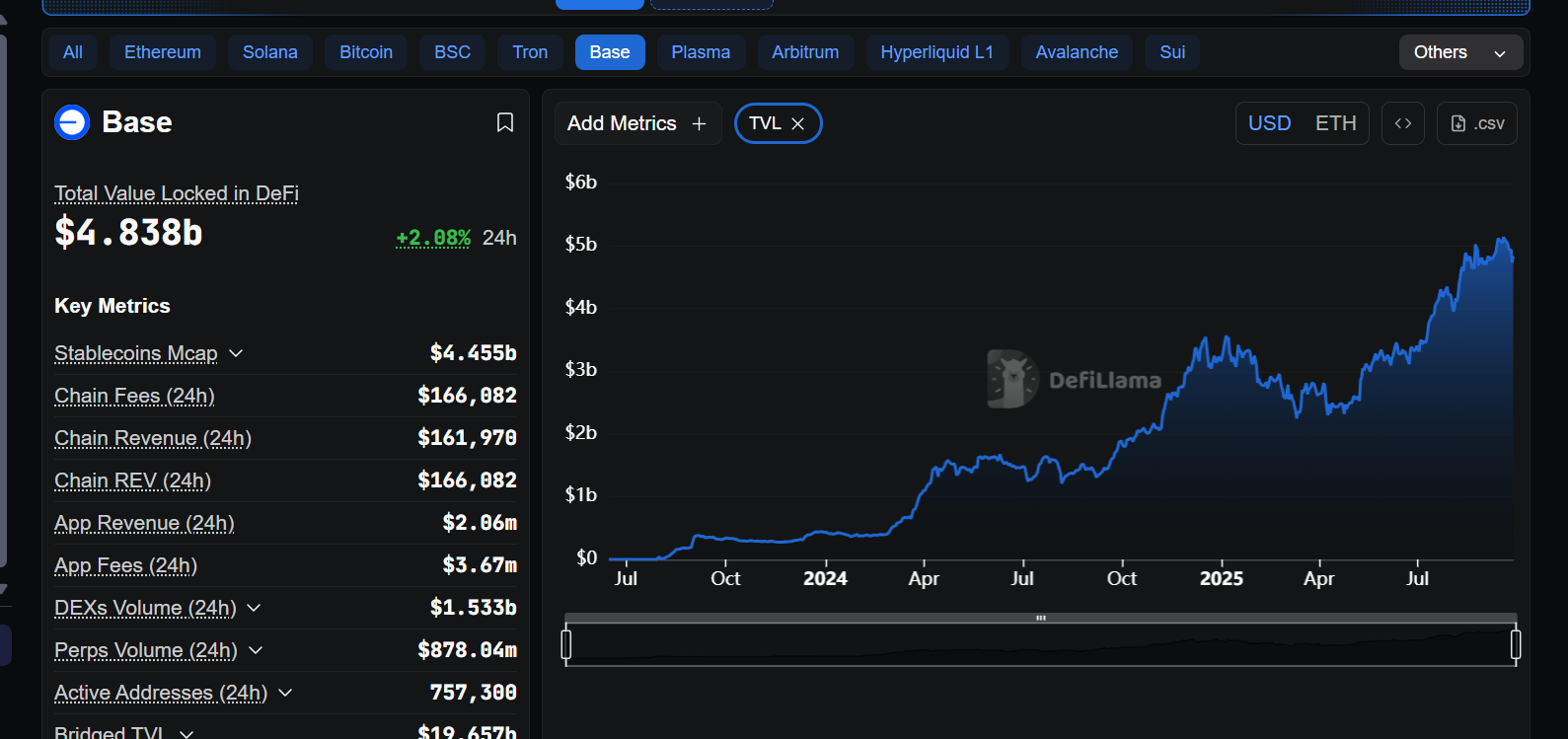
Source: DefiLlama

Ethereum remains dominant in the industry with a locked value of $86.3 billion. Solana comes behind, with Base gaining an increasing market share despite its smaller size. The gradual increase emphasizes the significance of the Coinbase user base and infrastructure. Base has positioned itself as a major player in the growth of the market. Its development demonstrates the ability of Layer-2 networks to compete and overcome innovation objectives as well as legal challenges.

eToro Platform

Best Crypto Exchange

  • Over 90 top cryptos to trade
  • Regulated by top-tier entities
  • User-friendly trading app
  • 30+ million users
9.9

5 Stars

Visit eToro

eToro is a multi-asset investment platform. The value of your investments may go up or down. Your capital is at risk. Don’t invest unless you’re prepared to lose all the money you invest. This is a high-risk investment, and you should not expect to be protected if something goes wrong.

Market Opportunity
TokenFi Logo
TokenFi Price(TOKEN)
$0.00364
$0.00364$0.00364
-1.86%
USD
TokenFi (TOKEN) Live Price Chart
Disclaimer: The articles reposted on this site are sourced from public platforms and are provided for informational purposes only. They do not necessarily reflect the views of MEXC. All rights remain with the original authors. If you believe any content infringes on third-party rights, please contact service@support.mexc.com for removal. MEXC makes no guarantees regarding the accuracy, completeness, or timeliness of the content and is not responsible for any actions taken based on the information provided. The content does not constitute financial, legal, or other professional advice, nor should it be considered a recommendation or endorsement by MEXC.

You May Also Like

Bitcoin ETFs Outpace Ethereum With $2.9B Weekly Surge

Bitcoin ETFs Outpace Ethereum With $2.9B Weekly Surge

The surge follows a difficult August, when investors pulled out more than $750 million while rotating capital into Ethereum-focused funds. […] The post Bitcoin ETFs Outpace Ethereum With $2.9B Weekly Surge appeared first on Coindoo.
Share
Coindoo2025/09/18 01:15
CME Group to launch options on XRP and SOL futures

CME Group to launch options on XRP and SOL futures

The post CME Group to launch options on XRP and SOL futures appeared on BitcoinEthereumNews.com. CME Group will offer options based on the derivative markets on Solana (SOL) and XRP. The new markets will open on October 13, after regulatory approval.  CME Group will expand its crypto products with options on the futures markets of Solana (SOL) and XRP. The futures market will start on October 13, after regulatory review and approval.  The options will allow the trading of MicroSol, XRP, and MicroXRP futures, with expiry dates available every business day, monthly, and quarterly. The new products will be added to the existing BTC and ETH options markets. ‘The launch of these options contracts builds on the significant growth and increasing liquidity we have seen across our suite of Solana and XRP futures,’ said Giovanni Vicioso, CME Group Global Head of Cryptocurrency Products. The options contracts will have two main sizes, tracking the futures contracts. The new market will be suitable for sophisticated institutional traders, as well as active individual traders. The addition of options markets singles out XRP and SOL as liquid enough to offer the potential to bet on a market direction.  The options on futures arrive a few months after the launch of SOL futures. Both SOL and XRP had peak volumes in August, though XRP activity has slowed down in September. XRP and SOL options to tap both institutions and active traders Crypto options are one of the indicators of market attitudes, with XRP and SOL receiving a new way to gauge sentiment. The contracts will be supported by the Cumberland team.  ‘As one of the biggest liquidity providers in the ecosystem, the Cumberland team is excited to support CME Group’s continued expansion of crypto offerings,’ said Roman Makarov, Head of Cumberland Options Trading at DRW. ‘The launch of options on Solana and XRP futures is the latest example of the…
Share
BitcoinEthereumNews2025/09/18 00:56
The FDA Is Trying To Make Corporate Free Speech Situational

The FDA Is Trying To Make Corporate Free Speech Situational

The post The FDA Is Trying To Make Corporate Free Speech Situational appeared on BitcoinEthereumNews.com. BENSENVILLE, ILLINOIS – SEPTEMBER 10: Flanked by U.S. Attorney General Pam Bondi (rear), and FDA Commissioner Marty Makary (R), Secretary of Health and Human Services Robert F. Kennedy Jr. speaks to the press outside Midwest Distribution after it was raided by federal agents on September 10, 2025 in Bensenville, Illinois. According to the company, various e-liquids were seized in the raid. (Photo by Scott Olson/Getty Images) Getty Images While running for President in 2008, Barack Obama famously chanted “Yes we can.” Love or hate his political views, Obama’s politics were quite effective. He was asking voters to think big, to envision a much better future. Advertisers no doubt approved. That’s because ads routinely evoke things not as they are, but as they could be. Gyms and exercise equipment companies don’t promote their locations and equipment with flabby, lumbering people, rather their ads show fit, upright, energetic individuals. A look ahead. Restaurants do the same with ads showing happy people enjoying impressively put together plates of food. Conversely, ads meant to convince smokers to quit have not infrequently shown the worst of the worst future downsides of the habit. The nature of advertising comes to mind as FDA commissioner Marty Makary puzzlingly brags that “The Trump Administration Is Taking On Big Pharma” in the New York Times. Makary laments pharmaceutical ads that “are filled with dancing patients, glowing smiles and catch jingles that drown out the fine print.” Not explained is whether Makary would be happier if drug companies placed ads with immobile patients, frowns, and funereal music. Seriously, what does he expect? Does he want drug companies to commit billions to drug development to accompany their achievements with imagery defined by misery? Has Makary stopped to contemplate the myriad shareholders lawsuits drugmakers would face if, upon risking staggering sums meant…
Share
BitcoinEthereumNews2025/09/18 06:29