Author: 0xreseracher If market conditions are a thermometer of sentiment, then treasury allocation is a company's voting machine. Who's putting real money on their balance sheets and which altcoins they're betting on is often more reliable than social media buzz. In 2025, we'll see more and more publicly disclosed companies adding non-BTC and non-ETH tokens to their treasuries. Examples include FET and TAO in the AI sector, HYPE and ENA in emerging DeFi infrastructure, payment veterans LTC and TRX, and even the more socially engaged DOGE. These holdings reflect both business synergies and the desire for asset diversification. They also provide ordinary investors with a window into the market: who's buying, why, and how they're using their holdings. By asking these questions, you'll more easily distinguish strong from weak narratives and understand which altcoins are being taken seriously by institutional investors. Why look at treasury configuration? Use "real money" to identify strong narratives. First, it's harder to falsify. Once a company includes tokens in financial reports or regulatory filings, management must explain the size of its holdings, accounting policies, custody, and risks. This is more binding than just slogans. Second, it's closer to "holding for use." During this treasury boom, many companies aren't just buying tokens; they're also signing technical partnerships, introducing tokens for product use, or generating on-chain staking returns. Typical examples include Interactive Strength's plan to purchase approximately $55 million in FET and partner with fetch.ai; Freight Technologies' integration of FET with logistics optimization scenarios; Hyperion DeFi's use of HYPE for staking and establishing a collaborative income and staking pathway with Kinetiq; and TLGY (to be merged into StablecoinX)'s plan to establish an ENA treasury to stake on Ethena's synthetic stability and yield structure. What these initiatives share is that tokens are not just prices, but also "certificates" and "fuel." Third, they provide an alternative path for ordinary investors. You can research tokens directly or gain indirect exposure by researching the publicly listed companies that hold them. Of course, this is a double-edged sword: when a small-cap company is paired with a highly volatile token, the stock price often becomes a proxy for the token, leading to more dramatic fluctuations. If you choose indirect stock exposure, position control and a good sense of timing are crucial. Judging from the market context of 2025, this trend is accelerating. On a macro level, the launch of US spot crypto ETFs has boosted risk appetite. The strength of BTC and ETH has provided a window for spillover from altcoins, garnering more attention for high-quality sectors. Corporate attitudes are also evolving: from "exploratory holdings" a few years ago, they have evolved into "strategic allocations," and even a new breed of companies has emerged, with "crypto treasuries as their primary business." Some companies have proactively transformed, explicitly making the construction and operation of crypto treasuries their core business. Regarding disclosure, companies are no longer content with press releases, but are increasingly disclosing holdings, fair value, custody details, and risk management arrangements through regulatory filings, quarterly reports, and investor presentations. This enhances the verifiability of this information. In short, the excitement is back, the path is clearer, and investors are becoming more serious. This also means that observing treasury dynamics is becoming a reliable window into the direction of the industry. Recent statistics on altcoin holdings in the treasury of listed companies Three major altcoin themes: AI, new DeFi, and traditional payment currencies AI Track (FET, TAO): The key signal of this track is "use and hold." Tokens of AI-native networks are often not simply speculative targets, but rather "tickets and fuel" for access and settlement: the invocation of intelligent agents, access to computing power and model markets, and network incentive mechanisms all require the inherent use of tokens. The entry of corporate treasuries is often accompanied by technical collaboration and business integration, such as closed-loop development in logistics optimization, computing power deployment, or intelligent agent deployment. Therefore, speculative weighting is relatively low, with a greater emphasis on strategic allocation. However, this track also presents uncertainties: the integration of AI and blockchain is still in the verification phase, valuations may preempt future expectations, and the long-term sustainability of the token economy (inflation/deflation mechanisms, incentive models, and fee recovery) remains to be seen. New DeFi Infrastructure (HYPE, ENA): This sector focuses on a combination of efficiency and profitability. HYPE represents performance-oriented DeFi infrastructure: It leverages a high-performance chain to facilitate derivatives trading and staking derivatives, creating a capital cycle of "earning income + liquid staking and re-hypothecation," providing an efficient utilization path for institutions and capital pools. Corporate treasuries are interested in this approach because it not only provides on-chain governance and profitability, but also enhances liquidity and market stickiness through capital circulation. ENA's appeal lies more in its design of synthetic stability and hedging returns. By combining staking derivatives and hedging strategies, Ethena seeks to create a "dollar-like" stable asset and generate an endogenous source of income without relying on the traditional banking system. If this model can be integrated with exchanges, custodians, and payment gateways, it could form a truly closed-loop "cryptodollar + income" system. For corporate treasuries, this means holding a stable unit of account while also generating income and a tool to hedge against volatility. However, the risks are also more complex: clearing security, smart contract robustness, and stability in extreme market conditions are all key areas that require rigorous auditing and risk control. Source: X Payments and established majors (LTC, TRX, DOGE): By comparison, this group of assets tends to serve as a "hassle-free base and payment gateway." Their longer history, greater liquidity, and more established infrastructure make them suitable for use as a "cash-like" asset in corporate treasuries, fulfilling both long-term value storage and payment needs. LTC and TRX's efficiency advantages in payment and settlement make them readily accessible to treasuries. DOGE, with its community and brand influence, offers unique value in lightweight payments and buzz generation. Overall, these assets play a more stable and foundational role, but new growth stories are limited, and they may face increasing competition from stablecoins and L2 payment networks. Know what to buy, but also know how to look at it See which way the wind is blowing, but don't make simplistic analogies. When a company includes a token in its financial report, it's voting with real money. This can help us filter out a lot of noise, but it's not a universal indicator. A more comprehensive observation framework is to look at three levels simultaneously: whether there is business synergy (does the company actually use this token), whether there is formal disclosure (written in regulatory documents, explaining how much was purchased, how it is kept, and what risks are involved), and whether the on-chain data is keeping up (activity, trading depth, and whether liquidation is stable). The true value of corporate treasury allocation lies not in providing investment advice, but in revealing the underlying logic of industry evolution. When traditional listed companies begin to allocate specific tokens on a large scale, what is reflected behind this is the structural transformation of the entire crypto ecosystem from "pure speculation" to "value anchoring." From a macro perspective, this surge in treasury allocations marks the convergence of three key trends: a maturing regulatory environment—companies are now more willing to disclose their crypto holdings in public documents, signaling the establishment of a compliance framework; a more specific application scenario—moving beyond the abstract "blockchain revolution" to quantifiable business needs such as AI training, DeFi returns, and cross-border payments; and the institutionalization of funding structures—shifting from retail investor dominance to corporate participation, implying longer holding periods and more rational pricing mechanisms. A deeper meaning lies in the fact that treasury allocations are redefining the very nature of "digital assets." Previously, we tended to view cryptocurrencies as high-risk speculative instruments, but as more and more companies use them as operational assets or strategic reserves, they begin to take on attributes similar to foreign exchange reserves, commodity inventories, or technology licenses. This shift in perception may be more disruptive than any technological breakthrough.Author: 0xreseracher If market conditions are a thermometer of sentiment, then treasury allocation is a company's voting machine. Who's putting real money on their balance sheets and which altcoins they're betting on is often more reliable than social media buzz. In 2025, we'll see more and more publicly disclosed companies adding non-BTC and non-ETH tokens to their treasuries. Examples include FET and TAO in the AI sector, HYPE and ENA in emerging DeFi infrastructure, payment veterans LTC and TRX, and even the more socially engaged DOGE. These holdings reflect both business synergies and the desire for asset diversification. They also provide ordinary investors with a window into the market: who's buying, why, and how they're using their holdings. By asking these questions, you'll more easily distinguish strong from weak narratives and understand which altcoins are being taken seriously by institutional investors. Why look at treasury configuration? Use "real money" to identify strong narratives. First, it's harder to falsify. Once a company includes tokens in financial reports or regulatory filings, management must explain the size of its holdings, accounting policies, custody, and risks. This is more binding than just slogans. Second, it's closer to "holding for use." During this treasury boom, many companies aren't just buying tokens; they're also signing technical partnerships, introducing tokens for product use, or generating on-chain staking returns. Typical examples include Interactive Strength's plan to purchase approximately $55 million in FET and partner with fetch.ai; Freight Technologies' integration of FET with logistics optimization scenarios; Hyperion DeFi's use of HYPE for staking and establishing a collaborative income and staking pathway with Kinetiq; and TLGY (to be merged into StablecoinX)'s plan to establish an ENA treasury to stake on Ethena's synthetic stability and yield structure. What these initiatives share is that tokens are not just prices, but also "certificates" and "fuel." Third, they provide an alternative path for ordinary investors. You can research tokens directly or gain indirect exposure by researching the publicly listed companies that hold them. Of course, this is a double-edged sword: when a small-cap company is paired with a highly volatile token, the stock price often becomes a proxy for the token, leading to more dramatic fluctuations. If you choose indirect stock exposure, position control and a good sense of timing are crucial. Judging from the market context of 2025, this trend is accelerating. On a macro level, the launch of US spot crypto ETFs has boosted risk appetite. The strength of BTC and ETH has provided a window for spillover from altcoins, garnering more attention for high-quality sectors. Corporate attitudes are also evolving: from "exploratory holdings" a few years ago, they have evolved into "strategic allocations," and even a new breed of companies has emerged, with "crypto treasuries as their primary business." Some companies have proactively transformed, explicitly making the construction and operation of crypto treasuries their core business. Regarding disclosure, companies are no longer content with press releases, but are increasingly disclosing holdings, fair value, custody details, and risk management arrangements through regulatory filings, quarterly reports, and investor presentations. This enhances the verifiability of this information. In short, the excitement is back, the path is clearer, and investors are becoming more serious. This also means that observing treasury dynamics is becoming a reliable window into the direction of the industry. Recent statistics on altcoin holdings in the treasury of listed companies Three major altcoin themes: AI, new DeFi, and traditional payment currencies AI Track (FET, TAO): The key signal of this track is "use and hold." Tokens of AI-native networks are often not simply speculative targets, but rather "tickets and fuel" for access and settlement: the invocation of intelligent agents, access to computing power and model markets, and network incentive mechanisms all require the inherent use of tokens. The entry of corporate treasuries is often accompanied by technical collaboration and business integration, such as closed-loop development in logistics optimization, computing power deployment, or intelligent agent deployment. Therefore, speculative weighting is relatively low, with a greater emphasis on strategic allocation. However, this track also presents uncertainties: the integration of AI and blockchain is still in the verification phase, valuations may preempt future expectations, and the long-term sustainability of the token economy (inflation/deflation mechanisms, incentive models, and fee recovery) remains to be seen. New DeFi Infrastructure (HYPE, ENA): This sector focuses on a combination of efficiency and profitability. HYPE represents performance-oriented DeFi infrastructure: It leverages a high-performance chain to facilitate derivatives trading and staking derivatives, creating a capital cycle of "earning income + liquid staking and re-hypothecation," providing an efficient utilization path for institutions and capital pools. Corporate treasuries are interested in this approach because it not only provides on-chain governance and profitability, but also enhances liquidity and market stickiness through capital circulation. ENA's appeal lies more in its design of synthetic stability and hedging returns. By combining staking derivatives and hedging strategies, Ethena seeks to create a "dollar-like" stable asset and generate an endogenous source of income without relying on the traditional banking system. If this model can be integrated with exchanges, custodians, and payment gateways, it could form a truly closed-loop "cryptodollar + income" system. For corporate treasuries, this means holding a stable unit of account while also generating income and a tool to hedge against volatility. However, the risks are also more complex: clearing security, smart contract robustness, and stability in extreme market conditions are all key areas that require rigorous auditing and risk control. Source: X Payments and established majors (LTC, TRX, DOGE): By comparison, this group of assets tends to serve as a "hassle-free base and payment gateway." Their longer history, greater liquidity, and more established infrastructure make them suitable for use as a "cash-like" asset in corporate treasuries, fulfilling both long-term value storage and payment needs. LTC and TRX's efficiency advantages in payment and settlement make them readily accessible to treasuries. DOGE, with its community and brand influence, offers unique value in lightweight payments and buzz generation. Overall, these assets play a more stable and foundational role, but new growth stories are limited, and they may face increasing competition from stablecoins and L2 payment networks. Know what to buy, but also know how to look at it See which way the wind is blowing, but don't make simplistic analogies. When a company includes a token in its financial report, it's voting with real money. This can help us filter out a lot of noise, but it's not a universal indicator. A more comprehensive observation framework is to look at three levels simultaneously: whether there is business synergy (does the company actually use this token), whether there is formal disclosure (written in regulatory documents, explaining how much was purchased, how it is kept, and what risks are involved), and whether the on-chain data is keeping up (activity, trading depth, and whether liquidation is stable). The true value of corporate treasury allocation lies not in providing investment advice, but in revealing the underlying logic of industry evolution. When traditional listed companies begin to allocate specific tokens on a large scale, what is reflected behind this is the structural transformation of the entire crypto ecosystem from "pure speculation" to "value anchoring." From a macro perspective, this surge in treasury allocations marks the convergence of three key trends: a maturing regulatory environment—companies are now more willing to disclose their crypto holdings in public documents, signaling the establishment of a compliance framework; a more specific application scenario—moving beyond the abstract "blockchain revolution" to quantifiable business needs such as AI training, DeFi returns, and cross-border payments; and the institutionalization of funding structures—shifting from retail investor dominance to corporate participation, implying longer holding periods and more rational pricing mechanisms. A deeper meaning lies in the fact that treasury allocations are redefining the very nature of "digital assets." Previously, we tended to view cryptocurrencies as high-risk speculative instruments, but as more and more companies use them as operational assets or strategic reserves, they begin to take on attributes similar to foreign exchange reserves, commodity inventories, or technology licenses. This shift in perception may be more disruptive than any technological breakthrough.

Looking at the wind direction from the treasury: Which counterfeit goods are being paid for by companies with "real money" in 2025?

2025/09/19 16:00
7 min read

Author: 0xreseracher

If market conditions are a thermometer of sentiment, then treasury allocation is a company's voting machine. Who's putting real money on their balance sheets and which altcoins they're betting on is often more reliable than social media buzz. In 2025, we'll see more and more publicly disclosed companies adding non-BTC and non-ETH tokens to their treasuries. Examples include FET and TAO in the AI sector, HYPE and ENA in emerging DeFi infrastructure, payment veterans LTC and TRX, and even the more socially engaged DOGE. These holdings reflect both business synergies and the desire for asset diversification. They also provide ordinary investors with a window into the market: who's buying, why, and how they're using their holdings. By asking these questions, you'll more easily distinguish strong from weak narratives and understand which altcoins are being taken seriously by institutional investors.

Why look at treasury configuration?

Use "real money" to identify strong narratives. First, it's harder to falsify. Once a company includes tokens in financial reports or regulatory filings, management must explain the size of its holdings, accounting policies, custody, and risks. This is more binding than just slogans. Second, it's closer to "holding for use." During this treasury boom, many companies aren't just buying tokens; they're also signing technical partnerships, introducing tokens for product use, or generating on-chain staking returns. Typical examples include Interactive Strength's plan to purchase approximately $55 million in FET and partner with fetch.ai; Freight Technologies' integration of FET with logistics optimization scenarios; Hyperion DeFi's use of HYPE for staking and establishing a collaborative income and staking pathway with Kinetiq; and TLGY (to be merged into StablecoinX)'s plan to establish an ENA treasury to stake on Ethena's synthetic stability and yield structure. What these initiatives share is that tokens are not just prices, but also "certificates" and "fuel." Third, they provide an alternative path for ordinary investors. You can research tokens directly or gain indirect exposure by researching the publicly listed companies that hold them. Of course, this is a double-edged sword: when a small-cap company is paired with a highly volatile token, the stock price often becomes a proxy for the token, leading to more dramatic fluctuations. If you choose indirect stock exposure, position control and a good sense of timing are crucial.

Judging from the market context of 2025, this trend is accelerating. On a macro level, the launch of US spot crypto ETFs has boosted risk appetite. The strength of BTC and ETH has provided a window for spillover from altcoins, garnering more attention for high-quality sectors. Corporate attitudes are also evolving: from "exploratory holdings" a few years ago, they have evolved into "strategic allocations," and even a new breed of companies has emerged, with "crypto treasuries as their primary business." Some companies have proactively transformed, explicitly making the construction and operation of crypto treasuries their core business. Regarding disclosure, companies are no longer content with press releases, but are increasingly disclosing holdings, fair value, custody details, and risk management arrangements through regulatory filings, quarterly reports, and investor presentations. This enhances the verifiability of this information. In short, the excitement is back, the path is clearer, and investors are becoming more serious. This also means that observing treasury dynamics is becoming a reliable window into the direction of the industry.
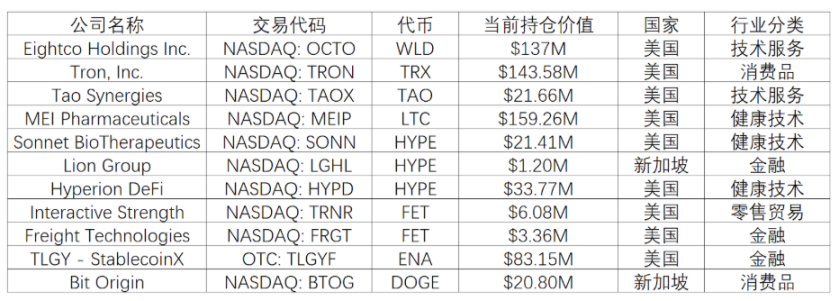
 Recent statistics on altcoin holdings in the treasury of listed companies

Three major altcoin themes: AI, new DeFi, and traditional payment currencies

AI Track (FET, TAO): The key signal of this track is "use and hold." Tokens of AI-native networks are often not simply speculative targets, but rather "tickets and fuel" for access and settlement: the invocation of intelligent agents, access to computing power and model markets, and network incentive mechanisms all require the inherent use of tokens. The entry of corporate treasuries is often accompanied by technical collaboration and business integration, such as closed-loop development in logistics optimization, computing power deployment, or intelligent agent deployment. Therefore, speculative weighting is relatively low, with a greater emphasis on strategic allocation. However, this track also presents uncertainties: the integration of AI and blockchain is still in the verification phase, valuations may preempt future expectations, and the long-term sustainability of the token economy (inflation/deflation mechanisms, incentive models, and fee recovery) remains to be seen.

New DeFi Infrastructure (HYPE, ENA): This sector focuses on a combination of efficiency and profitability. HYPE represents performance-oriented DeFi infrastructure: It leverages a high-performance chain to facilitate derivatives trading and staking derivatives, creating a capital cycle of "earning income + liquid staking and re-hypothecation," providing an efficient utilization path for institutions and capital pools. Corporate treasuries are interested in this approach because it not only provides on-chain governance and profitability, but also enhances liquidity and market stickiness through capital circulation.

ENA's appeal lies more in its design of synthetic stability and hedging returns. By combining staking derivatives and hedging strategies, Ethena seeks to create a "dollar-like" stable asset and generate an endogenous source of income without relying on the traditional banking system. If this model can be integrated with exchanges, custodians, and payment gateways, it could form a truly closed-loop "cryptodollar + income" system. For corporate treasuries, this means holding a stable unit of account while also generating income and a tool to hedge against volatility. However, the risks are also more complex: clearing security, smart contract robustness, and stability in extreme market conditions are all key areas that require rigorous auditing and risk control.
 Source: X

Payments and established majors (LTC, TRX, DOGE): By comparison, this group of assets tends to serve as a "hassle-free base and payment gateway." Their longer history, greater liquidity, and more established infrastructure make them suitable for use as a "cash-like" asset in corporate treasuries, fulfilling both long-term value storage and payment needs. LTC and TRX's efficiency advantages in payment and settlement make them readily accessible to treasuries. DOGE, with its community and brand influence, offers unique value in lightweight payments and buzz generation. Overall, these assets play a more stable and foundational role, but new growth stories are limited, and they may face increasing competition from stablecoins and L2 payment networks.

Know what to buy, but also know how to look at it

See which way the wind is blowing, but don't make simplistic analogies. When a company includes a token in its financial report, it's voting with real money. This can help us filter out a lot of noise, but it's not a universal indicator. A more comprehensive observation framework is to look at three levels simultaneously: whether there is business synergy (does the company actually use this token), whether there is formal disclosure (written in regulatory documents, explaining how much was purchased, how it is kept, and what risks are involved), and whether the on-chain data is keeping up (activity, trading depth, and whether liquidation is stable). The true value of corporate treasury allocation lies not in providing investment advice, but in revealing the underlying logic of industry evolution. When traditional listed companies begin to allocate specific tokens on a large scale, what is reflected behind this is the structural transformation of the entire crypto ecosystem from "pure speculation" to "value anchoring."

From a macro perspective, this surge in treasury allocations marks the convergence of three key trends: a maturing regulatory environment—companies are now more willing to disclose their crypto holdings in public documents, signaling the establishment of a compliance framework; a more specific application scenario—moving beyond the abstract "blockchain revolution" to quantifiable business needs such as AI training, DeFi returns, and cross-border payments; and the institutionalization of funding structures—shifting from retail investor dominance to corporate participation, implying longer holding periods and more rational pricing mechanisms. A deeper meaning lies in the fact that treasury allocations are redefining the very nature of "digital assets." Previously, we tended to view cryptocurrencies as high-risk speculative instruments, but as more and more companies use them as operational assets or strategic reserves, they begin to take on attributes similar to foreign exchange reserves, commodity inventories, or technology licenses. This shift in perception may be more disruptive than any technological breakthrough.

Market Opportunity
Threshold Logo
Threshold Price(T)
$0.006446
$0.006446$0.006446
-7.98%
USD
Threshold (T) Live Price Chart
Disclaimer: The articles reposted on this site are sourced from public platforms and are provided for informational purposes only. They do not necessarily reflect the views of MEXC. All rights remain with the original authors. If you believe any content infringes on third-party rights, please contact service@support.mexc.com for removal. MEXC makes no guarantees regarding the accuracy, completeness, or timeliness of the content and is not responsible for any actions taken based on the information provided. The content does not constitute financial, legal, or other professional advice, nor should it be considered a recommendation or endorsement by MEXC.

You May Also Like

Polygon Tops RWA Rankings With $1.1B in Tokenized Assets

Polygon Tops RWA Rankings With $1.1B in Tokenized Assets

The post Polygon Tops RWA Rankings With $1.1B in Tokenized Assets appeared on BitcoinEthereumNews.com. Key Notes A new report from Dune and RWA.xyz highlights Polygon’s role in the growing RWA sector. Polygon PoS currently holds $1.13 billion in RWA Total Value Locked (TVL) across 269 assets. The network holds a 62% market share of tokenized global bonds, driven by European money market funds. The Polygon POL $0.25 24h volatility: 1.4% Market cap: $2.64 B Vol. 24h: $106.17 M network is securing a significant position in the rapidly growing tokenization space, now holding over $1.13 billion in total value locked (TVL) from Real World Assets (RWAs). This development comes as the network continues to evolve, recently deploying its major “Rio” upgrade on the Amoy testnet to enhance future scaling capabilities. This information comes from a new joint report on the state of the RWA market published on Sept. 17 by blockchain analytics firm Dune and data platform RWA.xyz. The focus on RWAs is intensifying across the industry, coinciding with events like the ongoing Real-World Asset Summit in New York. Sandeep Nailwal, CEO of the Polygon Foundation, highlighted the findings via a post on X, noting that the TVL is spread across 269 assets and 2,900 holders on the Polygon PoS chain. The Dune and https://t.co/W6WSFlHoQF report on RWA is out and it shows that RWA is happening on Polygon. Here are a few highlights: – Leading in Global Bonds: Polygon holds 62% share of tokenized global bonds (driven by Spiko’s euro MMF and Cashlink euro issues) – Spiko U.S.… — Sandeep | CEO, Polygon Foundation (※,※) (@sandeepnailwal) September 17, 2025 Key Trends From the 2025 RWA Report The joint publication, titled “RWA REPORT 2025,” offers a comprehensive look into the tokenized asset landscape, which it states has grown 224% since the start of 2024. The report identifies several key trends driving this expansion. According to…
Share
BitcoinEthereumNews2025/09/18 00:40
BetFury is at SBC Summit Lisbon 2025: Affiliate Growth in Focus

BetFury is at SBC Summit Lisbon 2025: Affiliate Growth in Focus

The post BetFury is at SBC Summit Lisbon 2025: Affiliate Growth in Focus appeared on BitcoinEthereumNews.com. Press Releases are sponsored content and not a part of Finbold’s editorial content. For a full disclaimer, please . Crypto assets/products can be highly risky. Never invest unless you’re prepared to lose all the money you invest. Curacao, Curacao, September 17th, 2025, Chainwire BetFury steps onto the stage of SBC Summit Lisbon 2025 — one of the key gatherings in the iGaming calendar. From 16 to 18 September, the platform showcases its brand strength, deepens affiliate connections, and outlines its plans for global expansion. BetFury continues to play a role in the evolving crypto and iGaming partnership landscape. BetFury’s Participation at SBC Summit The SBC Summit gathers over 25,000 delegates, including 6,000+ affiliates — the largest concentration of affiliate professionals in iGaming. For BetFury, this isn’t just visibility, it’s a strategic chance to present its Affiliate Program to the right audience. Face-to-face meetings, dedicated networking zones, and affiliate-focused sessions make Lisbon the ideal ground to build new partnerships and strengthen existing ones. BetFury Meets Affiliate Leaders at its Massive Stand BetFury arrives at the summit with a massive stand placed right in the center of the Affiliate zone. Designed as a true meeting hub, the stand combines large LED screens, a sleek interior, and the best coffee at the event — but its core mission goes far beyond style. Here, BetFury’s team welcomes partners and affiliates to discuss tailored collaborations, explore growth opportunities across multiple GEOs, and expand its global Affiliate Program. To make the experience even more engaging, the stand also hosts: Affiliate Lottery — a branded drum filled with exclusive offers and personalized deals for affiliates. Merch Kits — premium giveaways to boost brand recognition and leave visitors with a lasting conference memory. Besides, at SBC Summit Lisbon, attendees have a chance to meet the BetFury team along…
Share
BitcoinEthereumNews2025/09/18 01:20
Tether Advances Gold Strategy With $150 Million Stake in Gold.com

Tether Advances Gold Strategy With $150 Million Stake in Gold.com

TLDR Tether buys $150M Gold.com stake to expand digital gold infrastructure Partnership links physical gold supply with blockchain settlement rails XAUT token distribution
Share
Coincentral2026/02/06 10:09