Ethereum’s recent development focus is centered around its upcoming network upgrade, Fusaka, which is scheduled for a tentative launch in early December. Designed to improve scalability and efficiency, the update will primarily involve a series of hard forks aimed at increasing the network’s blob capacity, a critical factor for handling larger data sets offchain and [...]Ethereum’s recent development focus is centered around its upcoming network upgrade, Fusaka, which is scheduled for a tentative launch in early December. Designed to improve scalability and efficiency, the update will primarily involve a series of hard forks aimed at increasing the network’s blob capacity, a critical factor for handling larger data sets offchain and [...]

Ethereum’s Fusaka Hard Fork Launches December 3: What You Need to Know
Ethereum’s Fusaka Hard Fork Launches December 3: What You Need To Know

Ethereum’s recent development focus is centered around its upcoming network upgrade, Fusaka, which is scheduled for a tentative launch in early December. Designed to improve scalability and efficiency, the update will primarily involve a series of hard forks aimed at increasing the network’s blob capacity, a critical factor for handling larger data sets offchain and supporting the growth of layer-2 solutions and DeFi protocols.

The initial deployment of Fusaka is set for December 3, followed by a significant blob capacity increase approximately two weeks later, around December 17. A subsequent hard fork targeting further blob capacity enhancement is planned for January 7, 2026. These upgrades will more than double the current blob capacity, significantly bolstering Ethereum’s ability to process and store large data offchain, thus reducing transaction costs and improving network throughput.

Prior to the mainnet rollout, three public testnets are scheduled between early October and mid-November, allowing developers to validate the updates comprehensively. Ethereum researcher Christine D. Kim confirmed that Ethereum’s community has approved configurations for the hard forks to support these capacity increases safely and efficiently, with planned parameters set to maximize network performance without compromising security.
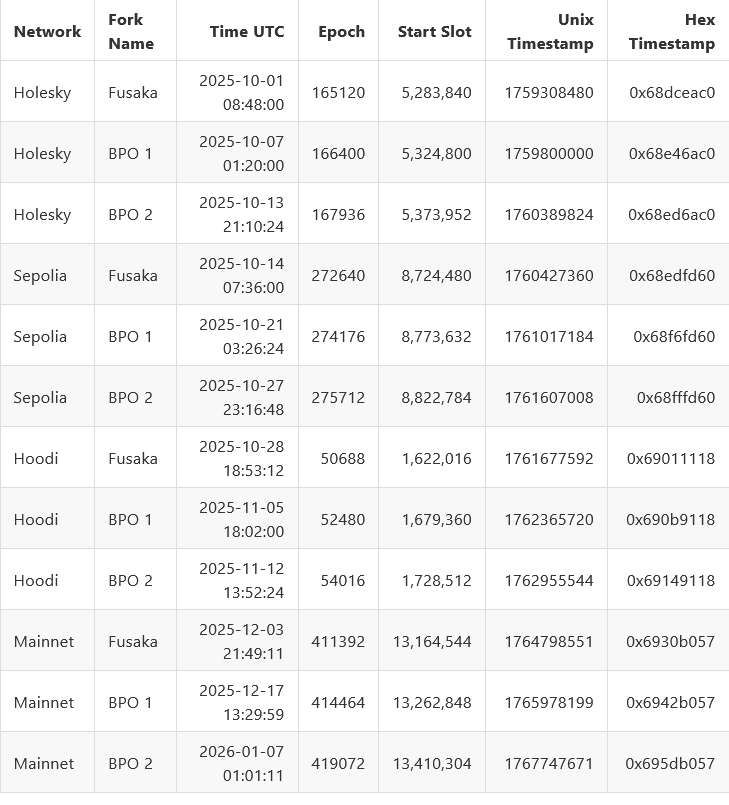
The slated timeline for Fusaka’s deployment. Source: Barnabas Busa

Meanwhile, Ethereum’s development community is also focusing on safety measures, as the Foundation announced a four-week code audit program offering a $2 million reward for vulnerabilities identified during the Fusaka coding phase. This reflects a broader trend of rigorous security scrutiny amid increasing network complexity and growing adoption of smart contracts, NFTs, and decentralized finance applications.

Since the recent upgrade called Dencun, blob usage on the Ethereum network has steadily increased, with current average blob counts per block at 5.1—up from 0.9 in March 2023. This surge indicates a rising demand for onchain data storage solutions that support scaling efforts and reduce transaction costs.

Additionally, recent metrics show a record amount of ETH being unstaked, with 2.6 million ETH, worth approximately $12 billion, entering the exit queue last week. Despite this, the queue for staking deposits remains at a four-week low, highlighting cautious sentiment among validators concerned about potential selling pressure. Ethereum’s co-founder Vitalik Buterin justified the lengthy exit queue, asserting that reducing it could undermine network trust and security, underscoring ongoing debates about staking and network stability in the evolving crypto landscape.

This article was originally published as Ethereum’s Fusaka Hard Fork Launches December 3: What You Need to Know on Crypto Breaking News – your trusted source for crypto news, Bitcoin news, and blockchain updates.

Disclaimer: The articles reposted on this site are sourced from public platforms and are provided for informational purposes only. They do not necessarily reflect the views of MEXC. All rights remain with the original authors. If you believe any content infringes on third-party rights, please contact service@support.mexc.com for removal. MEXC makes no guarantees regarding the accuracy, completeness, or timeliness of the content and is not responsible for any actions taken based on the information provided. The content does not constitute financial, legal, or other professional advice, nor should it be considered a recommendation or endorsement by MEXC.

You May Also Like

MoneyGram launches stablecoin-powered app in Colombia

MoneyGram launches stablecoin-powered app in Colombia

The post MoneyGram launches stablecoin-powered app in Colombia appeared on BitcoinEthereumNews.com. MoneyGram has launched a new mobile application in Colombia that uses USD-pegged stablecoins to modernize cross-border remittances. According to an announcement on Wednesday, the app allows customers to receive money instantly into a US dollar balance backed by Circle’s USDC stablecoin, which can be stored, spent, or cashed out through MoneyGram’s global retail network. The rollout is designed to address the volatility of local currencies, particularly the Colombian peso. Built on the Stellar blockchain and supported by wallet infrastructure provider Crossmint, the app marks MoneyGram’s most significant move yet to integrate stablecoins into consumer-facing services. Colombia was selected as the first market due to its heavy reliance on inbound remittances—families in the country receive more than 22 times the amount they send abroad, according to Statista. The announcement said future expansions will target other remittance-heavy markets. MoneyGram, which has nearly 500,000 retail locations globally, has experimented with blockchain rails since partnering with the Stellar Development Foundation in 2021. It has since built cash on and off ramps for stablecoins, developed APIs for crypto integration, and incorporated stablecoins into its internal settlement processes. “This launch is the first step toward a world where every person, everywhere, has access to dollar stablecoins,” CEO Anthony Soohoo stated. The company emphasized compliance, citing decades of regulatory experience, though stablecoin oversight remains fluid. The US Congress passed the GENIUS Act earlier this year, establishing a framework for stablecoin regulation, which MoneyGram has pointed to as providing clearer guardrails. This is a developing story. This article was generated with the assistance of AI and reviewed by editor Jeffrey Albus before publication. Get the news in your inbox. Explore Blockworks newsletters: Source: https://blockworks.co/news/moneygram-stablecoin-app-colombia
Share
BitcoinEthereumNews2025/09/18 07:04
UAE Central Bank Joins Hong Kong's CMU to Access Chinese Capital Markets

UAE Central Bank Joins Hong Kong's CMU to Access Chinese Capital Markets

CBUAE becomes member of Hong Kong's Central Moneymarkets Unit, gaining direct access to mainland Chinese debt markets as bilateral digital asset cooperation deepens
Share
BlockChain News2026/02/12 15:44
UK GDP Growth Stalls: Markets Brace for March Rate Cut Amid Economic Uncertainty

UK GDP Growth Stalls: Markets Brace for March Rate Cut Amid Economic Uncertainty

BitcoinWorld UK GDP Growth Stalls: Markets Brace for March Rate Cut Amid Economic Uncertainty LONDON, January 2025 – The United Kingdom’s economic landscape faces
Share
bitcoinworld2026/02/12 15:35