MEXC offers two types of futures trading: USDT-M futures (forward contracts) and Coin-M futures (inverse contracts). While their calculation principles are similar, there are some differences. Below,MEXC offers two types of futures trading: USDT-M futures (forward contracts) and Coin-M futures (inverse contracts). While their calculation principles are similar, there are some differences. Below,
Learn/Trading Guide/Futures/Margins & P...alculations

Margins & PNL Calculations

Jul 16, 2025MEXC
0m
MemeCore
M$2.34955+1.63%
OpenLedger
OPEN$0.16044+0.35%
Orderly Network
ORDER$0.0508+4.09%
Bitcoin
BTC$67,920.15-0.36%
Universal HighIncome
INCOME$0.00019485+92.23%

MEXC offers two types of futures trading: USDT-M futures (forward contracts) and Coin-M futures (inverse contracts). While their calculation principles are similar, there are some differences. Below, this article will provide specific examples and explanations. Please note: the following calculations eschew extremely complex logic in favor of clarity and brevity for margin calculation.

1. Introduction to Margin


In MEXC perpetual futures, a certain amount of margin is required for opening a position. In the process of margin trading, it is crucial to pay attention to the following points:

1.1 Initial Margin


The minimum amount of margin required to open a position. Additionally, the initial margin rate (position value / position margin) also reflects your leverage multiplier.

1.2 Maintenance Margin


The minimum margin requirement to maintain a position. Falling below this ratio will trigger liquidation or partial liquidation.

1.3 Opening Cost


The total assets that must be frozen in order to open a position, including the initial margin and possible trading fees.

2. Margin Calculation


In perpetual futures, margin refers to the order cost required to open a position. The actual trading fee or rebate is ultimately determined by the manner in which the order (type) is executed. (A maker is a liquidity provider, while a taker is a liquidity consumer.)

2.1 USDT-M Futures


Margin Amount = Average Entry Price x Opening Quantity x Futures Size / Leverage Multiplier

2.2 Coin-M Futures


Margin Amount = Opening Quantity x Futures Size / (Leverage Multiplier x Average Entry Price)

2.3 Calculation Example


  • USDT-M Futures:

If you use 200x leverage and submit a limit order for 10,000 BTC/USDT contracts at a price of 50,000 USDT/BTC, and the futures size is 0.0001 BTC per contract:

Your margin amount = (10,000 contracts x 0.0001 BTC/contract x 50,000 USDT/BTC) / 200x leverage = 250 USDT

  • Coin-M Futures:

If you use 125x leverage and submit a limit order for 100 BTC/USD contracts at a price of 50,000 USD/BTC, and the futures size is 100 USD per contract:

Your margin amount = 100 contracts x 100 USD / (50,000 USD/BTC x 125x leverage) = 0.0016 BTC

3. PNL Calculation


Your profit and loss (PNL) are influenced by three factors: trading fees, funding fees (income or expenditure), and PNL from closing positions.

3.1 Trading Fees


  • As a liquidity consumer or taker, you will incur a fee calculated as Position Value x Taker Fee Rate.

  • As a liquidity provider or maker, you will incur a fee calculated as Position Value x Maker Fee Rate.

3.2 Funding Fee


  • Depending on the funding rate (positive or negative) and the direction (long or short) of your position, you will either receive or incur funding fees.

  • Funding Fee = Funding Rate x Position Value.

  • Position Value = Position Quantity (Tokens) x Fair Price.

3.3 PNL Calculation


3.3.1 Closing PNL


  • USDT-M Futures:

For long positions: (Close Price - Average Entry Price) x Position Quantity x Size

For short positions: (Average Entry Price - Close Price) x Position Quantity x Size

  • Coin-M Futures:

For long positions: (1 / Average Entry Price - 1 / Average Close Price) x Position Quantity x Size

For short positions: (1 / Average Close Price - 1 / Average Entry Price) x Position Quantity x Size

3.3.2 Unrealized PNL


  • USDT-M Futures:

For long positions: (Fair Price - Average Entry Price) x Position Quantity x Size

For short positions: (Average Entry Price - Fair Price) x Position Quantity x Size

  • Coin-M Futures:

For long positions: (1 / Average Entry Price - 1 / Fair Price) x Position Quantity x Size

For short positions: (1 / Fair Price - 1 / Average Entry Price) x Position Quantity x Size

3.4 Calculation Example


Using USDT-M Futures as an Example:

If you, as a taker, open a long position of 10,000 contracts in the BTC/USDT perpetual futures at a price of 50,000 USDT/BTC:

  • With Taker Fee Rate = 0.02%, Maker Fee Rate = 0.00%, Funding Rate = -0.025%, and the current market price = 50,000 USDT/BTC, you will incur a trading fee calculated as follows:

50,000 USDT/BTC x 10,000 contracts x 0.0001 BTC/contract x 0.02% = 10 USDT

  • When the funding rate is negative, you will receive a funding fee calculated as follows:

50,000 USDT/BTC x 10,000 contracts x 0.0001 BTC/contract x (-0.025%) = -12.5 USDT (the funding fee to be received)

Suppose you, as a maker, close 10,000 contracts at a price of 60,000 USDT/BTC:

  • Closing PNL = (60,000 USDT/BTC - 50,000 USDT/BTC) x 10,000 contracts x 0.0001 BTC/contract = 10,000 USDT

  • Closing Fee = 60,000 USDT/BTC x 10,000 contracts x 0.0001 BTC/contract x 0.00% = 0 USDT

  • So, in this scenario, your total realized PNL is calculated as follows:

= Closing PNL - Funding Fee - Taker Fee - Maker Fee

= 10,000 USDT -(- 12.5 USDT)- 10 USDT - 0 USDT

= 10,002.5 USDT

3.5 Reminders


  • When settling the funding rate, the position value is calculated based on the current fair price.

  • The calculation results are for reference only, and specific situations should be based on the rules of MEXC futures products.

  • Tutorials and guides may vary across different operating systems. Please refer to your actual operating system for accurate information.


4. Summary


In MEXC perpetual futures, a certain amount of margin is required for opening a position. The initial margin represents the minimum amount required to open a position, reflecting your leverage multiplier. The maintenance margin is the minimum requirement to keep a position, falling below which may lead to forced liquidation. The opening cost includes the initial margin and potential trading fees. The calculation of the order cost varies based on different types of futures and prices. PNL is influenced by trading fees, funding fees, and closing PNL. Liquidity consumers, or takers, pay fees equal to the position value multiplied by the taker fee rate. Liquidity providers, or makers, pay fees equal to the position value multiplied by the maker fee rate. Depending on the funding rate and position direction, you will receive or pay funding fees, with the amount equal to the funding rate multiplied by the position value.

Disclaimer: This information does not provide advice on investment, taxation, legal, financial, accounting, or any other related services, nor does it constitute advice to purchase, sell, or hold any assets. MEXC Learn provides information for reference purposes only and does not constitute investment advice. Please ensure you fully understand the risks involved and exercise caution when investing. The platform is not responsible for users' investment decisions.

Market Opportunity
MemeCore Logo
MemeCore Price(M)
$2.34955
$2.34955$2.34955
-0.67%
USD
MemeCore (M) Live Price Chart

Popular Articles

XLM vs XRP Explained: Two Coins, Two Very Different Missions

XLM vs XRP Explained: Two Coins, Two Very Different Missions

If you've been researching cross-border payment coins, you've probably run into XLM and XRP sitting side by side on every list.They share a founder, solve similar problems, and often move in price tog

What Is the XRP Mastercard? The Gemini Credit Card and Ripple Explained

What Is the XRP Mastercard? The Gemini Credit Card and Ripple Explained

Ripple and Mastercard are no longer just parallel players in the payments world — they're actively building together.This article breaks down the XRP and Mastercard partnership, explains the Gemini XR

Is XRP ISO 20022 Compliant? Here's What You Need to Know

Is XRP ISO 20022 Compliant? Here's What You Need to Know

The global banking system is getting a major upgrade — and XRP is one of the few cryptocurrencies built to fit right into it.This article breaks down what ISO 20022 actually is, how XRP connects to it

Will XRP Replace SWIFT? What Investors Need to Know

Will XRP Replace SWIFT? What Investors Need to Know

Every time XRP makes headlines, the same debate resurfaces — can a cryptocurrency actually challenge the backbone of global banking?SWIFT has moved trillions of dollars across borders for decades, but

Hot Crypto Updates

View More
Israeli Strike on Iran Triggers Crypto Crash: Bitcoin Plunges to $63K with $100M Liquidated in 15 Minutes

Israeli Strike on Iran Triggers Crypto Crash: Bitcoin Plunges to $63K with $100M Liquidated in 15 Minutes

On February 28, 2026, Israel's military strike on Iran caused Bitcoin to crash from $65,500 to $63,700 in 15 minutes, liquidating over $100 million in long positions. Discover how geopolitical
Will Bitcoin Drop Below $50,000 in 2026? Prediction Markets Reveal Investor Sentiment After Trump Tariff Shockwave

Will Bitcoin Drop Below $50,000 in 2026? Prediction Markets Reveal Investor Sentiment After Trump Tariff Shockwave

Trump's 15% tariff policy triggers $465M crypto liquidations. Prediction markets show 61% probability of Bitcoin falling below $50K. Deep analysis of BTC price trends, market sentiment, and MEXC

Northern Data Divests Bitcoin Mining Assets in Strategic $200M Deal

Northern Data Divests Bitcoin Mining Assets in Strategic $200M Deal

Deal Announcement and Strategic Repositioning Northern Data, a German data center operator majority-owned by Tether, has completed the divestment of its Bitcoin mining division, Peak Mining, in a

From “Yajuu Senpai” to Solana Meme: A Cultural Analysis of the 114514 Coin

From “Yajuu Senpai” to Solana Meme: A Cultural Analysis of the 114514 Coin

Deep dive into how 114514 meme coin evolved from Japanese "Beast Senpai" internet culture into a Solana phenomenon, reaching $40M market cap with early investors turning $321 into $2.18M. Discover

Trending News

View More
D.M. Wenceslao stays in ATRAM SDG fund for fourth year

D.M. Wenceslao stays in ATRAM SDG fund for fourth year

D.M. WENCESLao and Associates, Inc. (DMW) has been included in the ATRAM Philippine Sustainable Development and Growth Fund for 2026, marking its fourth consecutive

Hotel101 eyes $300-M US offering for global rollout

Hotel101 eyes $300-M US offering for global rollout

HOTEL101 Global Holdings Corp., the Nasdaq-listed subsidiary of DoubleDragon Corp., is moving forward with a planned $300-million Series A perpetual preferred share

Dye Reinstated But Now Faces An Even More Uncertain Future In NASCAR

Dye Reinstated But Now Faces An Even More Uncertain Future In NASCAR

The post Dye Reinstated But Now Faces An Even More Uncertain Future In NASCAR appeared on BitcoinEthereumNews.com. CHARLOTTE, NORTH CAROLINA – JANUARY 20: Daniel

‘Can’t Prove It’s Me,’ Cardano Founder Raises Concerns Over Proving Identity Online

‘Can’t Prove It’s Me,’ Cardano Founder Raises Concerns Over Proving Identity Online

The post ‘Can’t Prove It’s Me,’ Cardano Founder Raises Concerns Over Proving Identity Online appeared on BitcoinEthereumNews.com. In a recent post on X, Cardano

Related Articles

A Must-Read Before Trading Futures: Key Terms Explained

A Must-Read Before Trading Futures: Key Terms Explained

For many investors, futures trading is a field full of opportunities but also significant challenges. Compared to spot trading, it involves more specialized terminology and complex mechanisms. When yo
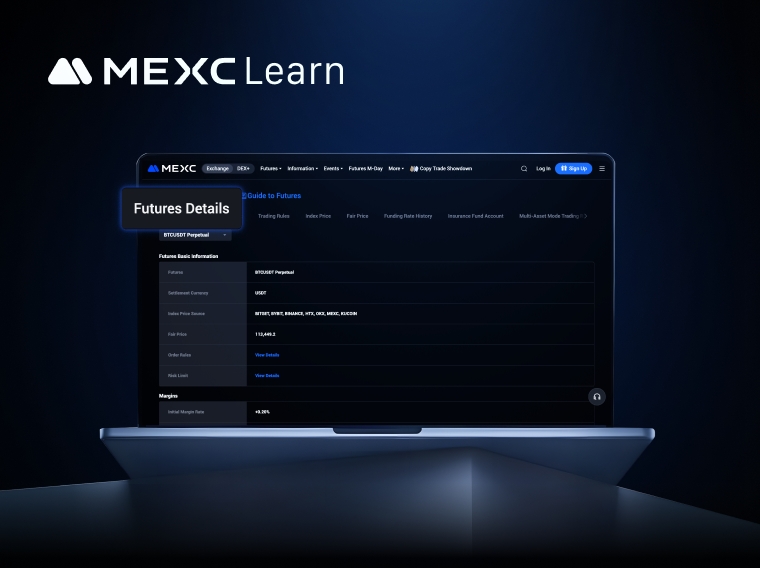
Quick Guide to Futures Information Terminology and Trade Futures with Confidence

Quick Guide to Futures Information Terminology and Trade Futures with Confidence

When you open the MEXC Futures trading interface, what greets you isn't just the dynamic candlestick chart, but also rows of constantly changing data and professional terms: Index Price, Fair Price, F
What is Copy Trading?

What is Copy Trading?

Copy trading is an investment strategy in cryptocurrency trading that allows investors to automatically replicate the trading actions of other experienced traders. It is a very user-friendly investmen

Spot Trading vs. Futures Trading: A Beginner's Guide to Determining Which is Right for You

Spot Trading vs. Futures Trading: A Beginner's Guide to Determining Which is Right for You

As the cryptocurrency market continues to mature, the diversification of trading tools has become one of the key elements for investors to build their strategy portfolios. Among the world's leading di

Sign Up on MEXC
Sign Up & Receive Up to 10,000 USDT Bonus