Solana’s validator count has dropped over 70% from its 2023 peak as rising costs and fee competition squeeze smaller operators out of the network. The post SolanaSolana’s validator count has dropped over 70% from its 2023 peak as rising costs and fee competition squeeze smaller operators out of the network. The post Solana

Solana Validator Count Drops 70%, Fueling Decentralisation Concerns

  • Solana’s active validator count has plummeted 68%, dropping from over 2,500 in 2023 to roughly 795 in early 2026.
  • Smaller operators are being priced out by intense competition from zero-fee institutional validators and annual voting costs that now exceed $49,000.
  • Network decentralisation is weakening, as evidenced by the Nakamoto Coefficient falling from 31 to 20, signaling that control is concentrating among fewer large-scale entities.

Solana’s validator network is shrinking fast due to economic reasons.

According to data from Solana Compass, the number of active validators has fallen from about 2,560 in early 2023 to roughly 795 today, a 68% drop. Validators are the machines that vote on blocks and keep the chain running. Fewer validators means fewer independent actors securing the network.
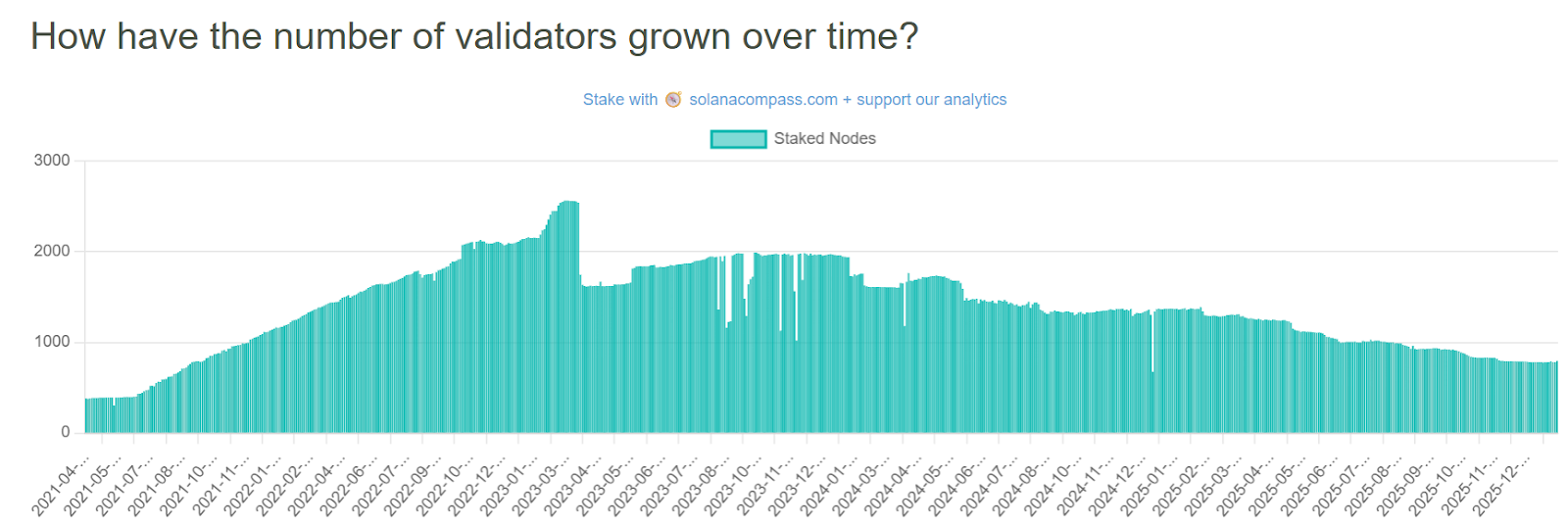
Source: Solana Compass

Some of this decline is harmless cleanup of inactive nodes. But operators say the real problem is that running a validator no longer pays for smaller players. 

Read more: Solana Mobile Launches SKR Token Airdrop for Seeker Smartphone Users

Low Fees Make Operations Less Viable

For instance, Moo, an independent Solana validator, said large validators now charge 0% fees to attract stake, leaving little revenue for independents. When rewards fall below costs, smaller validators shut down.

it is becoming increasingly impossible to operate a validator profitably (…) Many small validators are actively considering shutting down. Not due to lack of belief in Solana, but because the economics no longer work. At this point, the only justification left is altruism. Loving the network and caring about decentralization is not a sustainable business model.

Moo | Elemental – Solana Validator

That pressure also shows up clearly in decentralisation metrics, as the Solana Nakamoto Coefficient, or the minimum number of independent entities needed to control a critical share of the network, has dropped from 31 to 20. In simpler words, control over Solana’s stake is becoming more concentrated in fewer hands.

The cost structure goes something like this: 

  • A validator must stake SOL and continuously send vote transactions to participate in consensus. 
  • Voting alone can cost up to about 1.1 SOL per day. Over a year, that adds up to roughly 401 SOL just to stay online. 
  • At current prices, the first-year requirement excluding hardware and servers is around US$49,000 (AU$75,000). For many small operators, that math doesn’t work anymore.

This doesn’t mean Solana is failing or insecure today. Large validators are professional, well-capitalised, and technically capable, but it does mean decentralisation is drifting toward institutions and large staking providers rather than individuals.

Related: Analyst: Gold’s Surge Signals a Trust Crisis – and Crypto’s Moment

The post Solana Validator Count Drops 70%, Fueling Decentralisation Concerns appeared first on Crypto News Australia.

Disclaimer: The articles reposted on this site are sourced from public platforms and are provided for informational purposes only. They do not necessarily reflect the views of MEXC. All rights remain with the original authors. If you believe any content infringes on third-party rights, please contact service@support.mexc.com for removal. MEXC makes no guarantees regarding the accuracy, completeness, or timeliness of the content and is not responsible for any actions taken based on the information provided. The content does not constitute financial, legal, or other professional advice, nor should it be considered a recommendation or endorsement by MEXC.

You May Also Like

SEC Delays Crypto Innovation Exemptions, Citing Further Study

SEC Delays Crypto Innovation Exemptions, Citing Further Study

SEC postpones crypto innovation exemptions for blockchain products pending further analysis and congressional input.
Share
CoinLive2026/01/31 11:15
Crypto Market Crash To 6-Month Low Amid Rising Tensions Between Iran and The US

Crypto Market Crash To 6-Month Low Amid Rising Tensions Between Iran and The US

The post Crypto Market Crash To 6-Month Low Amid Rising Tensions Between Iran and The US appeared on BitcoinEthereumNews.com. Key Insights: President Trump induces
Share
BitcoinEthereumNews2026/01/31 11:02
If you put $1,000 in Intel at the start of 2025, here’s your return now

If you put $1,000 in Intel at the start of 2025, here’s your return now

The post If you put $1,000 in Intel at the start of 2025, here’s your return now appeared on BitcoinEthereumNews.com. Intel (NASDAQ: INTC) and Nvidia (NASDAQ: NVDA) announced a new partnership on Thursday, September 18, working on several generations of custom data center and computing chips designed to boost performance in hyperscale, enterprise, and consumer applications. As part of the collaboration, Nvidia, the undisputed leader of the semiconductor sector, will also invest $5 billion in Intel by purchasing its common stock at a price of $23.28 per share. Following the news, Intel stock jumped more than 30% in pre-market trading, while Nvidia saw a 3% uptick, a welcome change following weeks of shaky performance and controversies regarding its Chinese sales. Trading at $31.34 at the time of writing, INTC shares are up 54.99% year-to-date (YTD). INTC YTD stock price. Source: Google Accordingly, a $1,000 investment in the tech company at the start of the year would now be worth $1,549.90, giving you a return of $549.90. ‘The next era of computing’ The move follows a wave of fresh backing for the struggling Intel, including a nearly $9 billion U.S. government purchase of a 10% stake just weeks ago and a $2 billion investment from Japan’s SoftBank. As such, the deal has the potential to put Intel back into the game after years of trying to catch up not just with Nvidia but also AMD (NASDAQ: AMD) and Broadcom (NASDAQ: AVGO). “This historic collaboration tightly couples NVIDIA’s AI and accelerated computing stack with Intel’s CPUs and the vast x86 ecosystem — a fusion of two world-class platforms. Together, we will expand our ecosystems and lay the foundation for the next era of computing,” wrote Nvidia founder and chief executive officer (CEO), Jensen Huang.  However, the U.S. government’s direct involvement suggests that more is at stake than simply propping up Intel, as it likely reflects a broader concern about keeping America competitive…
Share
BitcoinEthereumNews2025/09/18 22:47