Binance Blockchain Week 2025 delivered one of its most anticipated moments when Changpeng Zhao (CZ), founder of Binance and Giggle Academy, took the stageBinance Blockchain Week 2025 delivered one of its most anticipated moments when Changpeng Zhao (CZ), founder of Binance and Giggle Academy, took the stage

CZ and Peter Schiff Face Off at Binance Blockchain Week 2025: Bitcoin or Tokenized Gold?

Binance Blockchain Week 2025 delivered one of its most anticipated moments when Changpeng Zhao (CZ), founder of Binance and Giggle Academy, took the stage opposite Peter Schiff, Senior Economist and Founder of Euro Pacific Asset Management and Schiff Gold.

The debate tackled a defining question for the global financial landscape: Is the future of sound money rooted in Bitcoin or will tokenized gold ultimately prevail? The atmosphere was charged with investors, developers, policymakers, and institutional delegates filling the main hall for what quickly became a clash of ideology, economics, and technology.

Schiff: Tokenized Gold Enhances What Already Works

Peter Schiff framed tokenized gold not as competition to Bitcoin but as the modernization of a centuries-tested store of value. “Tokenized gold improves all the monetary properties of gold while it remains a store of value. The token is simply the evidence that you own the gold in the vault.”

He argued that technology solves the core logistical weakness of gold—portability—without undermining its intrinsic qualities. “For money purposes, tokenized gold is better than physical gold. Ownership can change hands while the gold never leaves the vault.”
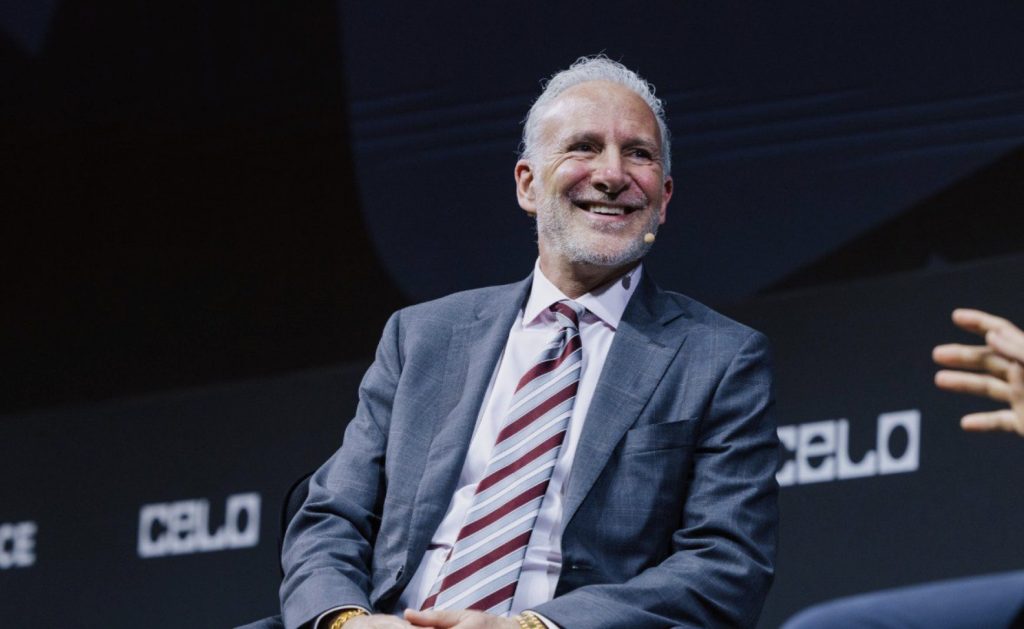
Schiff reminded the audience that gold’s value is anchored in utility, rarity, and historical trust. “What gives gold value is not that you can touch it, but that it has real utility as a metal. There are industries that need gold and things only gold can do.”

For Schiff, tokenization is evolutionary not revolutionary—retaining the asset while removing friction.

CZ: Digital Value Needs No Physical Form

CZ countered with the argument that Bitcoin is native to the internet economy and benefits from being purely digital. “If I give you Bitcoin right now, we can verify it in several ways that you received it. It settles instantly and transparently on-chain.”

He positioned Bitcoin as more than a currency—it’s a global decentralized ecosystem. “Bitcoin is more than a transaction network. It is an entire industry with many use cases and a very large, global community behind it.”

CZ dismissed the notion that money requires physical backing to be credible, comparing Bitcoin’s value to that of tech platforms. “The internet is virtual. There is nothing physical about Google or X, but they clearly have value. Many virtual things have value; that value is not tied to physical properties.”

Two Philosophies, One Converging Future

The debate highlighted a broader shift: traditional assets are being digitized, while native digital assets continue to mature. Tokenized gold caters to those who value tangible backing and historical stability; Bitcoin speaks to a generation aligned with decentralization and borderless liquidity.

If Binance Blockchain Week made one thing clear, it’s that the future of money may not be defined by one asset — but by how well traditional and digital systems coexist, compete, and inevitably converge.

Disclaimer: The articles reposted on this site are sourced from public platforms and are provided for informational purposes only. They do not necessarily reflect the views of MEXC. All rights remain with the original authors. If you believe any content infringes on third-party rights, please contact service@support.mexc.com for removal. MEXC makes no guarantees regarding the accuracy, completeness, or timeliness of the content and is not responsible for any actions taken based on the information provided. The content does not constitute financial, legal, or other professional advice, nor should it be considered a recommendation or endorsement by MEXC.

You May Also Like

The Channel Factories We’ve Been Waiting For

The Channel Factories We’ve Been Waiting For

The post The Channel Factories We’ve Been Waiting For appeared on BitcoinEthereumNews.com. Visions of future technology are often prescient about the broad strokes while flubbing the details. The tablets in “2001: A Space Odyssey” do indeed look like iPads, but you never see the astronauts paying for subscriptions or wasting hours on Candy Crush.  Channel factories are one vision that arose early in the history of the Lightning Network to address some challenges that Lightning has faced from the beginning. Despite having grown to become Bitcoin’s most successful layer-2 scaling solution, with instant and low-fee payments, Lightning’s scale is limited by its reliance on payment channels. Although Lightning shifts most transactions off-chain, each payment channel still requires an on-chain transaction to open and (usually) another to close. As adoption grows, pressure on the blockchain grows with it. The need for a more scalable approach to managing channels is clear. Channel factories were supposed to meet this need, but where are they? In 2025, subnetworks are emerging that revive the impetus of channel factories with some new details that vastly increase their potential. They are natively interoperable with Lightning and achieve greater scale by allowing a group of participants to open a shared multisig UTXO and create multiple bilateral channels, which reduces the number of on-chain transactions and improves capital efficiency. Achieving greater scale by reducing complexity, Ark and Spark perform the same function as traditional channel factories with new designs and additional capabilities based on shared UTXOs.  Channel Factories 101 Channel factories have been around since the inception of Lightning. A factory is a multiparty contract where multiple users (not just two, as in a Dryja-Poon channel) cooperatively lock funds in a single multisig UTXO. They can open, close and update channels off-chain without updating the blockchain for each operation. Only when participants leave or the factory dissolves is an on-chain transaction…
Share
BitcoinEthereumNews2025/09/18 00:09
Shanghai residents flock to sell gold as its price hit record highs

Shanghai residents flock to sell gold as its price hit record highs

The post Shanghai residents flock to sell gold as its price hit record highs appeared on BitcoinEthereumNews.com. Gold surged over the $5,500-per-ounce milestone
Share
BitcoinEthereumNews2026/01/31 01:48
Polygon Tops RWA Rankings With $1.1B in Tokenized Assets

Polygon Tops RWA Rankings With $1.1B in Tokenized Assets

The post Polygon Tops RWA Rankings With $1.1B in Tokenized Assets appeared on BitcoinEthereumNews.com. Key Notes A new report from Dune and RWA.xyz highlights Polygon’s role in the growing RWA sector. Polygon PoS currently holds $1.13 billion in RWA Total Value Locked (TVL) across 269 assets. The network holds a 62% market share of tokenized global bonds, driven by European money market funds. The Polygon POL $0.25 24h volatility: 1.4% Market cap: $2.64 B Vol. 24h: $106.17 M network is securing a significant position in the rapidly growing tokenization space, now holding over $1.13 billion in total value locked (TVL) from Real World Assets (RWAs). This development comes as the network continues to evolve, recently deploying its major “Rio” upgrade on the Amoy testnet to enhance future scaling capabilities. This information comes from a new joint report on the state of the RWA market published on Sept. 17 by blockchain analytics firm Dune and data platform RWA.xyz. The focus on RWAs is intensifying across the industry, coinciding with events like the ongoing Real-World Asset Summit in New York. Sandeep Nailwal, CEO of the Polygon Foundation, highlighted the findings via a post on X, noting that the TVL is spread across 269 assets and 2,900 holders on the Polygon PoS chain. The Dune and https://t.co/W6WSFlHoQF report on RWA is out and it shows that RWA is happening on Polygon. Here are a few highlights: – Leading in Global Bonds: Polygon holds 62% share of tokenized global bonds (driven by Spiko’s euro MMF and Cashlink euro issues) – Spiko U.S.… — Sandeep | CEO, Polygon Foundation (※,※) (@sandeepnailwal) September 17, 2025 Key Trends From the 2025 RWA Report The joint publication, titled “RWA REPORT 2025,” offers a comprehensive look into the tokenized asset landscape, which it states has grown 224% since the start of 2024. The report identifies several key trends driving this expansion. According to…
Share
BitcoinEthereumNews2025/09/18 00:40