Starlink rival Amazon Leo has launched a waitlist for many countries, including Nigeria, to collect details of would-be…Starlink rival Amazon Leo has launched a waitlist for many countries, including Nigeria, to collect details of would-be…

Starlink rival, Amazon Leo launches waitlist for many countries, including Nigeria

Starlink rival Amazon Leo has launched a waitlist for many countries, including Nigeria, to collect details of would-be early users of its satellite Internet service when it eventually rolls out. Recall that the company recently began its first public testing with select enterprise customers ahead of an anticipated wider commercial rollout in 2026.

The list provides for three broad categories of users:

  1. Government: Government agencies and service providers like schools, hospitals, etc.
  2. Personal: individual users like you
  3. Business: corporate users and business owners

It also provides three different router types:

  • Ultra: It will support download speeds of up to 1Gbps and upload speeds of 400Mbps. Amazon boasts that it will be the world’s fastest satellite Internet antenna.
  • Nano: the smallest and lightest antenna, and most likely going to be the most affordable. The antenna weighs around 1kg. It will have a square dish panel that measures less than 18cm from side to side. It supports download speeds of up to 100Mbps.
  • Pro: Bulkier and heavier, measuring approximately 28cm across and weighing 2.4kg. It will offer download speeds of up to 400Mbps.

To apply, simply click here to start.
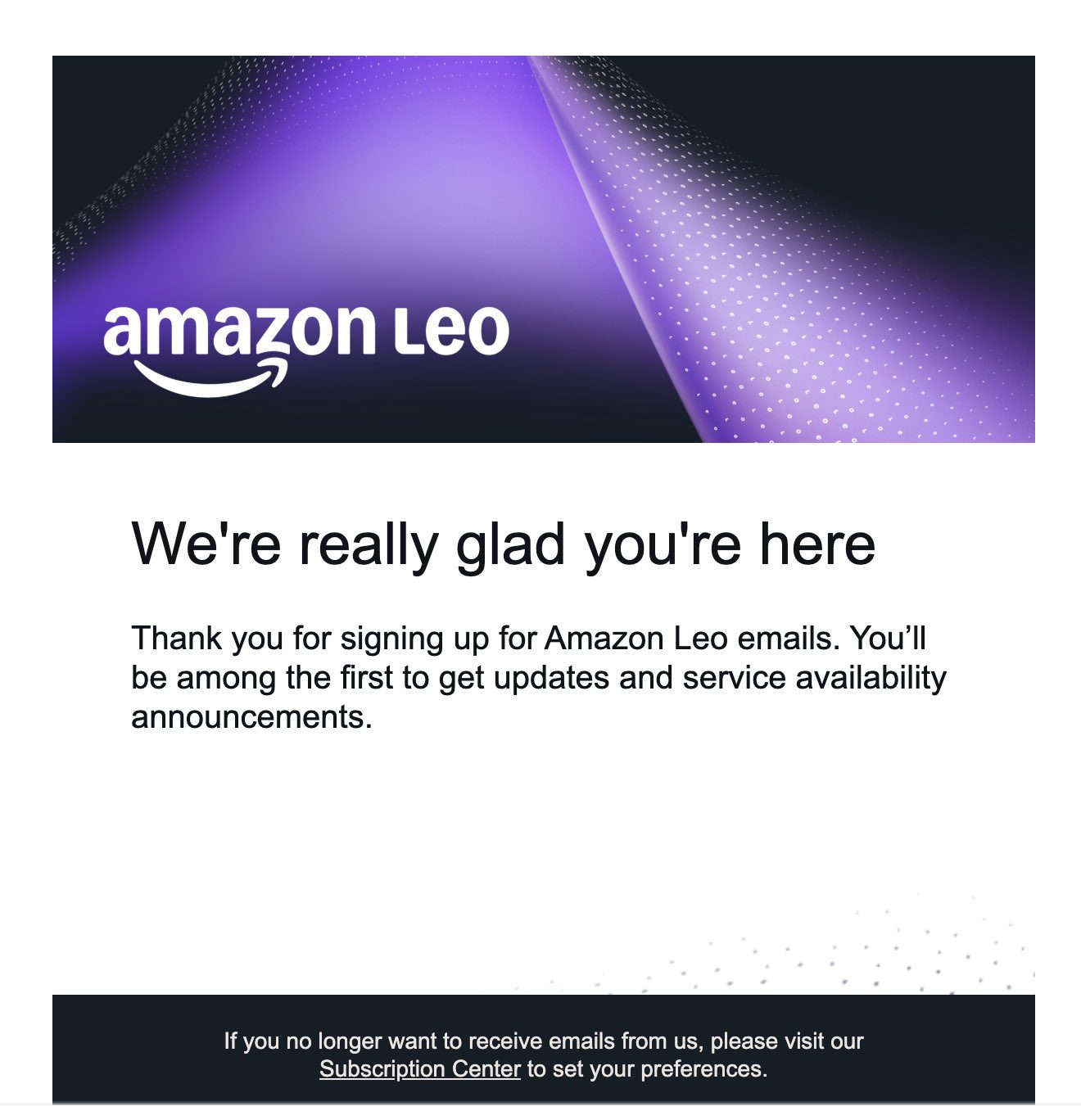
Starlink rival, Amazon Leo launches waitlist for many countries, including NigeriaYou will get a welcome email, like this, after you join the waitlist…

Recall that Amazon has partnered with Vanu, a US-based company, to deploy cellular towers in far-flung and rural parts of Southern Africa. There isn’t an announcement for a distribution structure for West Africa yet.

What you need to know about Amazon Leo

Previously known as Project Kuiper, Leo launched its first operational batch of internet satellites into low Earth orbit (LEO) last year. The mission, dubbed “KA-01” (Kuiper Atlas 1), saw 27 satellites lifted off aboard a United Launch Alliance (ULA) Atlas V rocket from Cape Canaveral Space Force Station in Florida in September.

The project now has a fleet of 153 production satellites in orbit and aims to expand to 1,618 satellites by 30 July 2026. Although this pales when compared with Starlink’s 10,000 satellites, the Amazon-owned company claims that its top-end product will offer speeds of up to 1Gbps.

Amazon’s ambitious initiative to provide global broadband access has been at least 10 years in the making. The company aims to deploy a constellation of more than 3,200 LEO satellites to deliver fast, reliable internet to customers worldwide, including underserved regions.

The first phase of the deployment will consist of 578 satellites orbiting around 630km above the Earth’s surface, slightly higher than Starlink’s fleet. Using these satellites, Amazon is rolling out 12 ground stations to provide backhaul connectivity to the Internet.

While SpaceX’s Starlink has a head start with its reusable Falcon 9 rockets and a licensed capacity for 12,000 first-generation satellites (plus 7,500 more for its second generation), Amazon is betting on its technological prowess and global reach to carve out a competitive niche.

The company has secured 80 launch missions with multiple providers, including ULA, Arianespace, and Jeff Bezos’ Blue Origin, to build out its initial constellation.

Experts believe that the setup process is likely to take at least one more year, with the earliest optimistic global launch date being late 2026 or early 2027.

Disclaimer: The articles reposted on this site are sourced from public platforms and are provided for informational purposes only. They do not necessarily reflect the views of MEXC. All rights remain with the original authors. If you believe any content infringes on third-party rights, please contact service@support.mexc.com for removal. MEXC makes no guarantees regarding the accuracy, completeness, or timeliness of the content and is not responsible for any actions taken based on the information provided. The content does not constitute financial, legal, or other professional advice, nor should it be considered a recommendation or endorsement by MEXC.

You May Also Like

Talos Extends Series B to $150M With Strategic Institutional Investors

Talos Extends Series B to $150M With Strategic Institutional Investors

The post Talos Extends Series B to $150M With Strategic Institutional Investors appeared on BitcoinEthereumNews.com. Talos raises an additional $45 million in a
Share
BitcoinEthereumNews2026/01/31 07:49
Headwind Helps Best Wallet Token

Headwind Helps Best Wallet Token

The post Headwind Helps Best Wallet Token appeared on BitcoinEthereumNews.com. Google has announced the launch of a new open-source protocol called Agent Payments Protocol (AP2) in partnership with Coinbase, the Ethereum Foundation, and 60 other organizations. This allows AI agents to make payments on behalf of users using various methods such as real-time bank transfers, credit and debit cards, and, most importantly, stablecoins. Let’s explore in detail what this could mean for the broader cryptocurrency markets, and also highlight a presale crypto (Best Wallet Token) that could explode as a result of this development. Google’s Push for Stablecoins Agent Payments Protocol (AP2) uses digital contracts known as ‘Intent Mandates’ and ‘Verifiable Credentials’ to ensure that AI agents undertake only those payments authorized by the user. Mandates, by the way, are cryptographically signed, tamper-proof digital contracts that act as verifiable proof of a user’s instruction. For example, let’s say you instruct an AI agent to never spend more than $200 in a single transaction. This instruction is written into an Intent Mandate, which serves as a digital contract. Now, whenever the AI agent tries to make a payment, it must present this mandate as proof of authorization, which will then be verified via the AP2 protocol. Alongside this, Google has also launched the A2A x402 extension to accelerate support for the Web3 ecosystem. This production-ready solution enables agent-based crypto payments and will help reshape the growth of cryptocurrency integration within the AP2 protocol. Google’s inclusion of stablecoins in AP2 is a massive vote of confidence in dollar-pegged cryptocurrencies and a huge step toward making them a mainstream payment option. This widens stablecoin usage beyond trading and speculation, positioning them at the center of the consumption economy. The recent enactment of the GENIUS Act in the U.S. gives stablecoins more structure and legal support. Imagine paying for things like data crawls, per-task…
Share
BitcoinEthereumNews2025/09/18 01:27
Tether Achieves Record-Breaking $10 Billion Net Profit as Gold Strategy Redefines Stablecoin Reserves

Tether Achieves Record-Breaking $10 Billion Net Profit as Gold Strategy Redefines Stablecoin Reserves

Tether's extraordinary financial performance in 2025 has fundamentally altered the stablecoin landscape, generating over $10 billion in net profit while amassing
Share
Blockchainmagazine2026/01/31 08:04
