PI has marked at least three ATLs in the past few days.PI has marked at least three ATLs in the past few days.

Pi Network’s (PI) Price Dumps to Another All-Time Low Despite Frequent Network Updates

Although most of the cryptocurrency market is in the red today after the US Federal Reserve pivoted on its monetary strategy and refused to lower the interest rates yesterday, Pi Network’s native token has declined in a painful manner lately, charting consecutive all-time lows.

The asset has seen more than 94% of its value evaporate in less than a year after its launch last February.
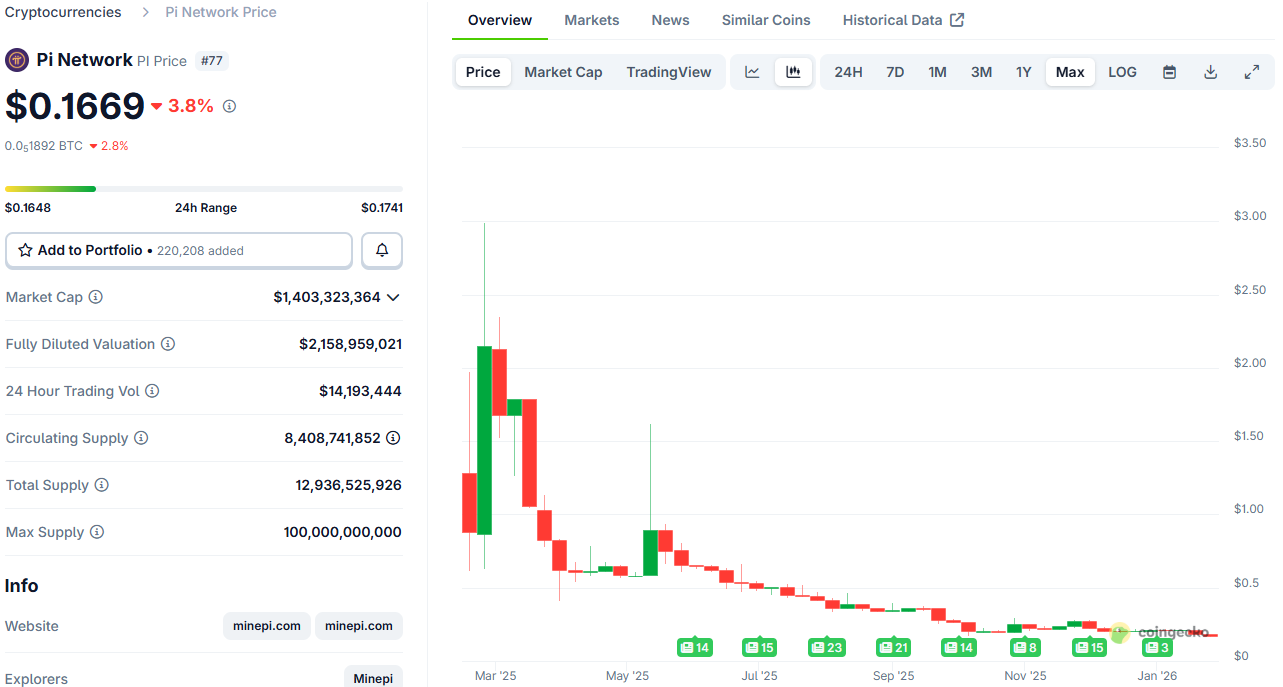
Pi Network (PI) Price on CoinGeckoPi Network (PI) Price on CoinGecko

The chart above paints a clear picture. After years of delays and hype, PI was finally released for trading nearly a year ago and quickly skyrocketed to a new all-time high of $2.99 (CoinGecko data). Some smaller exchanges rushed to list the asset, but most of the bigger ones, such as Binance and Coinbase, stood away, despite some rumors.

PI’s meteoric but brief rise drove it close to the top 10 alts by market cap shortly after its debut. However, that was just a momentary phase, and the token plunged significantly in the following months.

It registered an all-time low after the early October crash at $0.172 before it bounced and remained within a confined range between $0.20 and $0.22 for months, with just a few brief deviations.

The mid-January market-wide correction, though, didn’t spare PI, and it dropped below $0.17 days ago to chart another ATL. The past 24 hours have been violent as well amid the growing geopolitical uncertainty and the Fed’s decision, and PI’s new low came at $0.1648. This means that the token has lost roughly 94.5% of its value in less than 12 months.

These consistent declines from the project’s native token are in contrast to the attempts by the team to improve the overall ecosystem. They have introduced two updates since the start of the year, but they seem insufficient to drive any actual traction for PI.

The post Pi Network’s (PI) Price Dumps to Another All-Time Low Despite Frequent Network Updates appeared first on CryptoPotato.

Disclaimer: The articles reposted on this site are sourced from public platforms and are provided for informational purposes only. They do not necessarily reflect the views of MEXC. All rights remain with the original authors. If you believe any content infringes on third-party rights, please contact service@support.mexc.com for removal. MEXC makes no guarantees regarding the accuracy, completeness, or timeliness of the content and is not responsible for any actions taken based on the information provided. The content does not constitute financial, legal, or other professional advice, nor should it be considered a recommendation or endorsement by MEXC.

You May Also Like

The Channel Factories We’ve Been Waiting For

The Channel Factories We’ve Been Waiting For

The post The Channel Factories We’ve Been Waiting For appeared on BitcoinEthereumNews.com. Visions of future technology are often prescient about the broad strokes while flubbing the details. The tablets in “2001: A Space Odyssey” do indeed look like iPads, but you never see the astronauts paying for subscriptions or wasting hours on Candy Crush.  Channel factories are one vision that arose early in the history of the Lightning Network to address some challenges that Lightning has faced from the beginning. Despite having grown to become Bitcoin’s most successful layer-2 scaling solution, with instant and low-fee payments, Lightning’s scale is limited by its reliance on payment channels. Although Lightning shifts most transactions off-chain, each payment channel still requires an on-chain transaction to open and (usually) another to close. As adoption grows, pressure on the blockchain grows with it. The need for a more scalable approach to managing channels is clear. Channel factories were supposed to meet this need, but where are they? In 2025, subnetworks are emerging that revive the impetus of channel factories with some new details that vastly increase their potential. They are natively interoperable with Lightning and achieve greater scale by allowing a group of participants to open a shared multisig UTXO and create multiple bilateral channels, which reduces the number of on-chain transactions and improves capital efficiency. Achieving greater scale by reducing complexity, Ark and Spark perform the same function as traditional channel factories with new designs and additional capabilities based on shared UTXOs.  Channel Factories 101 Channel factories have been around since the inception of Lightning. A factory is a multiparty contract where multiple users (not just two, as in a Dryja-Poon channel) cooperatively lock funds in a single multisig UTXO. They can open, close and update channels off-chain without updating the blockchain for each operation. Only when participants leave or the factory dissolves is an on-chain transaction…
Share
BitcoinEthereumNews2025/09/18 00:09
Zaldy Co asks SC to halt graft reso

Zaldy Co asks SC to halt graft reso

FORMER Party-list Rep. Elizaldy “Zaldy” S. Co has filed a petition before the Supreme Court (SC) to halt an Ombudsman resolution that found probable cause to charge
Share
Bworldonline2026/01/29 21:08
FCA komt in 2026 met aangepaste cryptoregels voor Britse markt

FCA komt in 2026 met aangepaste cryptoregels voor Britse markt

De Britse financiële waakhond, de FCA, komt in 2026 met nieuwe regels speciaal voor crypto bedrijven. Wat direct opvalt: de toezichthouder laat enkele klassieke financiële verplichtingen los om beter aan te sluiten op de snelle en grillige wereld van digitale activa. Tegelijkertijd wordt er extra nadruk gelegd op digitale beveiliging,... Het bericht FCA komt in 2026 met aangepaste cryptoregels voor Britse markt verscheen het eerst op Blockchain Stories.
Share
Coinstats2025/09/18 00:33