

Ethereum 2029 Roadmap: ETH to Become the High-Speed Internet of Value

Ethereum just put a timestamp on its ambition, and the new roadmap could shape its price valuation. The Foundation’s new “Strawmap” (roadmap) targets a high-throughput settlement layer by 2029, cutting finality from around 16 minutes to seconds and aiming for 1 gigagas per second directly on Layer 1.
Instead of leaning almost entirely on Layer-2s for speed, Ethereum wants the base layer itself to become faster, tougher, and globally competitive with traditional financial rails.
Key Takeaways
- The Target: The roadmap aims for 10,000 TPS (1 gigagas/s) on Layer 1 and up to 10 million TPS on Layer 2 via data availability sampling.
- The Shift: Introduction of “Minimmit” single-slot finality intends to reduce transaction irreversible time from roughly 16 minutes to 6–16 seconds.
- The Timeline: Developers are planning seven hard forks on a six-month cycle through 2029 to implement these changes incrementally.
The Strawmap or Ethereum Roadmap: 10,000 TPS and Instant Finality
The big number is 10,000 TPS on Layer 1.
The Strawmap targets roughly 1 gigagas per second using zkEVMs and real-time proving. Today, transactions are included quickly but take around 16 minutes to reach finality. The new goal is 6 to 16 seconds, which is critical for serious financial use.
To get there, Ethereum plans up to seven hard forks through 2029. Slot times would gradually fall from 12 seconds to 8, and eventually toward near single-second blocks. That delays any push toward full “ossification” and prioritizes performance.
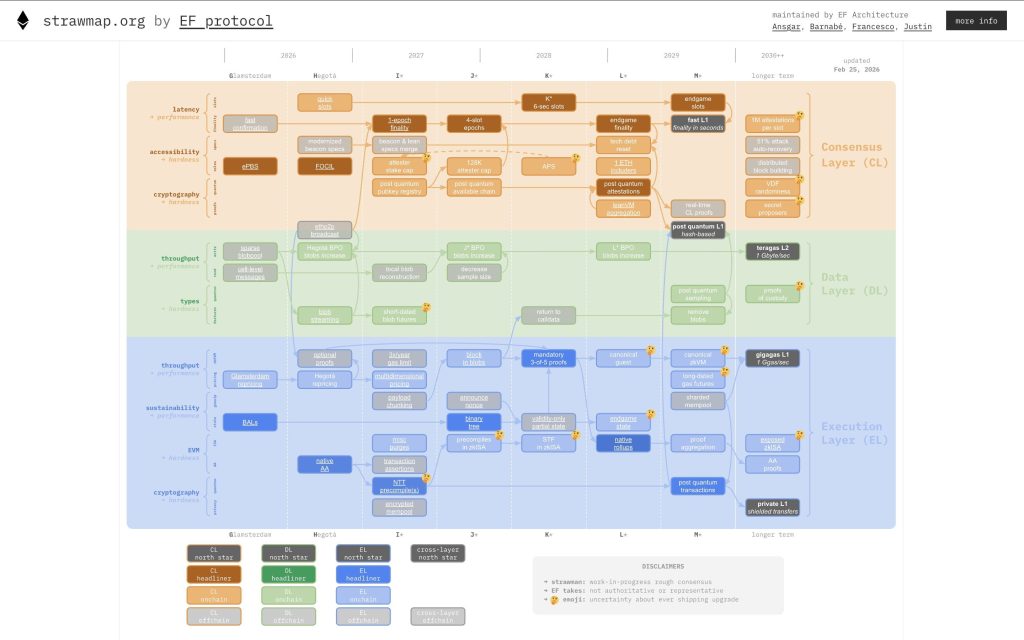 Source: Justin Drake
Vitalik has acknowledged that earlier assumptions about relying almost entirely on L2s need revision. If rollups are expected to process millions of TPS, the base layer must handle far more load itself.
For institutions, the message is clear. Ethereum wants to become a settlement infrastructure capable of supporting heavy, real-world financial flows without congestion.
Ethereum Roadmap: L1 Velocity vs. L2 Scale
For years, the message was simple: scale on Layer 2. The Strawmap adjusts that stance. Scale on L2, but make Layer 1 fast enough so it does not become the bottleneck. Ethereum is reacting to competitive pressure.
Vitalik has acknowledged that earlier assumptions about L2 reliance need updating. If rollups are expected to process millions of TPS, the base layer must comfortably handle around 10,000 TPS. Faster finality also matters for emerging AI-driven use cases, where agents require near-instant settlement to execute complex on-chain strategies.
The proposed shift toward techniques like erasure coding signals a deeper focus on data propagation and network efficiency. If successful, Ethereum strengthens its position as a high-speed settlement layer. If not, it risks ceding performance perception to faster, more centralized alternatives.
Ethereum Price Analysis: The Path to 2029 Valuation
The market reacted fast, with ETH whipping around the $2,060 area after the roadmap dropped. Long term, the plan gives investors a structural anchor. It signals Ethereum does not intend to fall behind faster monolithic chains.
 Source: ETHUSD / TradingView
Technically, Ethereum price is compressing. $2,150 is the key resistance. A clean break there opens the path toward $2,400. On the downside, $2,000 is the short-term pivot, and $1,920 to $1,800 is the structural support zone if sentiment turns.
Execution risk matters. If slot-time reductions and early upgrades slip past late 2026, the market could reprice lower. The move toward erasure coding shows the Foundation is tackling core data bottlenecks. If it works, Ethereum strengthens its case as a high-speed settlement infrastructure. If not, it risks being overshadowed by faster alternatives.
For now, holding $2,000 keeps the bullish structure alive. Losing $1,920 would weaken the setup until a new catalyst appears.
Discover: Here are the crypto likely to explode!
You May Also Like

The Channel Factories We’ve Been Waiting For

‘Customers are awake’- Eric Trump slams banks over stablecoin yield opposition
