Chainlink said it has strengthened its position as the industry-standard infrastructure for on-chain finance in 2025, as governments, banks, and asset managers Chainlink said it has strengthened its position as the industry-standard infrastructure for on-chain finance in 2025, as governments, banks, and asset managers

Chainlink Extends Lead in On-chain Finance as Institutional Adoption Grows

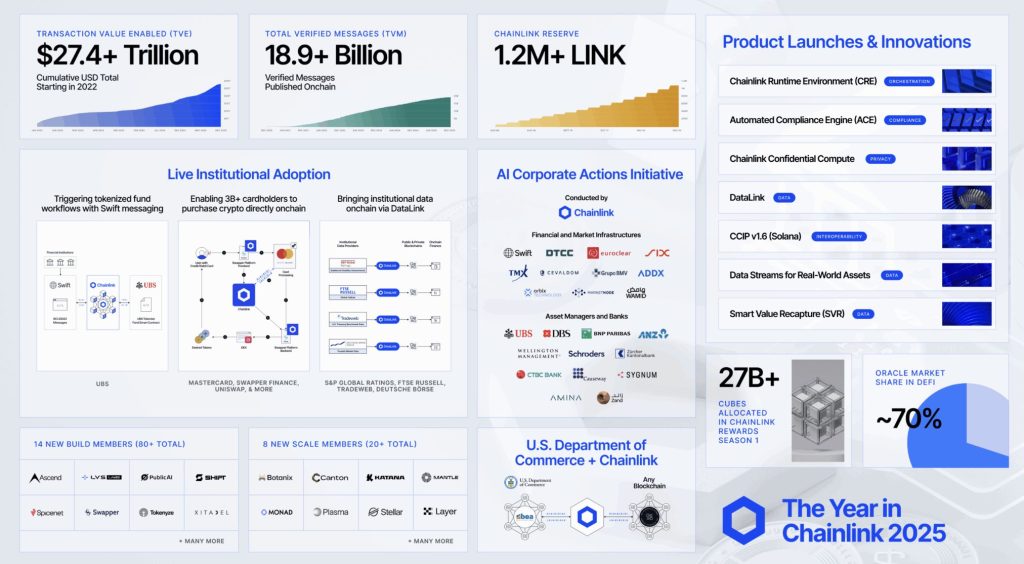
Chainlink said it has strengthened its position as the industry-standard infrastructure for on-chain finance in 2025, as governments, banks, and asset managers increasingly adopted its technology to move real-world financial activity onto blockchains, according to a blog post published by the company.

The report emphasized 2025 as an important year in which Chainlink’s oracle and interoperability standards became embedded across public- and private-sector financial systems used for everything from government data publication to institutional tokenized funds.

Government Adoption Accelerates

Government use of blockchain infrastructure marked progress during the year. Chainlink said the U.S. Department of Commerce partnered with the network to publish macroeconomic data on-chain using Chainlink Data Feeds sourced from the Bureau of Economic Analysis.
Chainlink co-founder Sergey Nazarov also participated in high-level policy discussions in Washington, including the White House Digital Asset Summit, as U.S. President Donald Trump signed the GENIUS Act into law.

The engagement reflects growing coordination between policymakers and blockchain infrastructure providers as regulatory clarity improves.

Banks and Capital Markets Move On-chain

In banking and capital markets, global financial institutions increasingly relied on Chainlink to execute production-grade on-chain workflows.

The research cites a partnership with Mastercard allowing more than three billion cardholders to purchase crypto assets directly on-chain via a Chainlink-powered application.

Asset managers also expanded tokenized offerings. UBS completed what Chainlink described as the world’s first live, end-to-end tokenized fund workflow using its Digital Transfer Agent standard, while firms such as WisdomTree and FTSE Russell began publishing institutional-grade net asset value and index data on-chain.

Financial market infrastructures, including DTCC, Euroclear, and SWIFT, collaborated with Chainlink to streamline corporate actions processing and cross-chain settlement using standardized messaging formats.

DeFi and Tokenization Scale Up

Decentralized finance and tokenization platforms also adopted Chainlink at scale in 2025. Coinbase selected Chainlink’s Cross-Chain Interoperability Protocol (CCIP) as the exclusive bridge infrastructure for its wrapped assets, while DeFi protocols, including Aave and Lido, upgraded their oracle and cross-chain infrastructure to support institutional-grade use cases.

Chainlink said the expansion of CCIP to non-EVM blockchains, including Solana, unlocked access to tens of billions of dollars in assets across multiple ecosystems.

Infrastructure Push Sets Stage for 2026

Beyond adoption, Chainlink said it also introduced new platform capabilities in 2025, including its Runtime Environment, Automated Compliance Engine, and Confidential Compute service intended to support privacy-preserving and compliant on-chain applications.

The report concludes that 2025 marked a turning point for on-chain finance, with 2026 expected to see tokenization adoption accelerate further as institutions standardize around shared infrastructure.

“Governments, financial institutions, and market infrastructures are increasingly aligning around Chainlink standards,” the company said, positioning its network as core plumbing for the global shift toward on-chain capital markets.

Market Opportunity
FINANCE Logo
FINANCE Price(FINANCE)
$0,0001722
$0,0001722$0,0001722
+1,89%
USD
FINANCE (FINANCE) Live Price Chart
Disclaimer: The articles reposted on this site are sourced from public platforms and are provided for informational purposes only. They do not necessarily reflect the views of MEXC. All rights remain with the original authors. If you believe any content infringes on third-party rights, please contact service@support.mexc.com for removal. MEXC makes no guarantees regarding the accuracy, completeness, or timeliness of the content and is not responsible for any actions taken based on the information provided. The content does not constitute financial, legal, or other professional advice, nor should it be considered a recommendation or endorsement by MEXC.

You May Also Like

The Channel Factories We’ve Been Waiting For

The Channel Factories We’ve Been Waiting For

The post The Channel Factories We’ve Been Waiting For appeared on BitcoinEthereumNews.com. Visions of future technology are often prescient about the broad strokes while flubbing the details. The tablets in “2001: A Space Odyssey” do indeed look like iPads, but you never see the astronauts paying for subscriptions or wasting hours on Candy Crush.  Channel factories are one vision that arose early in the history of the Lightning Network to address some challenges that Lightning has faced from the beginning. Despite having grown to become Bitcoin’s most successful layer-2 scaling solution, with instant and low-fee payments, Lightning’s scale is limited by its reliance on payment channels. Although Lightning shifts most transactions off-chain, each payment channel still requires an on-chain transaction to open and (usually) another to close. As adoption grows, pressure on the blockchain grows with it. The need for a more scalable approach to managing channels is clear. Channel factories were supposed to meet this need, but where are they? In 2025, subnetworks are emerging that revive the impetus of channel factories with some new details that vastly increase their potential. They are natively interoperable with Lightning and achieve greater scale by allowing a group of participants to open a shared multisig UTXO and create multiple bilateral channels, which reduces the number of on-chain transactions and improves capital efficiency. Achieving greater scale by reducing complexity, Ark and Spark perform the same function as traditional channel factories with new designs and additional capabilities based on shared UTXOs.  Channel Factories 101 Channel factories have been around since the inception of Lightning. A factory is a multiparty contract where multiple users (not just two, as in a Dryja-Poon channel) cooperatively lock funds in a single multisig UTXO. They can open, close and update channels off-chain without updating the blockchain for each operation. Only when participants leave or the factory dissolves is an on-chain transaction…
Share
BitcoinEthereumNews2025/09/18 00:09
400 Dolar Altından Ethereum Toplayan Balinalarıyla İlgili Gizli Sinyal Ortaya Çıkarıldı!
400 Dolar Altından Ethereum Toplayan Balinalarıyla İlgili Gizli Sinyal Ortaya Çıkarıldı!

Zincir üstü veriler, maliyetleri 400 doların altında olan “eski” Ethereum (ETH) balinalarının bu döngüde kâr alarak piyasadan çıkışlarının, fiyatın aşamalı zirvelerine
Share
Coinstats2026/01/02 04:02
FCA komt in 2026 met aangepaste cryptoregels voor Britse markt

FCA komt in 2026 met aangepaste cryptoregels voor Britse markt

De Britse financiële waakhond, de FCA, komt in 2026 met nieuwe regels speciaal voor crypto bedrijven. Wat direct opvalt: de toezichthouder laat enkele klassieke financiële verplichtingen los om beter aan te sluiten op de snelle en grillige wereld van digitale activa. Tegelijkertijd wordt er extra nadruk gelegd op digitale beveiliging,... Het bericht FCA komt in 2026 met aangepaste cryptoregels voor Britse markt verscheen het eerst op Blockchain Stories.
Share
Coinstats2025/09/18 00:33