Bitcoin has managed to reclaim the $88,000 level, offering a brief sense of stability after weeks of choppy price action. However, the broader picture remains fragileBitcoin has managed to reclaim the $88,000 level, offering a brief sense of stability after weeks of choppy price action. However, the broader picture remains fragile

Bitcoin Miner Distribution Re-Emerges: BTC Enters A Fragile Price Phase

2026/01/01 06:00

Bitcoin has managed to reclaim the $88,000 level, offering a brief sense of stability after weeks of choppy price action. However, the broader picture remains fragile. Since early December, BTC has repeatedly failed to push above the $90,000 threshold, a level that continues to cap upside attempts and reinforce market hesitation.

Adding to the cautious outlook, CryptoZeno, a CryptoQuant analyst, points to miner behavior as a growing short-term risk factor. According to his analysis, Bitcoin miner outflows are signaling rising sell-side pressure, a dynamic that has historically mattered during periods of weak momentum.

The data shows a clear relationship between miner activity and short-term price movements. Sharp increases in total miner outflows—especially when large volumes of BTC are sent to exchanges—have frequently coincided with local price pullbacks rather than sustained rallies.

Miners are often considered informed market participants, typically operating with relatively low cost bases. When their distribution activity increases, it can introduce additional supply at moments when spot demand is already struggling to absorb selling pressure. While miner outflows alone do not define a broader market top, they can amplify short-term weakness, particularly in range-bound conditions like the one Bitcoin is currently facing.

Miner Outflows Reinforce Short-Term Downside Risks

The report explains that recent spikes in Bitcoin miner outflows have repeatedly been followed by immediate or near-term price weakness, reinforcing the link between miner behavior and short-term market dynamics. These episodes suggest that miners—often considered informed participants with relatively low production cost bases—are actively distributing supply during periods of strength or heightened uncertainty.

Bitcoin Miner Outflow | Source: CryptoQuant

While a miner selling on its own does not signal a macro market top, it frequently adds incremental supply at sensitive moments, increasing short-term pressure when liquidity is thin, or spot demand is unable to absorb new inflows.

CryptoZeno adds that elevated miner outflows typically reflect a combination of factors. These include profit realization after rallies, the need to cover operational expenses, or a defensive response to weakening price structure. From an on-chain perspective, this behavior is not unusual during corrective or range-bound phases.

However, when miner transfers to exchanges cluster within a short time window, their impact becomes more pronounced. Concentrated outflows can materially increase sell-side pressure on exchanges, raising the probability of corrective price moves rather than sustained upside continuation.

At the macro level, miner distribution becomes especially influential when paired with broader headwinds. Neutral or declining risk appetite, tighter liquidity conditions, or cooling derivatives sentiment all reduce the market’s capacity to absorb additional supply. In such environments, miner-driven selling is less likely to be smoothly digested and can instead amplify downside volatility, keeping Bitcoin vulnerable in the near term.

Bitcoin Struggles Below Key Resistance

Bitcoin continues to trade in a tight consolidation range after failing to reclaim the $90,000 level, as shown on the daily chart. Following the sharp breakdown in November, price found support in the $85,000–$87,000 zone, where selling pressure began to ease and volatility compressed. Since then, BTC has been moving sideways, signaling indecision rather than a decisive trend reversal.
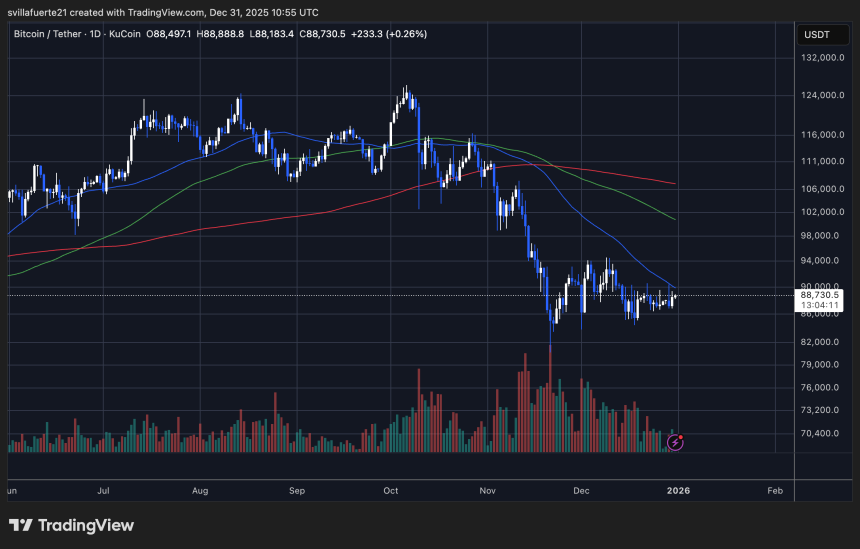
BTC consolidates below key MAs | Source: BTCUSDT chart on TradingView

From a technical perspective, Bitcoin remains capped below its declining short-term moving averages. The 50-day moving average continues to slope downward and acts as dynamic resistance. The 100-day and 200-day moving averages sit well above the current price, reinforcing a broader bearish structure. As long as BTC trades below these levels, upside attempts are likely to be sold into rather than sustained.

After the heavy sell-off in November, trading volume has gradually declined. This suggests that aggressive sellers have stepped back, but new demand has not yet entered with conviction. This typically characterizes a stabilization phase rather than the start of a new impulsive move.

Structurally, Bitcoin is forming a base, but confirmation remains absent. A daily close above $90,000 could signal a meaningful shift in momentum. And would open the door for a recovery toward higher resistance zones. Conversely, a loss of the $85,000 support area could expose BTC to another leg lower. For now, the chart reflects balance, hesitation, and a market waiting for a catalyst.

Featured image from ChatGPT, chart from TradingView.com 

Market Opportunity
Never Give Up Logo
Never Give Up Price(MINER)
$0.0013143
$0.0013143$0.0013143
-8.13%
USD
Never Give Up (MINER) Live Price Chart
Disclaimer: The articles reposted on this site are sourced from public platforms and are provided for informational purposes only. They do not necessarily reflect the views of MEXC. All rights remain with the original authors. If you believe any content infringes on third-party rights, please contact service@support.mexc.com for removal. MEXC makes no guarantees regarding the accuracy, completeness, or timeliness of the content and is not responsible for any actions taken based on the information provided. The content does not constitute financial, legal, or other professional advice, nor should it be considered a recommendation or endorsement by MEXC.

You May Also Like

Academic Publishing and Fairness: A Game-Theoretic Model of Peer-Review Bias

Academic Publishing and Fairness: A Game-Theoretic Model of Peer-Review Bias

Exploring how biases in the peer-review system impact researchers' choices, showing how principles of fairness relate to the production of scientific knowledge based on topic importance and hardness.
Share
Hackernoon2025/09/17 23:15
Foreigner’s Lou Gramm Revisits The Band’s Classic ‘4’ Album, Now Reissued

Foreigner’s Lou Gramm Revisits The Band’s Classic ‘4’ Album, Now Reissued

The post Foreigner’s Lou Gramm Revisits The Band’s Classic ‘4’ Album, Now Reissued appeared on BitcoinEthereumNews.com. American-based rock band Foreigner performs onstage at the Rosemont Horizon, Rosemont, Illinois, November 8, 1981. Pictured are, from left, Mick Jones, on guitar, and vocalist Lou Gramm. (Photo by Paul Natkin/Getty Images) Getty Images Singer Lou Gramm has a vivid memory of recording the ballad “Waiting for a Girl Like You” at New York City’s Electric Lady Studio for his band Foreigner more than 40 years ago. Gramm was adding his vocals for the track in the control room on the other side of the glass when he noticed a beautiful woman walking through the door. “She sits on the sofa in front of the board,” he says. “She looked at me while I was singing. And every now and then, she had a little smile on her face. I’m not sure what that was, but it was driving me crazy. “And at the end of the song, when I’m singing the ad-libs and stuff like that, she gets up,” he continues. “She gives me a little smile and walks out of the room. And when the song ended, I would look up every now and then to see where Mick [Jones] and Mutt [Lange] were, and they were pushing buttons and turning knobs. They were not aware that she was even in the room. So when the song ended, I said, ‘Guys, who was that woman who walked in? She was beautiful.’ And they looked at each other, and they went, ‘What are you talking about? We didn’t see anything.’ But you know what? I think they put her up to it. Doesn’t that sound more like them?” “Waiting for a Girl Like You” became a massive hit in 1981 for Foreigner off their album 4, which peaked at number one on the Billboard chart for 10 weeks and…
Share
BitcoinEthereumNews2025/09/18 01:26
Vitalik Buterin Reveals Ethereum’s Bold Plan to Stay Quantum-Secure and Simple!

Vitalik Buterin Reveals Ethereum’s Bold Plan to Stay Quantum-Secure and Simple!

Buterin unveils Ethereum’s strategy to tackle quantum security challenges ahead. Ethereum focuses on simplifying architecture while boosting security for users. Ethereum’s market stability grows as Buterin’s roadmap gains investor confidence. Ethereum founder Vitalik Buterin has unveiled his long-term vision for the blockchain, focusing on making Ethereum quantum-secure while maintaining its simplicity for users. Buterin presented his roadmap at the Japanese Developer Conference, and splits the future of Ethereum into three phases: short-term, mid-term, and long-term. Buterin’s most ambitious goal for Ethereum is to safeguard the blockchain against the threats posed by quantum computing.  The danger of such future developments is that the future may call into question the cryptographic security of most blockchain systems, and Ethereum will be able to remain ahead thanks to more sophisticated mathematical techniques to ensure the safety and integrity of its protocols. Buterin is committed to ensuring that Ethereum evolves in a way that not only meets today’s security challenges but also prepares for the unknowns of tomorrow. Also Read: Ethereum Giant The Ether Machine Takes Major Step Toward Going Public! However, in spite of such high ambitions, Buterin insisted that Ethereum also needed to simplify its architecture. An important aspect of this vision is to remove unnecessary complexity and make Ethereum more accessible and maintainable without losing its strong security capabilities. Security and simplicity form the core of Buterin’s strategy, as they guarantee that the users of Ethereum experience both security and smooth processes. Focus on Speed and Efficiency in the Short-Term In the short term, Buterin aims to enhance Ethereum’s transaction efficiency, a crucial step toward improving scalability and reducing transaction costs. These advantages are attributed to the fact that, within the mid-term, Ethereum is planning to enhance the speed of transactions in layer-2 networks. According to Butterin, this is part of Ethereum’s expansion, particularly because there is still more need to use blockchain technology to date. The other important aspect of Ethereum’s development is the layer-2 solutions. Buterin supports an approach in which the layer-2 networks are dependent on layer-1 to perform some essential tasks like data security, proof, and censorship resistance. This will enable the layer-2 systems of Ethereum to be concerned with verifying and sequencing transactions, which will improve the overall speed and efficiency of the network. Ethereum’s Market Stability Reflects Confidence in Long-Term Strategy Ethereum’s market performance has remained solid, with the cryptocurrency holding steady above $4,000. Currently priced at $4,492.15, Ethereum has experienced a slight 0.93% increase over the last 24 hours, while its trading volume surged by 8.72%, reaching $34.14 billion. These figures point to growing investor confidence in Ethereum’s long-term vision. The crypto community remains optimistic about Ethereum’s future, with many predicting the price could rise to $5,500 by mid-October. Buterin’s clear, forward-thinking strategy continues to build trust in Ethereum as one of the most secure and scalable blockchain platforms in the market. Also Read: Whales Dump 200 Million XRP in Just 2 Weeks – Is XRP’s Price on the Verge of Collapse? The post Vitalik Buterin Reveals Ethereum’s Bold Plan to Stay Quantum-Secure and Simple! appeared first on 36Crypto.
Share
Coinstats2025/09/18 01:22
