
Understanding USDT Networks: TRC20 vs. ERC20 vs. BEP20 (2026 Guide)
What is the difference between TRC20 and ERC20 USDT?
TL;DR (Key Takeaways)
- The Golden Rule: Always ensure the Deposit Network matches the Withdrawal Network. Sending ERC20 tokens to a TRC20 address will result in permanent loss.
- Cheapest Option: TRC20 (Tron) and BEP20 (BNB Chain) are the most cost-effective for moving funds between exchanges like MEXC.
- DeFi Standard: ERC20 (Ethereum) is required for most decentralized finance protocols (Uniswap, Aave).
- Emerging Speed: Networks like Polygon and Sui offer sub-second settlement for specific use cases.
1.Core Concepts: What Does "Multi-Chain" Mean?
- ERC-20: The standard for Ethereum.
- TRC-20: The standard for Tron.
- BEP-20: The standard for BNB Smart Chain.
- SPL: The standard for Solana.
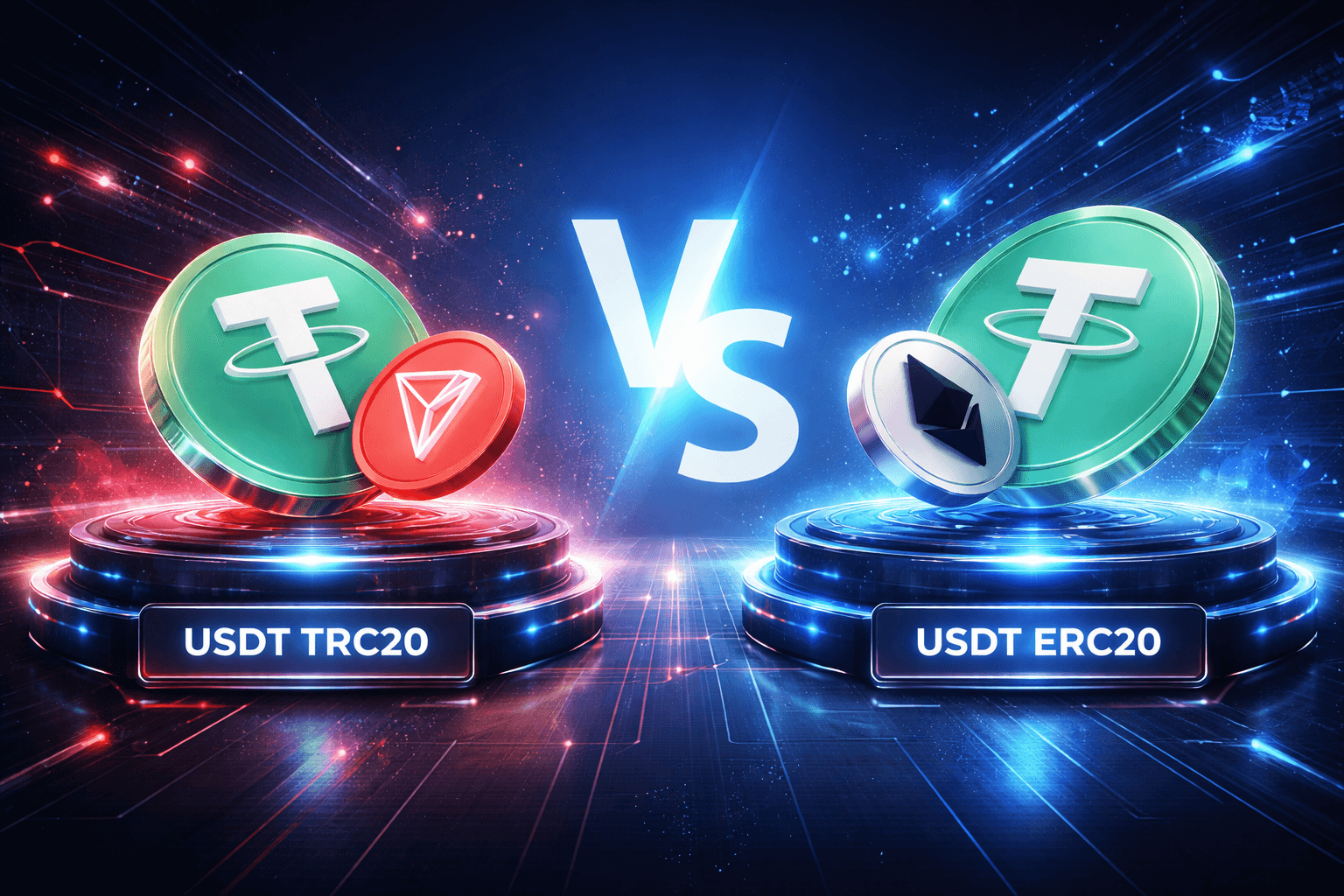
2.The Big Showdown: TRC20 vs. ERC20
2.1 TRC20 USDT (The King of Transfers)
- Why use it? Speed and Cost. Tron uses a Delegated Proof of Stake (DPoS) mechanism that allows for high throughput.
- Typical Fee: ~$1 or less.
- Best For: Depositing to exchanges, paying friends, cross-border remittances.
- Platform Compatibility: Extremely high. Supported by almost every major exchange.
2.2 ERC20 USDT (The King of DeFi)
- Why use it? Composability. Most DeFi apps (Uniswap, Compound) live on Ethereum. If you want to yield farm or lend your USDT, you need the ERC20 version.
- Typical Fee: $3 to $15+ (highly variable depending on network congestion).
- Best For: Interacting with smart contracts, institutional custody, cold storage on Ledger/Trezor.
3.Emerging Networks: BEP20, Polygon, and Sui
- BEP20 (BNB Smart Chain): Extremely popular on MEXC. Fees are often lower than Tron (<$0.50), and speeds are fast. Warning: Ensure the receiving wallet supports BSC.
- Polygon (MATIC): Used for cheap DeFi interactions.
- Sui & Solana: The new generation of high-speed chains. USDT on Sui represents the focus on scalability, offering theoretical speeds of 297,000 TPS (Transactions Per Second).
4.The "Matrix": USDT Network Comparison Table
Network Name | Standard | Avg. Speed | Est. Fee | Best Use Case | Risk Level |
Tron | TRC-20 | ~1-3 Mins | Low ($1) | General Transfers | Low |
Ethereum | ERC-20 | ~5-15 Mins | High ($5+) | DeFi & Security | Low |
BNB Chain | BEP-20 | ~30 Secs | Very Low (<$0.5) | Exchange Deposits | Low |
Solana | SPL | <5 Secs | Tiny (<$0.1) | High Freq. Trading | Med (Congestion) |
Arbitrum | ERC-20 (L2) | <5 Secs | Low ($0.1) | Ethereum L2 DeFi | Low |
5.How to Choose the Right Network (Decision Guide)
- Starts with 0x.... -> Likely ERC20, BEP20, or Polygon. (Double check!)
- Starts with T... -> Definitely TRC20.
- Moving funds to MEXC to trade? Use TRC20 or BEP20 (Save money).
- Moving funds to buy an NFT on OpenSea? Use ERC20 (Required).
6.Operational Risks: What If I Choose the Wrong Network?
- Scenario A: Sending ERC20 USDT to a TRC20 address.
- Result: The wallet will usually reject the address format (Safety feature).
- Scenario B: Sending BEP20 USDT to an ERC20 address (Exchange).
- Result: High Risk. Since the address formats (0x...) are the same, the transaction will go through. If the receiving exchange doesn't support BEP20, your funds may be stuck.
- Recovery: Sometimes, customer support can recover these funds for a fee, but never guarantee it.
7.Frequently Asked Questions (FAQ)
Conclusion
- Use TRC20 when you want to save money.
- Use ERC20 when you want to use Ethereum dApps.
Disclaimer:
Popular Articles

Hyperliquid (HYPE) Analysis: Can $141B Volume Absorb the $219M Unlock Shock?
Executive Summary (TL;DR)Is Hyperliquid (HYPE) a buy despite the volatility?Verdict: Neutral / Watchlist. While Hyperliquid has achieved a record-breaking $141.4B in monthly volume—solidifying its dom

Chainlink ETF Approved: LINK Price Prediction & Liquidity Analysis 2026
Executive Summary (TL;DR)Is the new Bitwise Chainlink ETF (CLNK) a buy signal?Yes. The SEC's approval of the Bitwise Chainlink Spot ETF (Ticker: CLNK) on January 14, 2026, marks a pivotal institutiona
Can Stargate (STG) Regain Price Momentum Through veSTG Incentives in 2026?
As the cross-chain interoperability landscape matures in 2026, Stargate Finance (STG) stands at a critical juncture following its acquisition by the LayerZero Foundation. For investors, one question l

StableChain (STABLE) Market Analysis: On-Chain Data vs. Growth Potential
Key TakeawaysInnovation: StableChain eliminates the need for volatile assets like ETH or SOL by using USDT as its native gas token for transaction fees.Bearish Signal: Despite a high-profile December
Related Articles
Hyperliquid (HYPE) Analysis: Can $141B Volume Absorb the $219M Unlock Shock?
Executive Summary (TL;DR)Is Hyperliquid (HYPE) a buy despite the volatility?Verdict: Neutral / Watchlist. While Hyperliquid has achieved a record-breaking $141.4B in monthly volume—solidifying its dom
Chainlink ETF Approved: LINK Price Prediction & Liquidity Analysis 2026
Executive Summary (TL;DR)Is the new Bitwise Chainlink ETF (CLNK) a buy signal?Yes. The SEC's approval of the Bitwise Chainlink Spot ETF (Ticker: CLNK) on January 14, 2026, marks a pivotal institutiona
Can Stargate (STG) Regain Price Momentum Through veSTG Incentives in 2026?
As the cross-chain interoperability landscape matures in 2026, Stargate Finance (STG) stands at a critical juncture following its acquisition by the LayerZero Foundation. For investors, one question l
StableChain (STABLE) Market Analysis: On-Chain Data vs. Growth Potential
Key TakeawaysInnovation: StableChain eliminates the need for volatile assets like ETH or SOL by using USDT as its native gas token for transaction fees.Bearish Signal: Despite a high-profile December
